Oil shipment and midterm campaigning
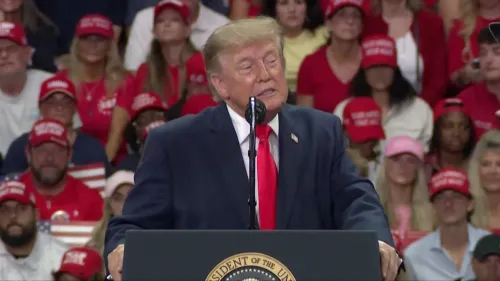
"Let's make it [Venezuela] the 51st state. And instead of a president, we'll have an election for a governor. How about that?" Trump said Tuesday, as quoted by ANTARA.
The rally took place at the Port of Corpus Christi. According to MercoPress, Trump announced that the first shipment under an oil agreement between Washington and Caracas had arrived, carrying one million barrels. He said Texas refineries, including those in Corpus Christi, would process the crude and described the shipment as "a historic win that gives us control over a massive part of the world's oil supply."
The event also served as a campaign stop a week before the November 3, 2026, midterm elections. Trump endorsed Republican Senate candidate Ken Paxton in his race against Democrat James Talarico. La Voce di New York reported that Trump's third Texas visit in a month reflected Republican concern about an unexpectedly close contest in a state that has been reliably Republican for more than 30 years.
Earlier proposals and Venezuela's response
Trump has suggested adding several places to the United States, which currently has 50 states. He has at times cast Canada as a prospective 51st state and has also raised statehood for Greenland and Venezuela.
His proposed numbering for Venezuela has changed. MercoPress reported that in February 2026, he suggested it could become the 53rd state, following Canada and Greenland. In August, he posted a map of Venezuela decorated with the U.S. flag's colors and labeled "51st state."
Rodríguez has rejected U.S. statehood more than once. In July 2026, she invoked Venezuela's more than two centuries of sovereignty.
A presidential suggestion alone would not admit a new state. As La Voce di New York explained, Article IV of the U.S. Constitution assigns that power to Congress. Venezuela would need a fundamental change in political status, a state constitution compatible with the American system of government and congressional approval. The outlet identified Texas, an independent republic before joining the United States in 1845, as the closest historical precedent.
U.S. military intervention and oil agreements
Washington's involvement in Venezuela expanded after the January 3, 2026, military operation in Caracas that captured President Nicolas Maduro and his wife, Cilia Flores. The Council on Foreign Relations identified the mission as Operation Absolute Resolve, conducted within the broader Caribbean military campaign Operation Southern Spear.
U.S. forces deployed 150 aircraft to strike multiple targets in the capital. Army Delta Force personnel and CIA operatives seized Maduro and Flores, taking them first to the assault ship USS Iwo Jima and then to New York to face U.S. narco-terrorism charges.
Maduro pleaded not guilty to drug, weapons and narco-terrorism charges in federal court in New York on January 5. He faces a possible life sentence. The Council on Foreign Relations reported at the time that his next appearance was scheduled for March 17, 2026.
Venezuela's Supreme Court appointed Rodríguez interim president after the operation. Washington subsequently recognized her government and removed sanctions against her and her brother, National Assembly President Jorge Rodríguez, according to MercoPress.
The United States has since exercised substantial influence over Venezuela's oil sector, redirecting exports and bringing U.S. companies into the development of its reserves while seeking to limit rival powers' influence. Bilateral agreements have sought to increase U.S. participation, raise production and modernize existing facilities. MercoPress reported that an August 2026 agreement gave Washington majority control over a significant share of Venezuela's reserves.
Opposition leader's return and an undated election
The Corpus Christi rally followed opposition leader María Corina Machado's return to Venezuela by two days. She had spent nearly ten months abroad. Trump said he hoped she "is safe," while Secretary of State Marco Rubio said Washington had urged Rodríguez to permit her return. Rodríguez dismissed Machado's arrival as a "show."
The State Department has said a roadmap negotiated with the opposition calls for Rodríguez to leave the presidency vacant in 2027. No date has been set for a presidential election.