An ambitious production target
NABEP's pledge would lift production from roughly 224,000 barrels per day in mid-October. The relatively little-known company, led by Venezuelan businessman Alejandro Betancourt, is responsible for 17 oil fields under an agreement that President Donald Trump has called the largest in history.
The Associated Press ranks NABEP as Venezuela's second-largest oil operator, behind Chevron. The company says it increased production from about 18,000 bpd to more than 200,000 bpd over two years, using roughly $1 billion of its own capital. In an update reported by World Oil on November 1, it outlined plans to invest nearly $100 billion in production capacity and infrastructure.
That update put production on October 19 at 223,509 barrels of oil equivalent per day, or boed, compared with about 200,000 boed in August. NABEP describes output above 1 million bpd as a near-term goal, while PDVSA Vice President Jovanny Martinez told state media this week that the company could reach that level in six to seven years.
Reuters interviewed 15 workers, contractors, financiers and industry experts whose accounts indicate that the expansion will be harder than Trump and NABEP have suggested. Eight sources familiar with its operations reported overdue contractor payments, difficulty recruiting employees and problems repairing infrastructure.
NABEP spokesperson Terry Wade said the company remained on course. "We are simply the pioneer of Venezuela's oil industry revival," he said. Official figures show that Venezuela's overall crude production has remained near 1.2 million bpd in recent months.
What the agreement gives Washington
The deal places 17 fields with estimated reserves of about 64 billion barrels under NABEP. Washington is to receive a 35% ownership stake in NABEP's parent company and the right to purchase 20% of its oil production at cost.
An August 2026 agreement also gives the United States a role in corporate governance, according to a White House fact sheet reported by the Associated Press. The U.S. is creating a private company for a joint venture with NABEP, and the government has veto power over NABEP board appointments. Most board members must be U.S. citizens, and the agreement falls under U.S. law and court jurisdiction. The White House said many of the fields had previously been owned or operated by Russian or Chinese companies.
The size of the reserves does not establish how much oil can be developed. Francisco Monaldi, director of the Latin America Energy Programme at Rice University's Baker Institute, estimated that roughly 10 billion barrels could realistically be developed over 25 years, the maximum duration of oil project contracts under Venezuelan law. "And that is only achievable if there are no obstacles," he told Reuters.
NABEP began operating in Venezuela's energy sector in 2024 with three projects contracted under Nicolas Maduro. U.S. forces ousted Maduro in January 2026; the Associated Press and the International Consortium of Investigative Journalists report that he was captured on federal narcoterrorism and drug trafficking charges and remains jailed in New York. NABEP assumed operational control of another 14 fields on October 1 under an agreement with the Venezuelan government.
Building the fleet and repairing wells
Junin Sur, in the Orinoco Belt, is the centerpiece of NABEP's production expansion. Growth in the Maracaibo Basin could take longer because of aging infrastructure and severe pollution. About 80% of the basin's 4,000 inactive wells need repairs.
An early-October satellite assessment by an intelligence company specializing in Venezuela found no drilling infrastructure at seven of the 17 fields. Junin Sur had just one drilling rig. Images and drone footage supplied by NABEP from the second half of October subsequently showed several rigs and well clusters at Junin Sur, along with drilling barges on Lake Maracaibo.
NABEP said it had secured 60 drilling rigs and 70 pieces of heavy equipment for delivery in stages. It also reported three operating drilling rigs in the Orinoco region, with three more due to enter service soon. In its November 1 update reported by World Oil, the company said its fleet in Venezuela would reach 41 rigs during November as part of the 60-rig buildout.
That update listed nine drilling rigs and 20 workover rigs already in the country. Another 15 workover rigs were being refurbished in Houston, and all 35 were being recertified to Category 4. Workover rigs repair and prepare existing wells. World Oil also reported that U.S. contractor Nabors Industries had signed a multiyear agreement to deploy a rig in Venezuela in early 2027.
At Petrozamora, three workers told Reuters of idle heavy equipment, damaged facilities, oil leaks and delayed supplier payments. Wade said repairs were underway, and NABEP has installed new equipment in Lake Maracaibo. During a visit last week, Betancourt cited internal PDVSA figures showing Petrozamora production of 115,000 bpd, compared with 98,000 bpd in September. He did not give a long-term production target for the area.
Six of NABEP's newly assigned areas have never been explored. They are also far from roads and existing oil infrastructure, adding to the work needed before production can expand.
Contractors, hiring and financing
NABEP depends on local contractors for hiring, equipment and day-to-day operational decisions, according to workers, contractors and business associates interviewed by Reuters. Three workers and a business associate described unpaid balances owed to business partners, although Reuters could not establish the amount.
Wade said the supplier network was growing while NABEP moved to a new payment system. "All invoices are being paid, and any disruptions are being addressed," he said.
The company reports about 5,000 direct employees and more than 10,000 contract workers. Three people familiar with recruitment said NABEP had recently hired administrative employees from PDVSA and was accelerating recruitment of technical specialists and field workers. That effort comes after decades of skilled professionals leaving Venezuela.
NABEP plans to develop all 17 fields at once and raise its annual reinvestment rate to as much as 50%. Five experts interviewed by Reuters said an undertaking of that scale would challenge even Chevron, ExxonMobil or ConocoPhillips. A banker involved in Venezuelan energy financing said NABEP would need substantial funding and strong partners.
Three sources told Reuters that investigations into Betancourt's past transactions with the Venezuelan government had made it difficult for NABEP to open bank accounts. Wade said the company could use foreign banks but gave no further details.
A U.S. investigation into an alleged scheme involving more than $1 billion misappropriated from PDVSA was suspended this year. ICIJ reported on September 3 that Betancourt was under investigation in Spain and Switzerland on suspicion of laundering billions of dollars out of Venezuela. As recently as May, he was living in the United Kingdom and contesting a Swiss extradition request; Spanish authorities were also investigating his company Derwick Associates. Betancourt has never been charged with a criminal offense in any jurisdiction.
Scrutiny in Caracas and Washington
Former Venezuelan Energy Minister Humberto Calderon Berti questioned whether NABEP had the technical qualifications and operating history to carry out the agreement. Speaking at a conference in September, he said he was convinced "the deal cannot be realised in the long term".
Opposition leader Maria Corina Machado, who returned to Venezuela this week, told reporters in Caracas on Thursday that she had not seen the contract. She nevertheless said the agreement appeared to fall short of transparency standards. "Of course, we want investment. The question is how that investment is made and with whom," she said. Interim President Delcy Rodriguez has defended the deal.
In Washington, four Democratic ranking members of Senate committees, Shaheen, Reed, Warren and Heinrich, sent an October 1 letter to Secretaries Rubio, Hegseth and Wright seeking the agreement, its legal basis and details of the administration's due diligence. They argued that the law establishing the Pentagon's Office of Strategic Capital does not explicitly authorize ownership stakes in private oil companies.
The first shipment and the price question
The first delivery under the agreement brought 1 million barrels to Texas on October 27. Trump called the cargo a gift, and a White House official said the U.S. government had received it for free.
NABEP initially described the shipment as a purchase under Washington's right to buy oil at production cost. It later said the cargo had been provided without cost to American taxpayers to recognize the agreement's historic significance. Reuters described the episode as an indication that Washington appears to have the final say over distribution, even though NABEP produces the oil.
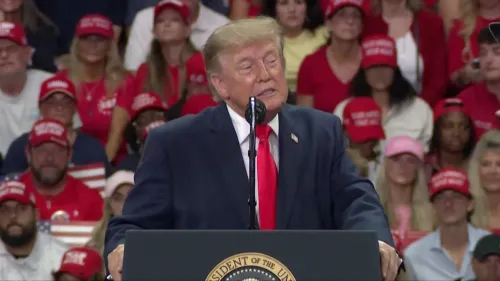
"The winner gets the spoils, right?" Trump said at the Port of Corpus Christi. White House spokesperson Taylor Rogers said, "Production is increasing, and this deal is already delivering results for the American people."
Trump had acknowledged on August 31 that lower fuel prices would not reach Americans immediately, saying "it could be a little bit," and planned to meet large and small refiners the following day. At the time, the Iran war had pushed the national average gasoline price to $4.08, up 28% from a year earlier, according to AAA.