State battery holding company calls for stronger policy framework to boost domestic nickel battery industry
Indonesia's state-owned battery holding company has called for comprehensive policy support to strengthen the domestic nickel battery industry, warning that without fiscal incentives and integrated demand policies, foreign producers could increasingly dominate the local electric vehicle market.
Indonesia Battery Corporation (IBC) president director Aditya Farhan Arif said on Wednesday that Southeast Asia's largest economy had developed a substantial electric vehicle market, but its battery manufacturing and mineral processing sectors remained disconnected from domestic demand, with most nickel output still directed toward international buyers.
The disconnect is stark: of approximately 100,000 electric vehicles sold domestically last year, only around 4,000 used nickel-based batteries, despite Indonesia holding roughly 46 percent of the world's nickel reserves.
IBC, established in March 2021 as a joint venture between state-owned enterprises Pertamina, PLN, MIND ID, and PT Aneka Tambang, was transformed from a project development entity into an investment holding company in February 2025 to better coordinate battery industry development.
"Simply expanding battery production will not be enough to build an integrated domestic industry. We also need fiscal support and policies that create predictable demand and allow locally made batteries to compete with imports," Aditya said.
Indonesia's efforts to move up the value chain in nickel processing have shown mixed results. The government enforced export bans on unprocessed nickel ore in 2014 and expanded them comprehensively in January 2020, forcing international buyers to establish domestic processing facilities. The strategy proved highly successful for stainless steel: exports surged from $564 million in 2017 to $11.85 billion in 2022, while overall processed nickel export value jumped 26-fold from $1.5 billion in 2014 to $38.5 billion in 2025.
However, battery exports told a different story, declining 36 percent from $307 million to $196 million between 2014 and 2022, illustrating the challenge of converting nickel reserves into competitive battery products.
Growing market, foreign dominance
Indonesia's electric vehicle market has expanded rapidly, with sales reaching approximately 99,755 units in 2025, representing a 182.5 percent increase from 35,306 units in 2024. Market penetration jumped from 4.1 percent of total vehicle sales in 2024 to 12.4 percent in 2025, with quarterly penetration hitting 15.2 percent of passenger car sales by the second quarter of 2025.
Yet Chinese manufacturers have captured most of this growth. Shanghai Automotive Industry Corporation held 31.6 percent market share and BYD controlled 29.7 percent from the first quarter of 2020 through the second quarter of 2025, with BYD leading the battery electric vehicle segment at approximately 39 percent share in 2025.
Aditya pointed to other countries using substantial incentives to help their battery industries achieve economies of scale. Without similar support, he warned, overseas producers with excess capacity could increasingly target Indonesia to compete on price as they seek new markets.
Investment flowing, integration lagging
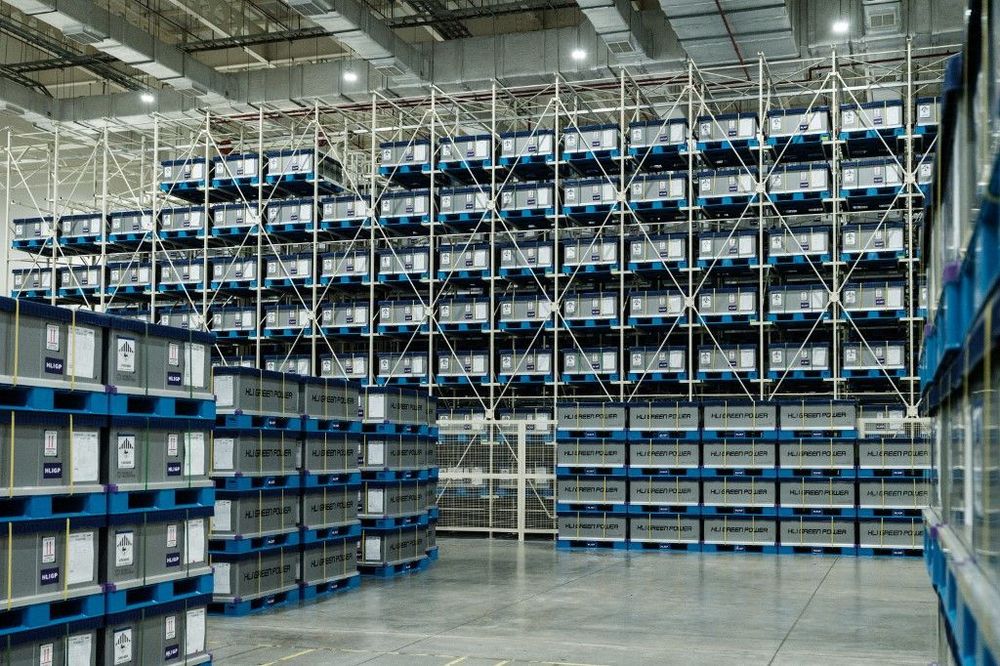
Battery manufacturing investment is arriving. PT HLI Green Power, a joint venture between Hyundai Motor Group and LG Energy Solution, began commercial production at its Karawang facility in April 2024, making Indonesia Southeast Asia's first domestic battery cell producer with initial capacity of 10 gigawatt-hours.
In June 2025, Chinese battery giant CATL broke ground on a $6 billion manufacturing facility in Karawang, West Java, partnering with IBC and PT Aneka Tambang. The plant is scheduled to begin operations by late 2026 with initial capacity of 6.9 gigawatt-hours, expanding toward a total planned capacity of 15 gigawatt-hours.
Downstream investment reached Rp300.1 trillion (approximately $16.86 billion) in the first half of 2026, accounting for 29.7 percent of total national investment and marking a 6.9 percent year-over-year increase, with foreign direct investment comprising 70.9 percent at Rp212.8 trillion.
The government has set an ambitious target to achieve battery production capacity of 140 gigawatt-hours by 2030, planning to export one-third while dedicating the remainder to domestic electric vehicle manufacturing. The strategic downstreaming roadmap requires an estimated $618.1 billion in investment through 2040.
But Aditya emphasized that capital flows alone would not guarantee that production serves domestic needs or that Indonesia captures the value-added potential from its mineral wealth. Coordinated fiscal policy, demand-side measures, and competitive conditions for local manufacturers remain essential to translating production capacity into integrated industrial development.