Planning, records and accountability
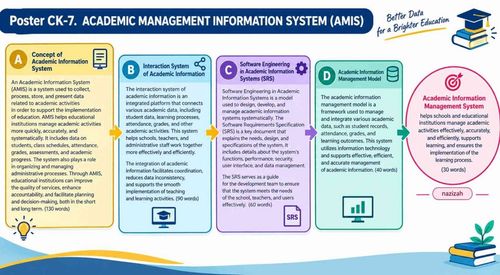
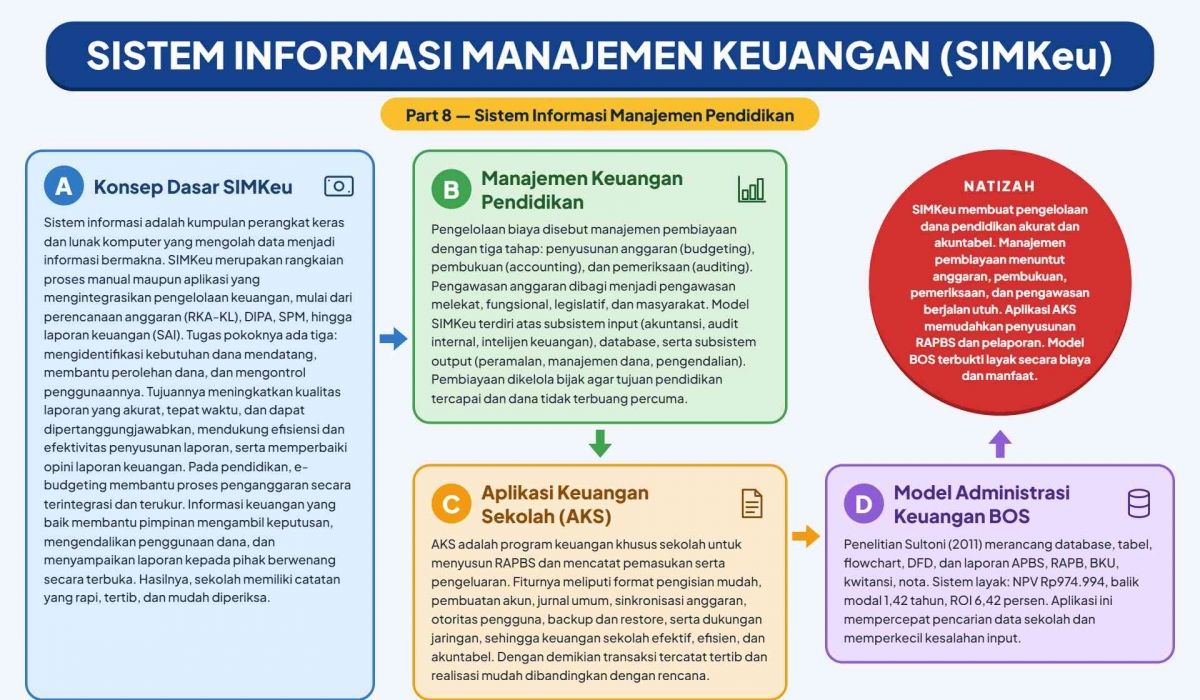
The article describes SIMKeu, short for Sistem Informasi Manajemen Keuangan, or Financial Management Information System, as a combination of applications and procedures for making financial data useful. Its role extends from anticipating funding needs and helping secure funds to controlling how those funds are spent.
The framework covers four areas: SIMKeu's basic concepts, financial management in education, school financial software and administration of School Operational Assistance (BOS) funds. Across these areas, the author emphasizes that reliable, timely information supports both budget planning and management decisions.
Software alone does not ensure reliable financial administration, the contributor cautions. Manual processes, mistakes in data entry, differences between budgets and actual spending, and weak monitoring can undermine information quality even when an institution has a digital system.
What schools need to manage and monitor
The financial-management pillar brings together budgeting, accounting and auditing. These activities serve different purposes: setting spending priorities, recording money received and spent, and examining the use of funds. The article identifies internal and functional supervision, legislative oversight and community monitoring as possible forms of scrutiny.
For day-to-day administration, the School Financial Application, known as AKS, supports budget preparation, income and expenditure records, and financial reporting. Its functions include managing accounts and general journals, synchronizing budgets, controlling user permissions and backing up data. The contributor says these capabilities can make administration more efficient and reduce entry errors.
The BOS administration pillar focuses on maintaining expenditure categories, transaction and cash records, budget information, and the General Cash Book. Database structure and reporting capabilities help make transactions traceable and available for examination. The learning material cited in the article includes a case study in which a BOS financial application improved data processing and report retrieval; that result is presented as a case study, not as a finding about all schools.
ARKAS provides the national platform
At the national level, Indonesia's education ministry uses ARKAS (Aplikasi Rencana Kegiatan dan Anggaran Sekolah) to support BOS planning, budgeting, implementation, administration and accountability in primary and secondary schools. When Kemendikbudristek launched ARKAS version 4 nationwide on August 7, 2023, the ministry reported platform usage of 99.5%.
Digital planning and reporting are requirements under Permendikdasmen No. 8 of 2026, the ministerial regulation governing BOSP funds. Signed by Minister Abdul Mu'ti, it took effect on February 6, 2026, replacing the corresponding 2025 rules. Schools must prepare their plans and reports directly in ARKAS, connected to Dapodik.
According to the Ministry of Primary and Secondary Education, principals must submit the Phase I realization report by July 31 and the annual report by January 31 of the following year. Late reporting reduces the next-phase allocation by 2% to 4%, depending on the delay's duration. Failure to report can lead to suspension of disbursement.
Spending requirements and minimum allocations
The 2026 regulation also sets boundaries for school budgets. Library development must receive at least 5% of Regular BOP PAUD funds and at least 10% of Regular BOS funds. Eligible library spending covers textbooks, non-text reading materials and library services. Maintenance of facilities and infrastructure is capped at 20% for public schools and 40% for private schools.
Schools receiving Regular BOS in designated special areas—remote, border, disaster-prone and customary regions—have minimum student counts used to calculate funding. Even if actual enrollment is lower, allocations are calculated using at least 9 students for PAUD, 60 for SD through SMA and 10 for equivalency programs.
The scale of 2026 funding
At a national webinar on April 10, 2026, the Ministry of Primary and Secondary Education said it had allocated Rp59 trillion for Educational Unit Operational Assistance (BOSP) in fiscal 2026. The allocation covers three schemes: Reguler, Kinerja and Afirmasi.
As of October 25, 2026, the ministry's public BOSP Salur portal indicated that Phase 1 disbursement of Regular BOSP was essentially complete. Funds had reached 99.99% of SD schools, or 291,389 of 291,415; 100% of SLB schools; 99.97% of SMA schools; 99.96% of SMK schools; and 99.98% of SMP schools.