Indonesia to fund free public schools from existing 2027 budget
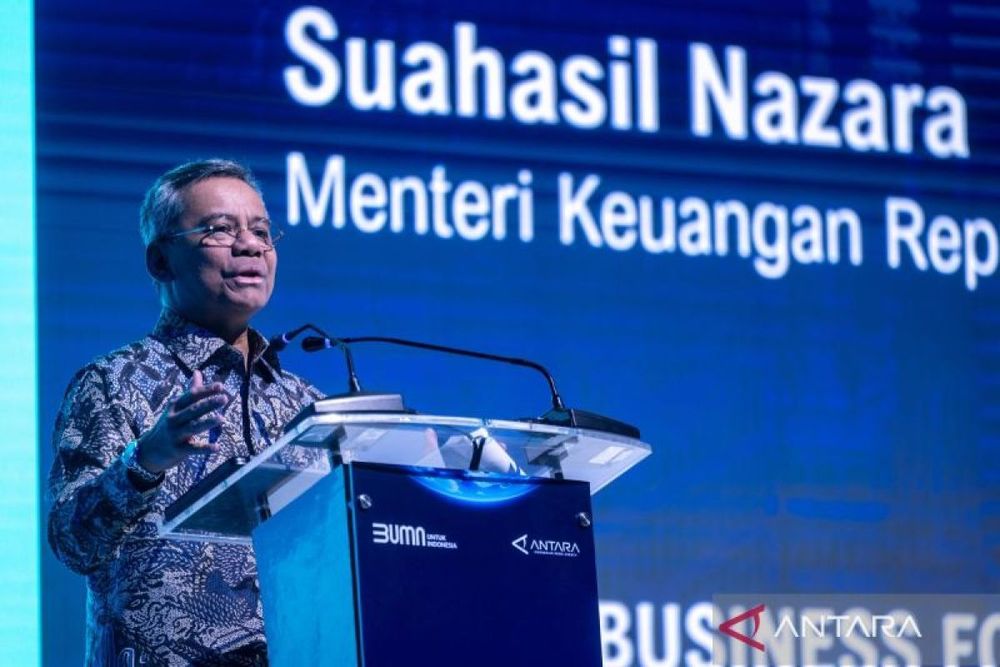
The Indonesian government will finance its upcoming free public school program directly from the mandated education allocation in the 2027 Draft State Budget, without creating a supplementary budget line, Finance Minister Suahasil Nazara announced on Wednesday.
Speaking at the Presidential Palace complex, Nazara stated that the 2027 draft budget allocates roughly Rp820.9 trillion (approximately US$45.97 billion) for education, fulfilling the constitutional requirement established in 2002 through an amendment to Article 31, Paragraph 4 of the 1945 Constitution, which mandates dedicating 20 percent of state spending to the education sector.
The allocation represents a significant increase from the 2026 education budget of Rp757.8 trillion, which was Indonesia's largest ever amount devoted to education at that time.
The state budget always allocates 20 percent for education. Therefore, the question is how to properly design the utilization of this budget, which exceeds Rp800 trillion.
Nazara told reporters.
The minister noted that the government is currently reviewing how education funds are distributed and utilized across the central government, regional administrations, and various state agencies. With the total education budget projected between Rp820 trillion and Rp824 trillion (US$45.92 billion and US$46.14 billion), the allocation will be structurally redesigned to enhance the overall quality of the national education system.
This budget planning comes at a critical juncture, as a Constitutional Court ruling in July 2026 mandated that the government must stop financing the Free Nutritious Meals program through the education budget no later than the 2028 budget, determining that the program does not constitute core education spending. This ruling adds complexity to how the 2027 education funds will be allocated.
We are discussing the 2027 budget; with this specific amount available, the focus is on how to design it optimally.
Nazara added.
Free education program scope and implementation
President Prabowo Subianto first announced his free public education plan on September 18, 2026, at the National Mandate Party anniversary celebration, stating that public education costs from elementary school through state universities should be free. The ambitious policy affects more than 160,000 state schools at all levels across Indonesia.
A task force led by Coordinating Minister for Human Development and Cultural Affairs Pratikno has been established to prepare funding schemes for the program, with members including the Ministers of Higher Education, Primary and Secondary Education, Religious Affairs, State Secretary, and Finance.
Higher Education, Science, and Technology Minister Brian Yuliarto said his ministry is still calculating the exact funding required to extend the free education program to state universities, where tuition fees currently range from approximately Rp500,000 to Rp25 million per semester depending on the program and institution. Top universities like the University of Indonesia charge between Rp7.5 million and Rp25.2 million per semester for regular undergraduate programs.
We are currently running the numbers, which is why we held a meeting today to discuss the schemes, stages, and other details.
Yuliarto said.
Addressing educational inequality
The free education initiative aims to address significant disparities in educational access across Indonesia. The country's tertiary education gross enrollment ratio stands at approximately 27 percent nationally, with rates exceeding 50 percent in major cities while rural regions lag far behind, highlighting profound inequality in access to higher education.
The government currently operates targeted assistance programs, including the Smart Indonesia Program for primary and secondary students and the Smart Indonesia Card for Higher Education, which provide financial support to low-income students using the National Single Social and Economic Data for eligibility determination. The new universal free education policy will build upon or potentially replace these existing frameworks.
Despite allocating 20 percent of its state budget to education as constitutionally required, Indonesia spends approximately 1.3 percent of GDP on education as of 2023, among the lowest of the world's 40 largest economies. This gap between budget percentage and GDP spending underscores the fiscal constraints the government faces in implementing the expanded free education program.
President Prabowo previously instructed his cabinet to formulate comprehensive plans and assess the financial requirements for providing free education from kindergarten through state universities, part of his commitment to expand access to equitable and quality education for all Indonesian children.