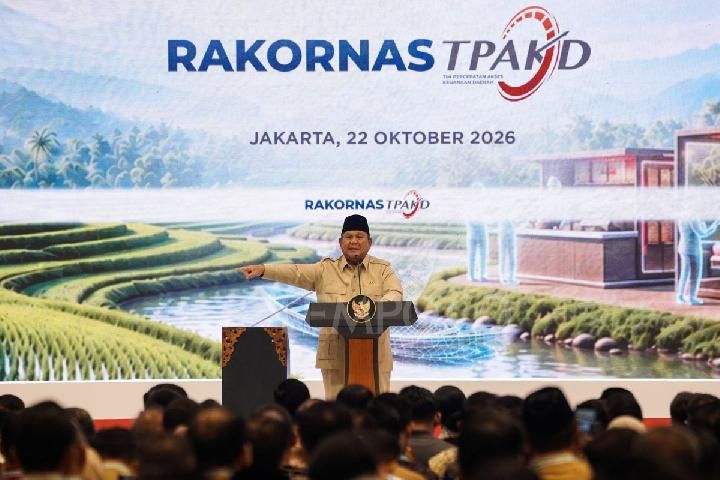
Self-sufficiency and export policy
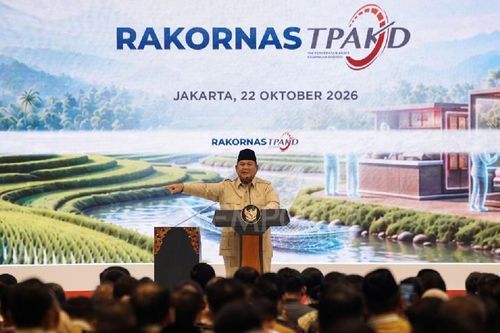
Prabowo presented the administration's major programs as measures to protect Indonesia's security. "Food self-sufficiency, Danantara, a one-stop export system. We have achieved so much. So, I ask you not to feel inferior anymore. We are on the right track," he said.
Coordinating Minister for Food Affairs Zulkifli Hasan provided details of the government's food claims on October 22, 2026. He said Indonesia had become self-sufficient in eight commodities during Prabowo's first two years: rice, corn, consumer sugar, bird's eye chilies, large red chilies, eggs, chicken meat and shallots. Rice imports for domestic consumption had stopped, he added. State logistics agency Bulog put government rice stocks at about 4.55 million metric tons as of October 20.
Prabowo had also claimed a milestone in fuel supply during his August 14, 2026, state address to the People's Consultative Assembly (MPR). He said the July 1 introduction of B50, a palm-oil biodiesel blend, had made Indonesia self-sufficient in diesel for the first time, ending diesel imports and saving Rp170 trillion, or about US$9.8 billion, in foreign exchange.
The centralized export system remains a planned change. An August 27, 2026, analysis by the Lowy Institute said Indonesia intended to channel strategic commodity exports through a state-controlled system beginning in January 2027. The stated goals are stronger pricing power and less under-invoicing, a practice Prabowo says may have cost Indonesia US$5 billion.
A new state-owned intermediary under Danantara Indonesia, PT Danantara Sumberdaya Indonesia, had already started reviewing selected export transactions, according to the analysis. Its first two months of reviews covered 6,500 transactions with a combined value of US$14 billion.
Meal program faces investigations and disciplinary action
Prabowo defended the Free Nutritious Meals (MBG) program as a strategic investment in Indonesian children's future while saying disciplinary measures and internal reviews were underway to address problems.
He reported that 13 people had been named suspects and that the Attorney General's Office was examining 203 people. Another 353 had been dishonorably dismissed, while the National Nutrition Agency (BGN) inspectorate was investigating 2,600 others. His statement neither identified the alleged violations nor established whether all those figures concerned MBG cases.
"Do not hesitate. Dismiss them, clean things up, until everything is clean. The MBG program is strategic and very important for the future of our children," Prabowo said.
In a separately reported MBG corruption investigation, the Attorney General's Office named former BGN chief Dadan Hindayana and former deputies Lodewyk Pusung and Sony Sonjaya as suspects on June 3, 2026. Investigators alleged that procurement contracts had been inflated by more than Rp1 trillion.
Among the transactions investigators cited was a Rp1.035 trillion contract, worth about US$57.6 million, for 21,801 electric motorcycles awarded to a vendor deemed unqualified. They also cited the purchase of 32,000 pairs of shoes, 31,994 tablets and 5,400 televisions, as well as the selection of foundations affiliated with the officials as MBG kitchen partners.
The program's 2026 allocation was reduced to Rp229 trillion (US$12.8 billion) from Rp335 trillion (US$18.8 billion), the Lowy Institute reported on August 27. Even after the cut, that amounted to about 45 percent of Indonesia's Rp508.2 trillion (US$28.5 billion) social-protection allocation and roughly 30 percent of education spending.
The same report described a nationwide network of more than 20,000 Nutrition Fulfilment Service Units (SPPGs) preparing and distributing meals by late July 2026, largely through private partners. Police operated 828 kitchens in July and aimed to reach 1,500 by year-end; the military had 113 kitchens operating.
Housing, schools and village connections
Prabowo's account of the administration's first two years also included 10,000 operating Merah Putih Village Cooperatives, renovations to around 440,000 homes and work completed on nearly 90,000 schools.
He credited the Bridge Task Force with building nearly 5,000 bridges linking around 12,000 villages, thanking both the task force and its head, Maruli.
Funding had been set aside for 66 regional hospitals, and Prabowo said 22 were complete. He also described efforts to expand public service malls and digitize government, with the aim of improving public services and the distribution of social assistance.
Call for cooperation
Prabowo thanked cabinet members for working together over the past two years. He also praised national figures who had joined the Presidential Advisory Council, portraying their participation as a sign of national unity.
Calling on officials to remedy shortcomings and move priority programs forward faster, he acknowledged unfinished work: "There is still much work to do, many challenges, and many weaknesses. We must work together to overcome them. We have to work as a team."