Clarification follows Luhut's remarks
The proposals address the wording of Articles 2 and 3 of the Corruption Eradication Law, known as the Tipikor Law, and Articles 603 and 604 of the Criminal Code, enacted through Law No. 1 of 2023. The package also calls for protections for good-faith business decisions, additional corruption offenses and an omnibus law on state finance.
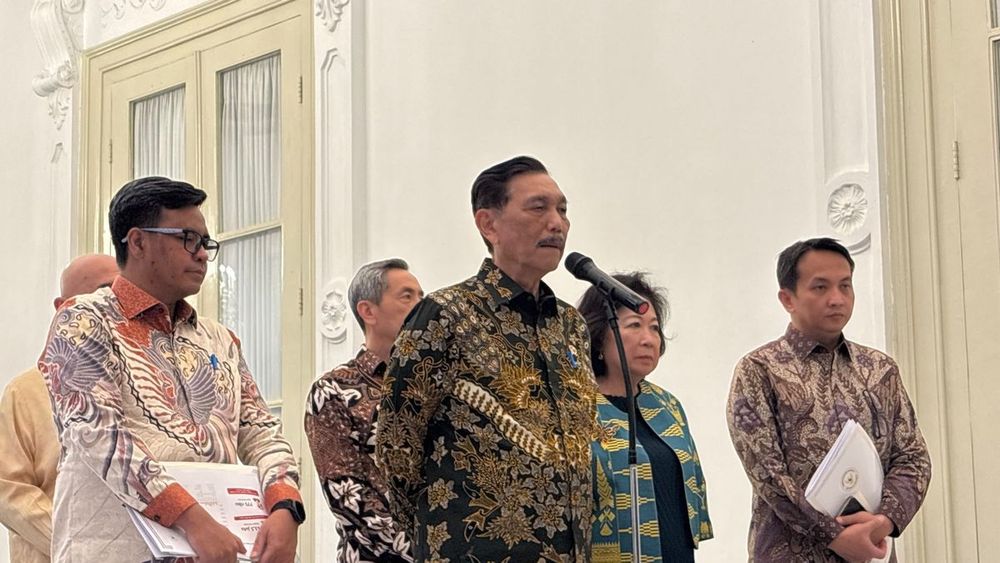
Questions about whether DEN wanted to remove state financial losses from the definition of corruption followed Luhut's remarks at Merdeka Palace on the night of October 20. According to Tirto.id, he said Indonesia was the only country to use state financial loss as an element of corruption and argued that this burdened entities such as Danantara in conducting business.
In DEN's subsequent statement, Luhut said: "State financial losses remain an element in the Tipikor Law, and misappropriated state funds must still be returned. What we are proposing is that the burden of proof be clear and objective, so that perpetrators of corruption do not escape, yet someone who makes decisions or actions in good faith is not penalized without basis. At the same time, we propose adding new offenses to broaden the scope of corruption eradication."
Although DEN recommends revisions to the wording, its statement also maintains that Articles 2 and 3 of the Tipikor Law and Articles 603 and 604 of the Criminal Code should remain unchanged.
Provisions under review and proposed safeguards
Article 2(1) covers unlawful enrichment of oneself, another person or a corporation that can harm state finances or the national economy. Article 3 concerns using the authority, opportunities or resources attached to a position or role to benefit oneself, another person or a corporation, where that abuse can harm state finances or the economy. The latter provision carries life imprisonment or a prison term of one to 20 years, and/or a fine ranging from Rp 50 million to Rp 1 billion.
In its October 21 press release, DEN presents the proposed refinement as a response to Constitutional Court decisions No. 142/PUU-XXII/2024 and No. 28/PUU-XXIV/2026. According to DEN, the court found inconsistencies in law enforcement's application of Articles 2 and 3 and asked legislators to prioritize a comprehensive study, leaving open the possibility of reformulating both provisions.
A second recommendation would introduce a policy judgment rule or business judgment rule. DEN says this protection would be limited to decision-makers who act in good faith, comply with applicable procedures and have no conflicts of interest. It would not shield embezzlement, bribery or self-enrichment.
DEN cites European practice and Indonesian Supreme Court decisions No. 130 PK/Pid.Sus/2013 and No. 121 K/Pid.Sus/2020 as the basis for that proposed safeguard.
Additional offenses and state-asset rules
The third part of the package seeks to bring corruption offenses covered by the United Nations Convention against Corruption (UNCAC) into national law where they are not yet included. DEN identifies bribery of foreign public officials as one such gap. Indonesia ratified the convention through Law No. 7 of 2006, but DEN says its standards have not been fully incorporated into domestic law.
An earlier UN implementation review, published January 16, 2012, identified several offenses that Indonesia had not yet established: bribery of foreign public officials and officials of public international organizations, trading in influence, illicit enrichment and private-sector bribery. The reviewers urged Indonesia to continue the criminalization process.
DEN's fourth recommendation is to draft an omnibus law on state finance to clarify the status of state assets.
DEN says it discussed the recommendations with representatives of the Ministry of Law, the Attorney General's Office, the Corruption Eradication Commission (KPK) and the Indonesian National Police. Those discussions also included academics from the University of Indonesia's Faculty of Law and anti-corruption figures, among them former KPK leaders.
KPK leaders oppose removing the loss element
KPK Chairman Setyo Budiyanto said on October 21 that the commission opposed eliminating the state financial loss element entirely. If UNCAC is the reference, he said, the preferable approach would be to amend the Tipikor Law to criminalize bribery of foreign public officials, trading in influence, private-sector bribery and illicit enrichment, Tirto.id reported.
Deputy Chairman Johanis Tanak also rejected Luhut's suggestion. He argued that removing state financial or economic loss from corruption offenses would prevent the state from prosecuting people who harm its finances.
Tanak said that if the purpose was to exclude state-owned enterprise wealth from the classification of state finances, an amendment to the State-Owned Enterprises Law would suffice rather than a change to the Tipikor Law. He also pointed to existing protection for directors under Article 97(5) of the Limited Liability Companies Law, Law No. 40 of 2007, as substantially amended by Law No. 6 of 2023.