
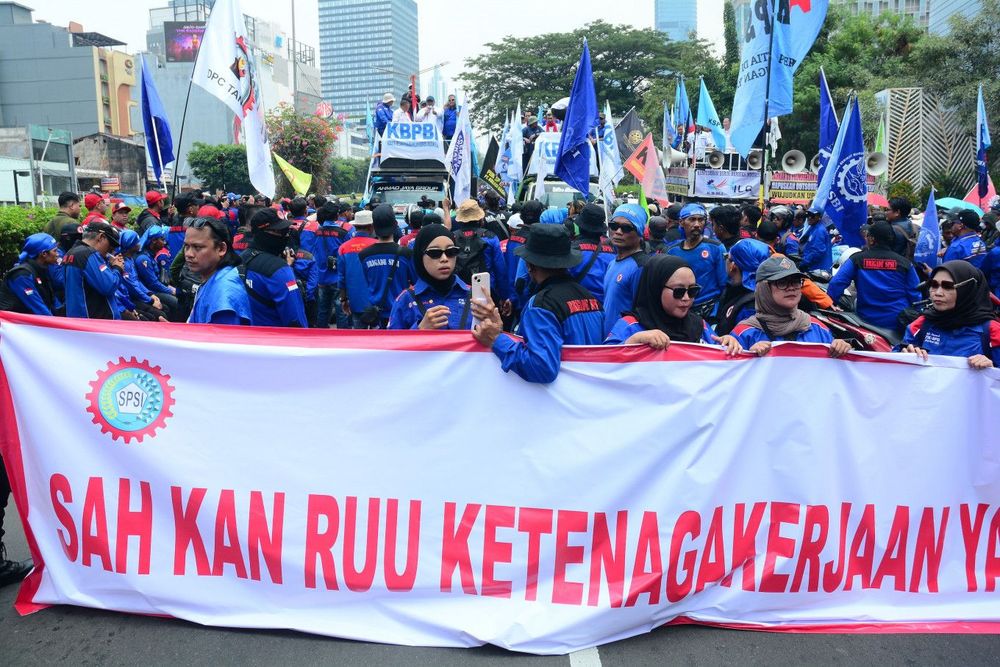
Employers warn stricter labor law could hurt investment and job creation
The Indonesian Employers Association (Apindo) has warned that stricter labor legislation could elevate business costs and discourage investment as lawmakers prepare to vote on the manpower protection bill by October 8, just weeks before a Constitutional Court deadline expires.
The urgency stems from Constitutional Court Decision 168/PUU-XXI/2023, issued on October 31, 2024, which found that employment provisions in the 2023 Job Creation Law overlapped with the 2003 Manpower Law. The court gave lawmakers two years to separate employment regulations into a standalone law, setting a deadline of October 31, 2026.
Apindo chairwoman Shinta W. Kamdani called for balanced legislation that addresses both worker protection and Indonesia's competitiveness in attracting investment and expanding employment opportunities.
"This is very concerning, because if it's not balanced and focuses solely on protection, what about the job itself?" Kamdani said at a press conference.
Labor market pressures mount
The association highlighted challenges facing Indonesian businesses, including a shift toward capital-intensive industries and weakening job absorption capacity in several sectors. These trends have contributed to expansion of the informal economy, which now employs nearly six out of every ten Indonesian workers.
As of February 2026, approximately 59.4 percent of Indonesia's 147.67 million employed workers—totaling 87.74 million people—work in the informal sector, while only 40.6 percent hold formal employment positions, according to data from the Central Statistics Agency (BPS).
The labor market faces additional pressure from demographic forces, with approximately 3 to 4 million new workers entering the workforce annually, intensifying the need for robust job creation.
Kamdani stressed that new regulations must provide certainty for businesses to maintain productivity, attract investment and create jobs, rather than imposing additional burdens.
"We, along with sectoral associations, are very cautious in our view that imposing additional obligations, restrictions on employment relationships and expanding sanctions, without an impact assessment or clear implementation mechanism, could undermine these objectives," she said.
Comprehensive bill raises concerns
The draft Manpower Protection Bill, presented to the House's Commission IX in June 2026, spans 19 chapters and 224 articles. The proposed legislation would introduce significant changes to employment termination rules, including removal of two efficiency-based termination grounds, making preventive measures a precondition for bipartite negotiations, and increasing severance multipliers for various termination scenarios.
The bill would also modify provisions governing fixed-term employment contracts, outsourcing arrangements, foreign worker employment, wage calculations and severance entitlements.
Key points of contention between employers and labor representatives include minimum wage calculations, outsourcing regulations, rules for fixed-term employment contracts (PKWT), and severance pay provisions.
Investment climate under scrutiny
Apindo's concerns align with broader assessments of Indonesia's business environment. The 2026 U.S. State Department Investment Climate Statement identified restrictive regulations, legal and regulatory uncertainty, economic nationalism, and trade protectionism as key challenges complicating investment decisions in Indonesia.
Investment data presents a mixed picture. While total investment realization in the first quarter of 2026 reached IDR 498.8 trillion, reflecting a 7.2 percent year-on-year increase according to the Ministry of Investment and Downstream Industry, some analyses suggest net foreign direct investment contracted by 26 percent year-on-year in the same period, indicating deteriorating investor sentiment affecting real economy decisions.
Historical context shapes debate
The current legislative push unfolds against the backdrop of Indonesia's contentious 2020 Omnibus Law on Job Creation, which sparked widespread protests from labor unions between 2020 and 2024. The Constitutional Court later ruled that law conditionally unconstitutional due to procedural flaws, leading to the government's enactment of Law Number 6 of 2023.
The mandate for the current bill represents another chapter in Indonesia's ongoing effort to balance worker protections with economic development needs.
The legislative debate also occurs as Indonesia expands labor protections in other areas. In April 2026, the country enacted Law No. 2 of 2026 on the Protection of Domestic Workers, providing the first formal legal protection for an estimated 4.2 million domestic workers, 90 percent of whom are women. That bill had been under consideration since 2004.
Apindo, established in 1952, represents business interests in Indonesia's tripartite labor relations system alongside government and unions. Kamdani has served as chairwoman for the 2023-2028 term.