Access is not the same as participation
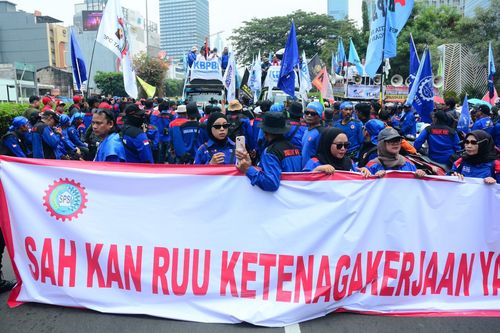
Rendy said the KPU's role in safeguarding popular sovereignty makes transparency a necessity, not an administrative formality. Yet its online channels often function as one-way broadcasts, he argued: the commission publishes data and regulations without providing enough opportunities for public discussion or education.
"If the KPU believes it has been transparent, on this 73rd anniversary, it is called upon to take further steps to provide more substantive transparency," he said.
He pointed to public review of the Temporary Candidate List (DCS) during legislative nominations and regional elections. The response was initially limited because the commission had not made access to candidate profiles and records sufficiently clear and user-friendly, he said. Protests on social media followed only after candidates with problematic records, including former corruption convicts, appeared on the Permanent Candidate List (DCT).
For the People's Voter Education Network (JPPR), turnout alone does not demonstrate successful transparency. Rendy called for understandable information and interactive public review from the outset, giving voters meaningful access to campaign finances, candidate records and vote tabulation.
What Sirekap makes visible
The KPU's Electronic Recapitulation Information System, Sirekap, publishes photographs of Model C results forms from polling stations, allowing voters across Indonesia to follow the count in real time. Its operation in 2024 also exposed the difficulty of keeping displayed figures aligned with the underlying records.
According to The Jakarta Post, via Asia News Network, Sirekap faced criticism when online tallies differed from manual C1 forms. As of February 19, 2024, the KPU reported presidential-election discrepancies at 1,223 polling stations, about 0.21 percent of the more than 585,000 stations that had uploaded C1 forms. It halted district-level tabulation to synchronize the system with the manual records.
Sirekap debuted in the 2020 regional elections. It replaced Situng, the online tabulation platform last used in the 2019 general election.
Election law practitioner Viktor Santoso Tandiasa described Sirekap as a means of public oversight that fulfills the constitutional mandate for access to public information. Viktor, a member of the HICON Law & Policy Strategies legal team representing the KPU, said the platform allows people to monitor their votes from the polling station onward.
That public-monitoring role is distinct from formal proof in Constitutional Court election disputes. Viktor said authentic Model C documents from manual recapitulation remain the basis for legal evidence. The scanned forms on Sirekap give voters and disputing parties a way to check uploaded data against physical documents.
Seven decades of ballot-box design
The physical history of election transparency is on display at the Election Journey Museum in the East Jakarta KPU office. Inside a glass cube stands a teak ballot box used in Indonesia's first election in 1955. Its thick, golden-brown lid shows the wood grain, but nothing inside is visible. Ballots entered through a narrow top slot; a metal fitting at the front secured the padlock.
Beside it is a replica labeled "Polling Station 02, Gondangdia, Central Jakarta," where President Suharto voted in 1997. Wooden boxes of that period distinguished contests by color: yellow for the national House of Representatives, white for the Level I provincial legislature and blue for the Level II district legislature. The color coding identified the election, while thick wooden walls and iron padlocks concealed the ballots.
Aluminum and zinc replaced wood during the Reform Era. The collection includes a box used in the Sula Islands in 2009 and one from the Jati polling station in the 2012 Jakarta gubernatorial election. These metal containers still required opening before anyone could inspect their contents. Each weighed 7 kilograms, while storage rentals cost the state hundreds of billions of rupiah. Their opaque walls also prompted suspicions about possible tampering during transport across the islands.
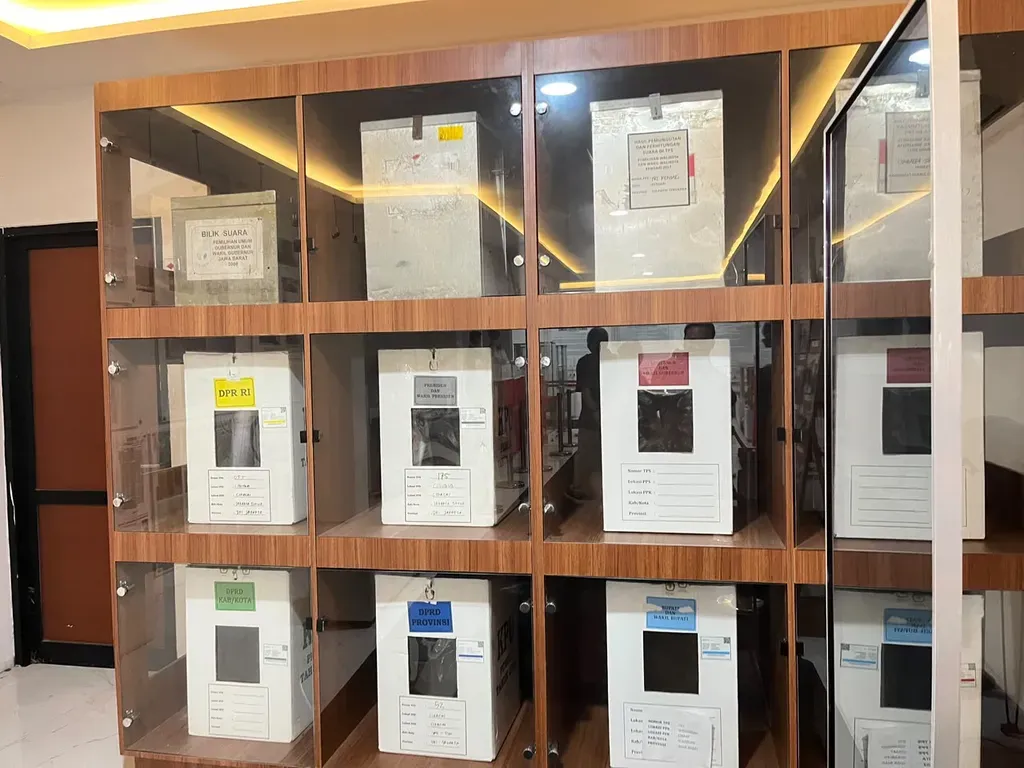
Duplex cardboard replaced metal in 2019, followed by transparent front panels in 2024. The museum also preserves gray voting booths from the 2008 West Java gubernatorial election and a sealed red metal ballot box from the 2017 Kendari regional election.
On a lower shelf, white 2024 boxes carry colored labels: yellow for the House of Representatives at TPS 055, gray for the presidential election at TPS 175 Cibubur, and blue for the provincial legislature at TPS 52 Ciracas. Their 17-by-20-centimeter windows, introduced under KPU Regulation No. 14 of 2023, permit inspection without opening the locks or breaking the seals.
Specifications and the scale of procurement
The KPU's 2024 technical specifications describe a box measuring 40 by 40 by 60 centimeters, built from water-resistant, double-wall duplex cardboard at least 6 millimeters thick. They specify transparent polyvinyl chloride (PVC) for the front window, with a minimum thickness of 300 microns and dimensions of 17 by 20 centimeters.
For the 2024 general election, the first procurement phase included about 4.1 million ballot boxes and 3.2 million voting booths. Kompas.id reported that consolidated purchasing coordinated with Indonesia's national procurement agency, LKPP, cut costs by 42.76 percent. Savings totaled about Rp 302.1 billion against a Rp 527.8 billion ceiling, bringing the required budget to Rp 225.7 billion.
The KPU monitors the wider supply chain centrally through its Logistics Information System, Silog. Its coverage extends from printing factories and procurement to delivery of ballot boxes, booths, ballots, ink, seals and voting tools to remote islands. Public and observer access allows real-time tracking of supplies and helps identify potential ballot shortages.
The systems behind an election
Sirekap and Silog belong to an extensive KPU software network. Sipol records verification of political-party leadership and membership; Sidapil supports the organization of electoral districts; and Sidalih manages data for more than 204 million voters online.
Other systems cover different stages of election administration. Silon documents candidacy requirements for offices ranging from the national legislature to regional heads. Sikadeka handles campaign and campaign-finance information, while Siakba covers KPU and ad hoc election-body members. The Legal Documentation and Information Network, JDIH, provides access to regulations.
The institution behind the anniversary
The KPU's anniversary reaches further back than its present institutional structure. Its official history records that Decree No. 170 of 2026 designated November 7, 1953, as its founding day, with the anniversary observed for the first time in 2026, marking 73 years.
That date refers to Presidential Decree No. 188 of 1953, which appointed the Panitia Pemilihan Indonesia (PPI). The PPI was the precursor election body charged under Law No. 7 of 1953 with organizing the country's first general election in 1955.
The current independent commission emerged through Reform Era changes. The New Order's election body, the Lembaga Pemilihan Umum, operated within the Interior Ministry before becoming the KPU in 1999. Its initial 53 members came from political parties and the government. In 2001, membership fell to 11 nonpartisan commissioners; since the 2004 election cycle, the commission has had seven members.