Election Law Hearing: Arsul Sani Remarks on Regional Election Cases Where Candidates Have Master's Degrees Yet Lack High School Diplomas
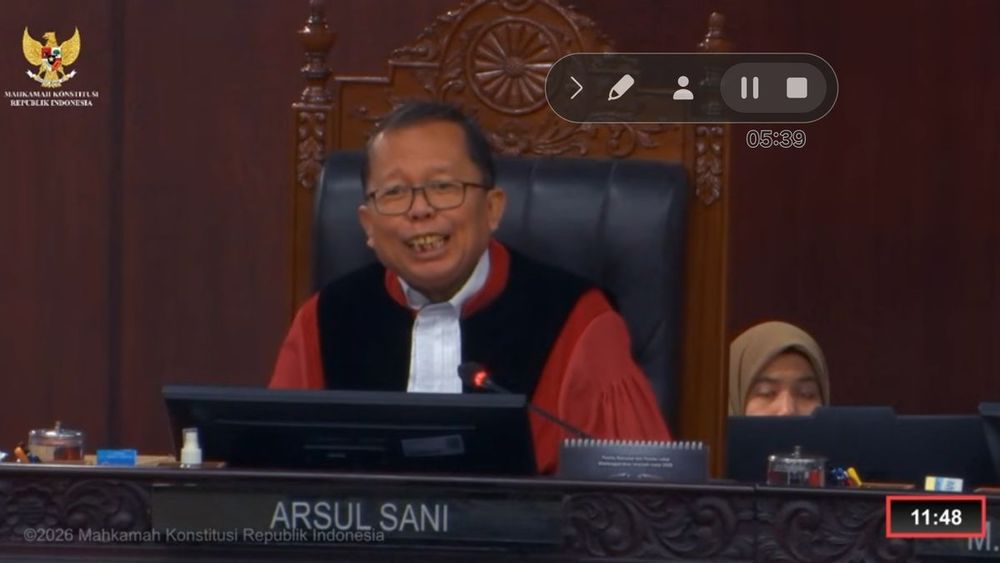
Constitutional Court Judge Arsul Sani highlighted a perplexing aspect of Indonesia's election regulations during a judicial review hearing on Tuesday, questioning why candidates with university degrees face disqualification for lacking high school diplomas.
"At the Constitutional Court, there are many cases in the regional elections where candidates have S1 or even S2 but do not finish high school or do not complete package C. How is that possible?" Sani stated during the preliminary examination of Election Law No. 7 of 2017, case number 382/PUU-XXIV/2026.
The issue has emerged as a significant concern in Indonesian elections. Under current law, all candidates for regional head positions must possess at minimum a senior high school diploma or equivalent, with minimum ages of 30 for gubernatorial candidates and 25 for mayor or regent candidates. Law Number 7 of 2017, passed after nine months of parliamentary debate and subsequently amended in 2022 and 2023, establishes these requirements.
Recurring Pattern of Diploma Controversies
The diploma verification problem has plagued Indonesian elections for over a decade. During the 2015 simultaneous regional elections, the Election Supervisory Agency discovered allegations of fake diplomas, prompting several candidates to withdraw their registration after verification with the Ministry of Research, Technology, and Higher Education.
The issue resurfaced dramatically in the 2024 Pesawaran regent election, where candidate Aries Sandi Darma Putra was disqualified despite winning with 149,391 votes against rival Nanda Indira-Antonius Muhammad Ali's 97,625 votes. Sandi held both a bachelor's degree in law from Universitas Saburai and a master's degree from Universitas Lampung.
The Constitutional Court ruled on February 24, 2025, that Sandi's Certificate of Companion for Diploma (SKPI) Package/Equivalence, issued on July 19, 2018, was legally flawed and could not substitute for a high school diploma. Chief Justice Suhartoyo declared the disqualification, stating that Sandi had never completed third grade at SMA Arjuna or any equivalent institution.
Following the ruling, the Court ordered a re-vote in Pesawaran to be completed within 90 days, allowing the runner-up pair to participate while permitting Sandi's supporting parties to nominate a different candidate.
National-Level Implications
The diploma requirement controversy extends beyond regional contests. In October 2026, the Constitutional Court dismissed a legal challenge to Vice President Gibran Rakabuming Raka's educational credentials. The Court found no convincing evidence that Gibran, son of former President Joko Widodo, possessed a foreign diploma equivalent to senior high school completion as required by law. However, the Court ruled it could not disqualify him as he had already been sworn into office.
Petitioners had argued that Gibran's education at Orchid Park Secondary School in Singapore and UTS Insearch in Australia did not meet legal requirements, and no graduation certificate was presented during the case. The controversy followed another disputed 2023 Constitutional Court ruling that exempted Gibran from the 40-year age requirement for vice presidential candidates, allowing the then 36-year-old to run based on his previous elected office experience.
Proposed Legal Reform
The current case before the Constitutional Court was filed by Farhan Hilmy, an alumnus of Universitas Sebelas Maret's Faculty of Medicine. Hilmy challenges Article 227 letter l of the Election Law, which requires submission of a high school diploma for presidential and vice-presidential candidates.
Hilmy argues that failing to recognize valid higher education diplomas as alternatives discriminates against and obstructs citizens' governance rights guaranteed under Article 28D paragraph (3) of the 1945 Constitution. He requests the Court declare the law unconstitutional unless interpreted to include higher education units or relevant ministries for candidates holding valid university diplomas.
Judge Sani advised petitioners to engage directly with the House of Representatives, which is currently reviewing the Election Law. "The Election Law is currently being discussed in the House of Representatives, so Mas Farhan Hilmy's aspirations should also be brought there, not just to the Constitutional Court, so that it can be fought for that if someone has a bachelor's degree, especially a postgraduate degree, they do not need to submit a high school diploma," Sani stated.
International Context
Indonesia's strict educational requirements appear unusual in global context. According to the ACE Electoral Knowledge Network, a collaborative project involving International IDEA, IFES, and UNDP, minimum educational requirements for presidential candidates are not a primary norm in many countries worldwide.
The diploma verification issue affects a substantial portion of Indonesia's electoral landscape. The November 2024 local elections covered 545 regions across the country, including 37 provinces, 415 regencies, and 93 cities, representing all provinces except Yogyakarta Special Region and all cities and regencies except Jakarta's constituents.