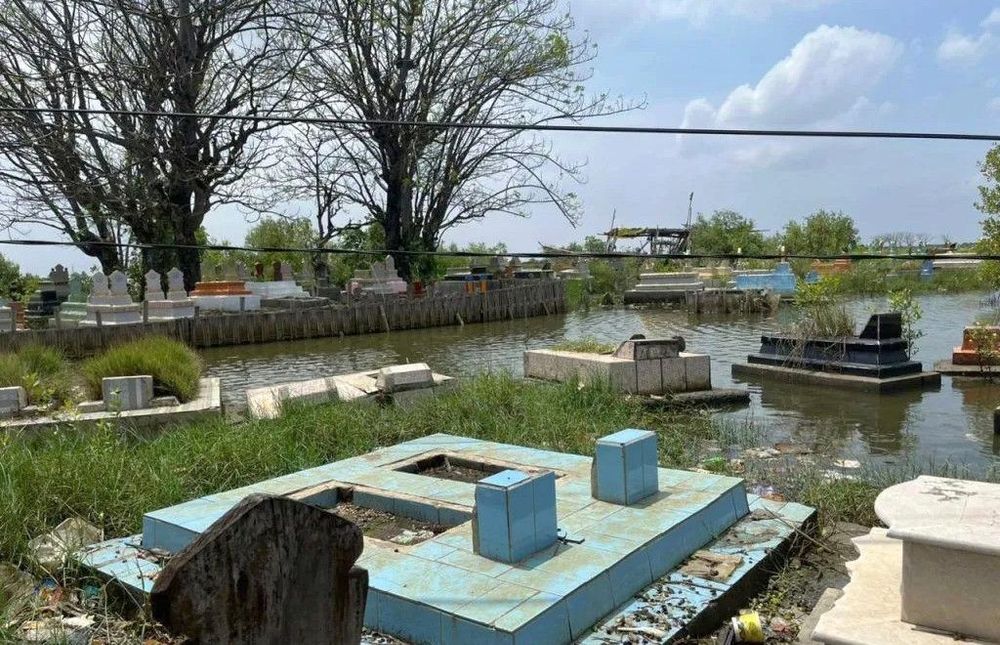
Eretan Wetan's submerged cemetery: A village where even the dead are losing ground
Eretan Wetan Village in Kandanghaur district, Indramayu regency, West Java, is slowly disappearing beneath the waves. While filmmaker Reza Rahadian used the village as a backdrop for his 2025 film Pangku, depicting its roadside coffee culture along the Pantura highway, residents face a far grimmer reality: their two-hectare public cemetery is sinking into the sea.
During a December 2025 visit, the cemetery presented a haunting scene. Only the tips of gravestones protruded above the water. Some markers leaned at precarious angles, while others had vanished entirely, swept away or submerged beneath brackish puddles. Tall weeds obscured the boundaries between pathways, dry land and graves. Piles of refuse dotted the waterlogged grounds.
That day, the village prepared to bury one of its own. Residents gathered to carry a coffin through standing water, dig a grave in soft, saturated soil and lower the body into a hole that would soon fill with floodwater again.
Living on the edge of submersion
Simin, a 40-year-old resident, lives just 30 meters from the cemetery. From his front yard, the submerged burial ground is clearly visible. Reaching his house requires navigating a treacherous path around the back, crossing several loosely arranged wooden logs that serve as stepping stones. The route is narrow, slippery and unstable.
This is the path Simin crosses daily. For elderly residents, children, pregnant women or people with disabilities, the journey presents serious dangers. There is no alternative unless one swims.
The flooding crisis in Eretan Wetan has accelerated dramatically over the past 11 years. Tidal floods now inundate the village almost every month, compared to only a handful of times annually in previous years. In December 2024, flooding in Kandanghaur and neighboring Cantigi district affected 4,354 households and damaged more than 100 hectares of agricultural land and residential areas. The impact prompted authorities to declare a disaster emergency alert status from November 2024 through May 2025.
Sinking faster than the seas rise
The crisis facing Eretan Wetan stems from a phenomenon more severe than climate-driven sea level rise alone. Cities along Java's northern coastline, including areas near Indramayu, are subsiding at least nine times faster than the global sea level rise rate. Land subsidence rates in the region range from 1 to 15 centimeters per year in different locations.
Scientific projections indicate that land subsidence will drive up to 85 percent of relative sea level rise along Java's coastlines by 2050, far outpacing global sea level rise as the primary factor. The main culprit is excessive groundwater extraction, driven by increasing demand for residential and industrial water supply along the densely populated northern coast.
The problem extends beyond subsidence. Coastal erosion rates in Indramayu range from 0.23 to 12.78 meters per year, with significant stretches experiencing erosion exceeding 2 meters annually. Across Indonesia, the country has lost 29,000 hectares of coastal land, with erosion claiming approximately 1,950 hectares per year while natural sedimentation creates only 895 hectares of new coastal land annually.
Community mobilization and government response
Residents have not accepted their fate passively. In July 2025, villagers formed the United Eretan Wetan Alliance and held demonstrations demanding government accountability to urgently address the tidal flooding constantly inundating their community.
The government has begun responding to the crisis. In January 2026, construction crews arrived in Eretan Wetan to build emergency embankments as an effort to prevent further flooding damage. Heavy machinery operators worked to erect barriers against the encroaching tides.
Yet the scale of the challenge extends far beyond a single village. Indonesia ranks fifth globally in terms of residents living in lower-elevation coastal zones. Without significant adaptation measures, the total population at risk of permanent flooding by 2070-2100 could exceed 4.2 million people.
In Eretan Wetan, the submerged cemetery stands as a stark symbol of displacement that extends even to the dead. As residents wade through floodwater to bury their loved ones, they confront a disturbing reality: in a village losing ground to the sea, even death has lost its space.