Greenpeace Indonesia Urges Govt to Take Climate Crisis Seriously
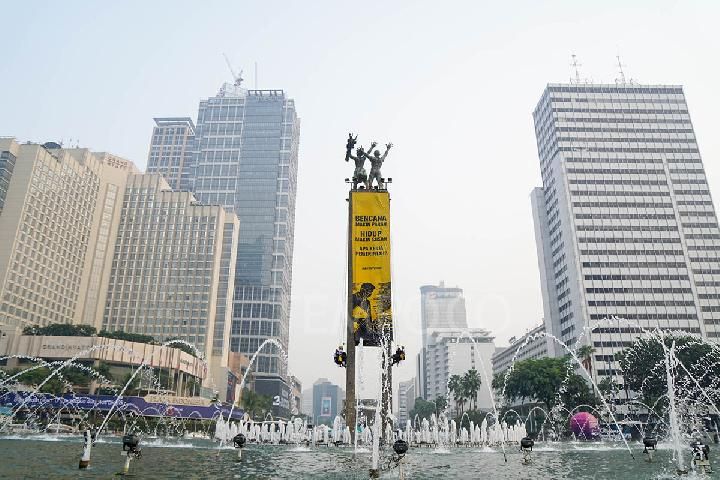
Greenpeace Indonesia activists staged a peaceful demonstration at the Hotel Indonesia Roundabout in Central Jakarta on Tuesday, October 20, 2026, marking the second anniversary of President Prabowo Subianto and Vice President Gibran Rakabuming Raka's administration. Two large banners were displayed from atop the iconic Selamat Datang monument, one reading "Address the Climate Crisis, Lower Living Costs" facing north toward Istana Merdeka, and another stating "Disasters Are Getting Worse, Life Is Getting Harder, What is the Government Doing?" directed south toward the roundabout.
The protest comes after two years marked by severe environmental disasters and mounting economic pressures on Indonesian communities. Since their inauguration on October 20, 2024, the Prabowo-Gibran administration has faced an unprecedented wave of climate-related catastrophes affecting millions of citizens.
"The Prabowo and Gibran administration must open their eyes to the climate crisis. Extreme weather and ecological disasters not only threaten the public's safety and health but also disrupt livelihoods, pressure income, and drive up food prices. The impact is most heavily felt by worker groups living in economic vulnerability."
— Jeanny Sirait, Climate Justice Campaigner for Greenpeace Indonesia
Devastating Natural Disasters
The administration's first two years have witnessed catastrophic flooding and persistent air quality crises. In November 2025, flash floods and landslides triggered by Cyclone Senyar devastated Aceh, North Sumatra, and West Sumatra, resulting in at least 969 deaths and over 5,000 injuries. The disaster, Indonesia's deadliest since the 2018 Sulawesi earthquake and tsunami, caused an estimated Rp 68.7 trillion in economic losses, affecting over 1.1 million people and displacing 570,000.
Environmental researchers have linked the severity of these floods to widespread deforestation. Between 2014 and 2024, Aceh, North Sumatra, and West Sumatra lost approximately 3.68 million hectares of natural forest, eliminating water retention systems that previously absorbed heavy rainfall and prevented flash flooding.
The country has also grappled with severe air pollution from forest fires. Since August 1, 2026, the Southeast Asian haze crisis has exposed more than 12.5 million people across seven Indonesian provinces to hazardous air quality. Wildfires in Sumatra, Kalimantan, and Papua have consumed over 1.32 million hectares, with fire emissions running 273 percent above seasonal averages in early September. Respiratory infections linked to the fires surged to 113,336 cases by September 9, roughly double the 50,891 cases recorded on September 1.
According to Indonesia's National Agency for Disaster Countermeasure, the country recorded 3,165 disasters from January to December 29, 2025, including floods, extreme weather events, landslides, forest fires, and volcanic eruptions. These disasters resulted in 1,552 deaths and affected over 10.3 million people, damaging nearly 195,621 homes and 2,533 public facilities.
"Prolonged haze is a concrete example of how the ecological crisis burdens the lives of the community, from health disturbances to daily economic activities. In this situation, the community is increasingly squeezed by rising living costs and job uncertainties, including waves of layoffs."
— Jeanny Sirait
Economic Impact on Vulnerable Workers
Greenpeace Indonesia's latest research, titled "Besok Harga Naik! Gambaran Dampak Krisis Iklim dari Tempat Kerja, Meja Makan, dan Rumah" (Tomorrow Prices Rise! Overview of Climate Crisis Impacts from the Workplace, Dining Table, and Home), reveals that climate change is eroding workers' income and purchasing power. The study surveyed eight community groups across three urban agglomerations on Java Island: Jakarta Raya (Jakarta, Bogor, Depok, Tangerang, Bekasi, Cianjur), Bandung Raya, and Kartamantul (Yogyakarta City, Sleman, and Bantul).
The findings show that 41 percent of respondents reported climate crisis impacts on consumption patterns and food costs, while 39 percent experienced effects on productivity and income. An additional 20 percent felt the impact on housing access and transportation costs. Fishermen and gig economy workers, including online motorcycle taxi drivers and freelancers, emerged as the groups most severely affected.
The Asian Development Bank projects that climate impacts could cost Indonesia between 2.5 and 7 percent of its GDP by 2100. The most vulnerable sectors—agriculture, forestry, and fishing—contributed almost 13 percent of Indonesia's GDP in 2023, placing millions of workers at direct economic risk from environmental degradation.
Government Response Under Scrutiny
Greenpeace Indonesia criticized what it characterizes as inadequate government action despite campaign promises.
"The Prabowo and Gibran administration promised to prioritize job creation, food and energy security, and improving the community's welfare. Our latest research findings show the opposite. The government has failed to provide solutions for the impacts of the climate crisis that are increasingly felt in daily life."
— Jeanny Sirait
The criticism comes against a backdrop of policy decisions that environmental advocates view as counterproductive. In December 2024, President Prabowo defended oil palm expansion, stating "Don't be afraid of deforestation" and claiming that "oil palms are trees … they've got leaves." Environmental groups criticized these remarks, citing scientific evidence that industrial palm plantations contribute to deforestation and biodiversity loss.
Adding to concerns, Indonesia's National Agency for Disaster Management saw its budget cut from US$118.7 million in 2025 to US$29.1 million in 2026, a reduction of approximately 75 percent, even as climate-related disasters have intensified.
Tempo contacted Minister of State Secretary Prasetyo Hadi, Head of the Indonesian Government Communication Agency Syahganda Nainggolan, and Deputy III for Partnerships and Media Relations Kurnia Ramadhana for comment, but none had responded as of publication.