Indonesia's 81st Independence Day: Pageantry meets protests and disaster
Indonesia celebrated its 81st Independence Day on August 17, 2026, with elaborate state ceremonies and traditional festivities across the archipelago. Yet the occasion revealed stark contrasts between official celebration and mounting public discontent, as natural disasters, environmental crises, and ongoing conflict cast shadows over the commemorations.
The centerpiece ceremony at Merdeka Palace in Jakarta drew overwhelming public interest, with approximately 336,000 people registering for just 5,500 available seats through an online ticketing system. While state officials and dignitaries filled the stands, the demand ratio of roughly 61 to 1 reflected both enthusiasm for the event and limited public access to official proceedings.
Disaster strikes before celebrations
Just two days before Independence Day, on August 15, a magnitude 7.7-7.8 earthquake devastated Flores Island in East Nusa Tenggara at 05:58 local time. The disaster killed at least 103 people and injured 1,666 others. Approximately 73,800 homes sustained damage, with 23,200 either collapsed or severely damaged. The earthquake also triggered a tsunami with waves reaching up to 1.61 meters, compounding the destruction.
The earthquake underscored questions about who truly experiences the promise of independence, as communities struggled with immediate survival needs while the nation prepared for celebrations.
Environmental crisis deepens
The Independence Day period coincided with a severe wildfire crisis affecting millions of Indonesians. The health ministry warned that 3.4 million people across seven provinces in Borneo and Sumatra faced risks of respiratory infections from wildfire haze. South Sumatra recorded the highest concentration of hotspots with 1,429, followed by West Kalimantan with 1,226 and Central Kalimantan with 811.
Climate conditions fueled the crisis, with the U.S. Climate Prediction Center projecting an 81 percent probability that El Niño would reach very strong intensity between October and December 2026. Forestry Ministry data showed that nearly 940 square kilometers had already burned in July 2026 alone.
The transboundary impact extended to neighboring Malaysia, where smoke from West Kalimantan drifted into Sarawak state. By August 11, eleven areas in Sarawak recorded unhealthy air pollution levels, forcing nearly 600 schools to close. Malaysia requested cloud-seeding assistance from Indonesia to combat the haze.
Official ceremony and military display
The state ceremony proceeded with traditional pomp despite the crises. The official theme for 2026, "A Sovereign, Just and Prosperous Indonesia," echoed through ceremonies nationwide and at Indonesian embassies abroad. An aerial display featured around 81 aircraft and helicopters, including F-16 and Sukhoi fighter jets, the Airbus A400M military transport aircraft, and the public debut of Indonesia's newly acquired French Rafale fighter jets.
One element of the military display sparked debate: Indonesian Military skydivers descended from 10,000 feet carrying a massive banner bearing President Prabowo Subianto's portrait. Critics questioned whether such personality-driven symbolism blurred lines between the presidency, the military institution, and national identity itself.
Grassroots protests and viral satire
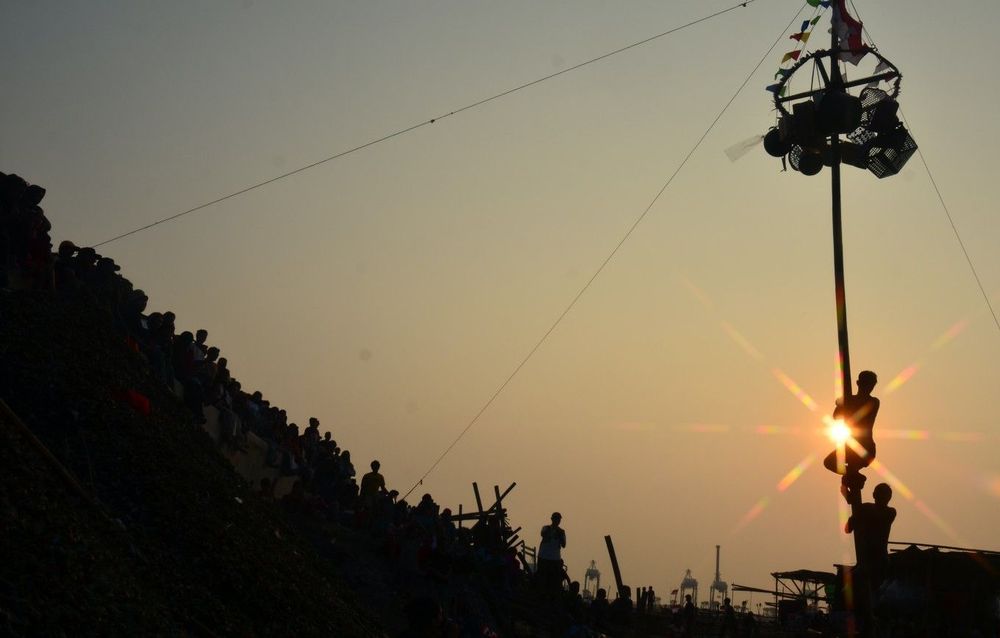
While some communities hung red-and-white bunting and organized traditional contests, others used the holiday to voice frustration. In Pati, Central Java, a grassroots coalition of farmers, residents, and civil society groups rallied to demand structural reforms after more than eight decades of independence.
Digital spaces became venues for pointed political commentary. One viral image reimagined the "81" logo, replacing the "8" with a well-fed caricature of President Prabowo and the "1" with an emaciated figure representing ordinary citizens. The graphic transformed a symbol of national pride into a critique of wealth disparity between political elites and the public.
Contested claims of harmony
During the ceremony, Religious Affairs Minister Nasaruddin Umar cited a 77.85 percent religious harmony index as an all-time high. The figure drew skepticism given persistent religious freedom challenges. SETARA Institute had documented 221 violations of freedom of religion and belief in 2025 across 331 total incidents, following 260 incidents with 402 acts in 2024. Amnesty International recorded at least five discrimination cases between January and mid-August 2026 alone. Recent pushback against church construction in Citraland, Surabaya, illustrated ongoing tensions on the ground.
Papua violence escalates
The Independence Day period also highlighted worsening conflict in Papua. Conflict-related deaths rose month-on-month throughout 2026, with over 40 people killed in May alone, according to ACLED data. Human Rights Monitor documented 24 alleged extrajudicial killings in the second quarter of 2026, representing the highest annualized quarterly civilian death figures attributed to security forces in a decade.
The nature of the conflict shifted as Indonesia's military deployed more advanced weaponry, including aerial and drone strikes, marking a move toward more lethal tactics beyond conventional gunfire exchanges. Human Rights Monitor reported that over 107,000 civilians had been internally displaced across Papua since January 2026 due to military operations and armed conflict.
As red-and-white flags flew across the archipelago and communities gathered for festivities, the 81st Independence Day exposed tensions between official narratives of progress and the lived reality of millions grappling with natural disasters, environmental degradation, religious intolerance, and violent conflict. The question persisted: whose sovereignty and prosperity was the nation truly celebrating?