Military deployment in Indonesia's resource belt raises questions about state priorities
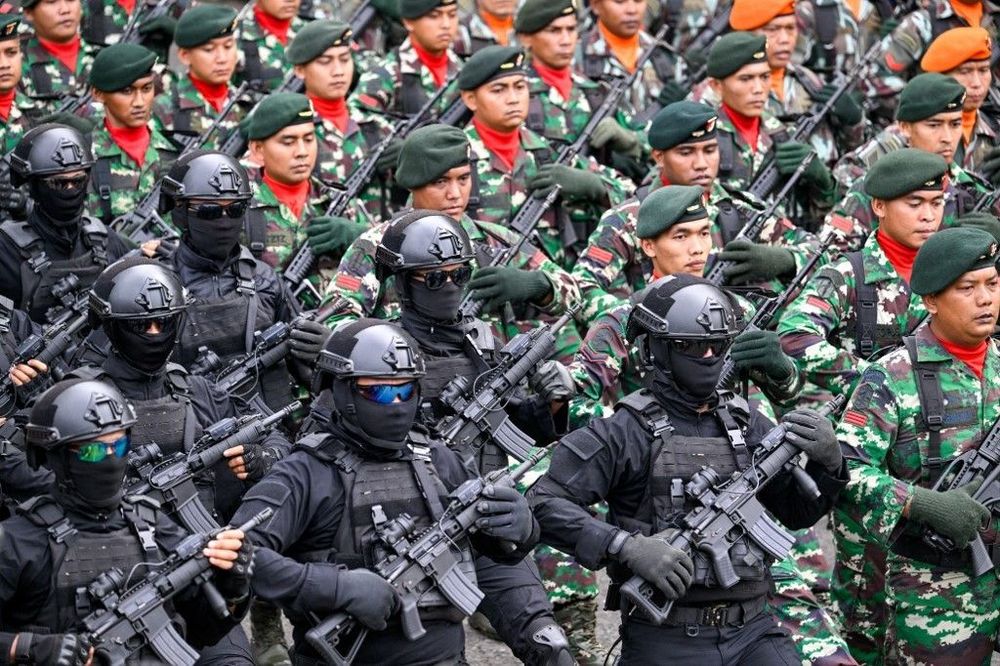
President Prabowo Subianto's August 2025 inauguration of 100 Territorial Development Infantry Battalions alongside six new regional military commands was framed as a national resilience initiative addressing food security, public health and rural infrastructure. However, the actual distribution of these forces reveals a pattern centered on Indonesia's extractive economy rather than demographic need.
The deployment concentrates along what emerges as the state's resource corridor: regions rich in nickel, coal, natural gas, bauxite and palm oil, as well as the industrial facilities processing these commodities. North Maluku and Maluku provinces demonstrate this alignment most clearly.
Nickel hub secured by three battalions
North Maluku contains virtually no petroleum reserves, yet it anchors Indonesia's electric vehicle ambitions through massive nickel processing operations. The province accounts for a significant share of Indonesia's nickel output, which represents approximately 50 percent of global mine production as of 2024. Its National Strategic Projects focus exclusively on industrial estates and processing plants.
The Indonesia Weda Bay Industrial Park in Central Halmahera, operated primarily by Chinese companies including Tsingshan Group, stands as one of the world's largest integrated nickel complexes, processing ore into ferronickel and battery-grade materials. Nearby facilities include the Obi/Harita industrial hub in South Halmahera, Antam's ferronickel-battery smelter in Buli, and the Alchemist iron sand-vanadium plant.
This industrial concentration corresponds to military positioning. Beyond the existing regular battalion in Jailolo, the state deployed three Territorial Development Infantry Battalions: Yonif TP 866 in Wasile, East Halmahera, situated between the Antam and Alchemist smelters and the Maba-Gebe nickel corridor; Yonif TP 867 in Bacan, South Halmahera, near the Gane nickel concessions and Obi industrial estate; and Yonif TP 822 on Morotai island.
These placements trace an arc through Halmahera's principal mining regencies rather than mirroring population density, healthcare deficits or agricultural acreage. Indonesia implemented a nickel ore export ban in 2020 to compel domestic processing, triggering rapid construction of smelters and industrial parks funded by an estimated $30 billion in predominantly Chinese investment between 2020 and 2024.
Gas fields and maritime corridors
Neighboring Maluku demonstrates that this security architecture extends beyond mineral sites. The province's two National Strategic Projects comprise the Way Apu Dam in Buru and the offshore Abadi Field in the Masela Block, linked via subsea pipeline to onshore terminals. The Masela Block gas field in the Arafura Sea holds estimated reserves of 10.7 trillion cubic feet, with development delayed over two decades due to disputes regarding onshore versus floating LNG processing before receiving approval for onshore development in the Tanimbar Islands in 2023.
Yonif TP 821 sits in Namlea, directly adjacent to Way Apu Dam. Three additional battalions line maritime fishery corridors: Yonif TP 912 in Aru, 913 in Moa and 914 in the Kei Islands, spanning the Arafura and Banda seas. While the offshore Masela Field itself contains no garrison on its platforms, the planned onshore LNG facility in Lermatang sits beside the regular Yonif 734 in Saumlaki.
Strategic projects and territorial expansion
The National Strategic Projects program, which designated 208 initiatives under the Jokowi administration and continues under Prabowo, covers infrastructure, energy and industrial projects deemed critical for national development. These projects receive expedited permits and state support, establishing a framework that may justify dedicated military security arrangements.
The August 2025 expansion from 12 to 18 regional military commands represents the first major reorganization of Indonesia's military territorial structure since the 1980s. Officials justified the expansion through geographical coverage gaps and modernization requirements, yet the timing coincides with accelerated resource extraction and industrial development in eastern provinces.
Territorial Development Infantry Battalions represent a relatively recent Indonesian National Armed Forces structure, established through military reforms to focus on non-combat territorial operations including community development, disaster response and infrastructure support in underdeveloped regions. The formal mandate emphasizes civilian welfare rather than asset protection.
Contested terrain
The regions receiving new military presence have experienced significant social friction. North Maluku has seen multiple violent conflicts related to nickel mining operations since 2019, including clashes between mining companies and local communities in Weda Bay and Obi Island over land rights, environmental damage and inadequate compensation.
Environmental documentation reveals substantial ecological consequences from nickel mining and smelting in North Maluku, including deforestation of over 40,000 hectares in Halmahera since 2015, marine pollution affecting coral reefs, and displacement of indigenous communities within mining concession areas.
The Indonesian National Armed Forces maintains a territorial command structure unique among modern militaries, preserving military presence down to village level. This system has historically been associated with both civic action programs and suppression of dissent, particularly in resource-rich regions such as Papua and Aceh, establishing a precedent for dual civilian-security functions in extraction zones.
The alignment between military deployment and industrial infrastructure suggests that beneath official development rhetoric, the state is constructing a security apparatus designed to protect extractive operations and processing facilities. Rather than directing forces toward areas of greatest civilian need, the territorial expansion secures what has become Indonesia's resource-industrial frontier, transforming remote provinces into militarized zones of economic production.