Signing follows talks launched in 2016
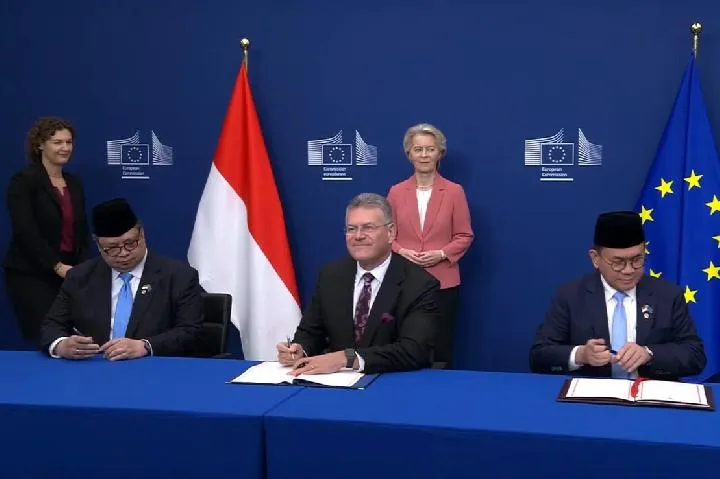
The signing followed a process launched by a joint announcement in Jakarta and Brussels on July 18, 2016. Indonesia's Coordinating Minister for Economic Affairs represented the country at the CEPA ceremony, while Trade Minister Budi Santoso signed the Investment Protection Agreement. Trade Commissioner Maroš Šefovi represented the EU.
Before the signing, European Commission President Ursula von der Leyen said the pact would remove duties on nearly all trade between the two economies. In remarks carried live on the European Commission's YouTube channel, she said: "This opens new opportunities for European and Indonesian companies, farmers, workers, and especially for small businesses."
Von der Leyen said clearer rules and open markets would give businesses greater certainty for long-term trade and investment. "It is a partnership between the world's largest single market and Southeast Asia's largest economy," she added. She expressed hope that it would support growth and good jobs for farmers, manufacturers and small businesses on both sides.
How the tariff cuts would unfold
The European Commission's summary, reported by bne IntelliNews, puts the pact's eventual coverage at up to 98.5% of tariff lines, with 80% liberalized when it enters into force. Indonesia is set to eliminate tariffs on 96% of goods within five years. Most Indonesian duties on EU cars, which currently reach 50%, would be removed over that period.
For Indonesian exports to the EU, Coordinating Minister for Economic Affairs Airlangga Hartarto said 90.4% of tariff lines would become duty-free on the first day. He also said palm oil would receive a zero-tariff quota of 1 million metric tons.
The Council of the EU estimates that businesses would save €600 million annually in customs duties, according to Reuters.
Agriculture, palm oil and industrial inputs
The Commission expects the agreement to increase EU agri-food sales to Indonesia by eliminating tariffs on key exports, including processed foods, most dairy products and meat. Those exports totaled €960 million in 2025. The pact would also protect 221 EU geographical indications.
Access to the EU market would remain restricted for several agricultural products. Rice, sugar, eggs, fresh bananas and ethanol would receive no new access, while garlic, mushrooms, sweetcorn, manioc starch and high-sugar-content products would be subject to limited quotas.
The agreement also provides an export duty-free quota for crude palm oil and palm kernel oil, which the Commission identifies as strategic inputs for EU industries. The Commission describes Indonesia as a world-leading producer of nickel and cobalt, critical raw materials needed for the green and digital transitions.
Those provisions do not remove existing EU measures affecting palm oil. According to bne IntelliNews, the pact's palm oil protocol establishes dialogue and cooperation but leaves intact both the EU's phase-out of palm oil from transport fuel by 2030 and its anti-subsidy duties on Indonesian biodiesel.
The economic and diplomatic relationship
Commission data put goods trade between the two partners at €28.9 billion in 2025: the EU bought €18.7 billion from Indonesia and sold €10.2 billion to it. In 2024, EU companies held €24.7 billion in direct investment in Indonesia, compared with Indonesian investment of €1.3 billion in the EU.
Von der Leyen described the signing as evidence of Indonesia's strong political commitment to its EU partnership and thanked President Prabowo Subianto. She said she looked forward to welcoming him to Brussels on December 11 before they traveled together to the G20 Summit in Miami, United States.
She also placed the agreement alongside other EU trade initiatives. The bloc has completed negotiations with Australia, modernized its global agreement with Mexico and reached a political agreement with the Philippines. Describing the EU's trade network in 2026, she cited 45 free trade agreements covering 80 partners.
Approvals and a looming tariff change
According to bne IntelliNews, both agreements must now receive the European Parliament's consent and ratification by the two sides' legislatures. Provisional application is possible before formal entry into force, which both sides are aiming to achieve in early 2027.
A separate tariff deadline falls on January 1, 2027, when Indonesia graduates from the EU's Generalised Scheme of Preferences (GSP). The Council said that change explains the push to apply CEPA as soon as possible. From that date, Indonesian goods would face standard EU duties until CEPA is applied.