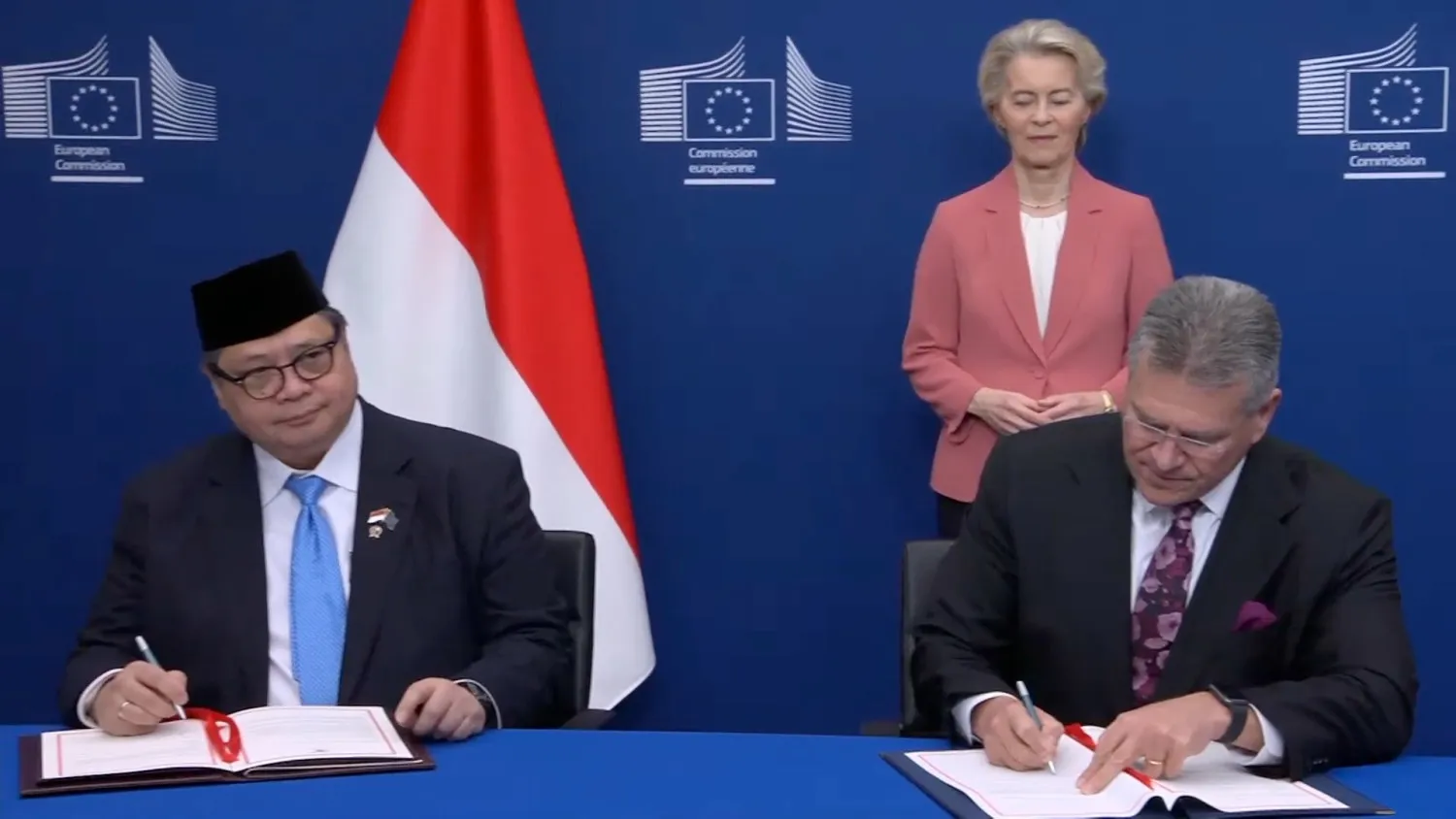
Signing follows years of negotiations
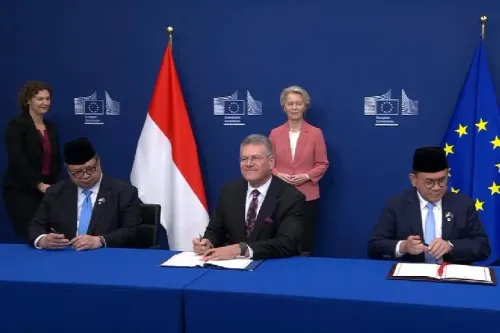
The package consists of the Indonesia–European Union Comprehensive Economic Partnership Agreement (IEU-CEPA) and a separate Investment Protection Agreement (IPA). Representing Indonesia were Coordinating Minister for Economic Affairs Airlangga Hartarto and Trade Minister Budi Santoso. European Commissioner for Trade Maroš Šefčovič represented the EU, with European Commission President Ursula von der Leyen also attending.
The signing capped a process spanning nearly a decade. The European Commission dates the launch of CEPA negotiations to July 2016; talks on both agreements concluded in September 2025.
Tariff reductions and market access
IEU-CEPA provides for zero import duties from its first day on about 90.4% of tariff lines covering Indonesian exports to the EU, according to RRI.co.id. Another 8.37% will receive phased reductions over 3 to 15 years or be covered by a tariff rate quota (TRQ) scheme. The European Commission puts the share of tariffs to be eliminated at 98.5%.
Airlangga said the agreement would open access to a market of roughly 450 million people. Annual trade between Indonesia and the EU is around US$30 billion, he said.
For EU exporters, the Commission estimates annual customs-duty savings of about €650 million. It says the agreement provides for cuts in existing Indonesian tariffs of up to 50% on cars, 15% on machinery, 25% on chemicals and 15% on pharmaceuticals. Protection will also extend to 221 EU geographical indications.
Investment provisions and regional context
The European Commission says the agreement will improve investment rules for EU businesses in priority industries, including electric vehicles, renewable energy and electronics. It also says the deal secures access to critical raw materials from Indonesia, including nickel and cobalt, and contains a Protocol on Palm Oil intended to encourage sustainable trade practices.
The Indonesia agreements join the EU's other trade initiatives in Southeast Asia. According to the Commission, the bloc has concluded agreements with Singapore and Vietnam, while talks with Thailand continue. A substantial agreement with the Philippines was announced in October 2026.
Ratification and the 2027 targets
Indonesia is targeting January 1, 2027, for full entry into force. The two sides are also aiming for provisional application in early 2027, subject to ratification and completion of their respective domestic legal procedures.
That timetable coincides with Indonesia's scheduled graduation from the EU's Generalized Scheme of Preferences (GSP) on January 1, 2027. Its exports will then lose the preferential tariffs available under that scheme. The EU and Indonesia have cited that change as the reason for their commitment to put the agreements into application as quickly as possible.