Missing person count nears 3,000 as Nepal-China flood rescue efforts continue
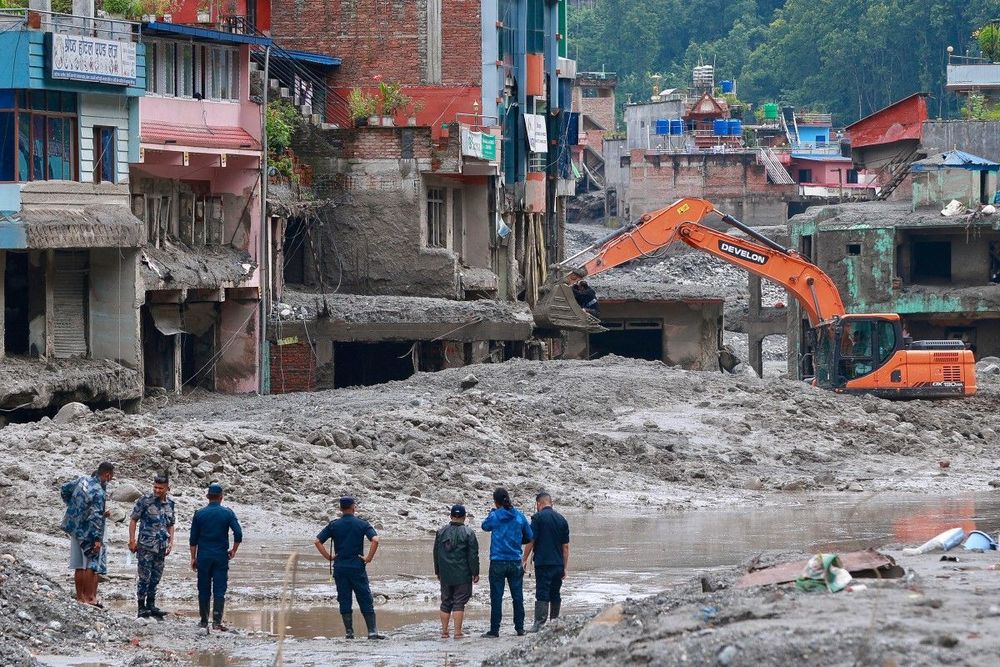
Rescue operations in Nepal and China entered their fourth day Saturday as authorities searched for nearly 3,000 people missing after a devastating flood swept through the Himalayan border region, leaving 633 confirmed dead and entire villages buried under debris.
Scientists have determined that a glacier collapse near Langtang Lirung triggered the disaster, registering a magnitude 5.2 tremor detected by seismometers worldwide. The resulting wall of ice, water and mud traveled 72 kilometers along the Trishuli River, affecting seven districts in Nepal including Rasuwa, Nuwakot, Dhading, Gorkha, Tanahun, Nawalparasi and Chitwan.
Nepal's disaster authority added 933 hydropower workers to the missing persons list Saturday, bringing the total number of unaccounted individuals in the country to 2,426. The workers were employed at multiple major projects in the Trishuli River valley, including the 216-megawatt Upper Trishuli-1 hydropower project, which was scheduled for completion in December and expected to boost Nepal's power production by approximately 20 percent.
In Tibet, Chinese authorities reported seven deaths and 554 people missing. State media said two villagers were rescued early Saturday from the hardest-hit area of Gyirong, though rescue operations were temporarily suspended due to the threat of renewed flooding from unstable lake formations created by the debris.
Border infrastructure destroyed
Gyirong Port, located about 130 kilometers north of Kathmandu at an elevation of approximately 2,700 meters, was completely destroyed in the floods. The facility served as the major gateway for trade and tourism between China and Nepal, and was the primary crossing point for pilgrims traveling to Tibet's Mount Kailash.
Scores of Hindu devotees from around the world are among the missing. Many were traveling on the traditional pilgrimage route from Kathmandu through the Gyirong border crossing, heading to complete the 52-kilometer circuit around Mount Kailash at an average altitude close to 5,000 meters.
Sivaranjani Muthunathan, 46, was traveling by bus with 56 others toward the Chinese border when the disaster struck.
"Then there was fog, smoke, something that seemed to suddenly engulf us,"
Passengers escaped by climbing through the driver's side window and scrambling up a hillside as vehicles around them were swept away or buried.
Tunnel rescue operations
The Nepali military located people trapped in the tunnel of the Trishuli 3A hydropower project and was working to extract survivors.
"Two helicopters have been dispatched, but it is challenging because it is tough to even locate the entry points of the tunnel,"
About 350 workers and residents have been brought to safety from the site, but efforts continued to rescue more than 100 people trapped in the same area.
Buddha Tamang, a worker airlifted Thursday after being marooned for more than 24 hours, survived only because he was inside a tunnel when the flood struck.
"The senior officers working on the other side, they were all swept away,"
The force of the flooding carried some victims' bodies 240 kilometers downstream into India, where authorities recovered seven bodies from rivers flowing from Nepal.
Mounting humanitarian crisis
The Red Cross said the trauma has been
"enormous,"with as many as 93,000 people potentially affected. Emergency teams faced dwindling food and water supplies in affected zones, where widespread devastation made access extremely difficult.
Survivor Buddhi Ram Dangol said,
"All the settlements near the river were swept away. There is nothing left."Samjhana Thing had been waiting three days for news of her missing brother:
"We don't know anything. Hopefully he is in a safe place."
Nepal has experienced 26 glacial lake outburst flood events since the 1970s, with economic losses from a single event exceeding $100 million. The Himalayas contain more than 5,000 glacier lakes dammed by potentially unstable moraines, with the Eastern Himalayas identified as a region where such hazards are three times higher than elsewhere in the mountain range.
Nepali police urged rescuers to
"immediately move to a safe location"
Chinese authorities later said the threat had eased, and state news agency Xinhua reported that rescue operations in Gyirong had resumed.
China also evacuated 555 stranded tourists and 499 Chinese residents from Tibet following the disaster.