Mounting casualties and missing persons
Rescue operations intensified on Thursday as emergency teams searched through mud and debris for more than 1,400 people missing after catastrophic flash floods and landslides struck the Nepal-Tibet border region, with the confirmed death toll reaching 392.
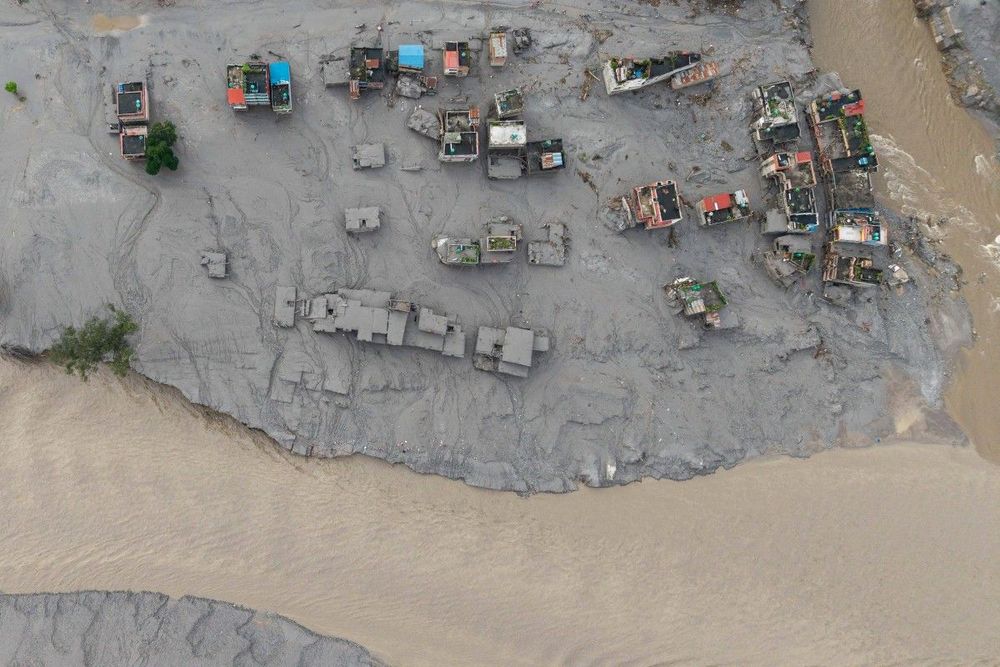
The disaster began when a massive section of glacier near Langtang Lirung peak collapsed, sending ice and rock crashing down to dam the Lhende river. When the natural barrier gave way, a tsunami-like wall of freezing water and mud surged through the valley, obliterating entire villages, smashing bridges and dams, and sweeping vehicles away.
The glacial collapse registered as a magnitude 5.2 seismic event on instruments in the United States and Germany, occurring at 2:52 a.m. UTC approximately 55 kilometers northwest of Kodari, Nepal. The surge destroyed homes, hydropower plants and border infrastructure about 20 kilometers northeast of the Rasuwagadhi border crossing.
Mounting casualties and missing persons
Nepali police reported recovering 389 bodies, while Chinese state media said three people died in Tibet's Gyirong Port area. In Nepal, 910 people remain out of contact, including 517 foreign tourists. China reported an additional 558 people missing in Tibet, including 260 foreigners not counted in Nepal's tally.
Among the missing are scores of Hindu pilgrims returning from Mount Kailash, Tibet's sacred peak. The pilgrimage circuit covers 52 kilometers at an average altitude close to 5,000 meters and typically takes three days to complete, with pilgrims crossing the border at Gyirong Port or Rasuwagadhi from Kathmandu.
Indian spiritual leader Sadhguru, speaking from Tibet in an emotional video message, said an entire group of pilgrims was caught at an immigration building when the floods struck.
This is a terrible and extraordinary event,
Indians comprise the largest number of missing foreigners, while the United States said 90 of its citizens are out of contact. Missing persons also include nationals from Australia, Britain, Malaysia, the Netherlands, Portugal, South Africa and South Korea.
Unprecedented scale of destruction
The floods destroyed at least 19 bridges and approximately 40 kilometers of road, severely hampering rescue efforts in terrain that is difficult to access even under normal conditions. Nepali soldiers deployed sniffer dogs to search for bodies buried under suffocating dirt, while emergency teams worked to evacuate survivors from affected zones.
It is a giant graveyard. All that is left are sand and pebbles, soaked red by human blood,
The disaster traveled nearly 170 kilometers south into Nepal, described by environmental historian Ruth Gamble of Australia's La Trobe University as
like an inland tsunami.The Trishuli River, which bore the brunt of the flooding, eventually joins the Narayani River and crosses into India's Bihar state as the Gandak River. Indian authorities evacuated thousands from areas in Bihar, Uttar Pradesh and Uttarakhand amid concerns about rising river levels.
Climate change and glacial risks
The US Geological Survey determined that a glacial collapse triggered the catastrophic debris flow, initially misidentified as a magnitude 4.4 earthquake. Climate change is accelerating glacier melt worldwide, dramatically increasing the frequency of such disasters.
The Himalayan region contains over 5,000 glacial lakes, with more than 200 classified as potentially dangerous. The current average number of glacial lake outburst flood events per decade is nearly five times higher than before 1950. More than 388 such events have been documented in the Himalaya-Karakoram region, with ice avalanches and extreme precipitation serving as the most common triggers.
Nepal has experienced 26 glacial lake outburst floods since the 1970s. Across the Hindu Kush Himalaya region, over 9,000 lives have been lost to these floods, with India, Pakistan, Nepal and Bhutan among the most severely affected countries.
Threat of secondary flooding
Authorities warned that water trapped behind debris blocking the valley poses a risk of additional flooding. Kathmandu's Flood Forecasting Division issued a special notice on Thursday about a growing lake forming behind the landslide debris, urging extreme caution in downstream areas.
With a blockage still lodged upstream on the Nepal-China border river, authorities warn a second flood may occur,
Prime Minister Balendra Shah toured the hardest-hit areas on Thursday and instructed local authorities to provide immediate relief to displaced families and reopen blocked roads. Chinese Premier Li Qiang also visited the affected region in Tibet to oversee relief operations, deploying nearly 800 emergency workers along with sniffer dogs and speed boats.
The Gyirong Port crossing, an important gateway for trade and tourism between China and Nepal, had previously experienced significant flooding in July 2025 that washed away the Sino-Nepal Friendship Bridge, underscoring the vulnerability of this strategic border corridor.
Buddhist spiritual leader the Dalai Lama, living in exile in India, said he would pray for all those who lost their lives in the disaster.