Five sites take part in export send-off
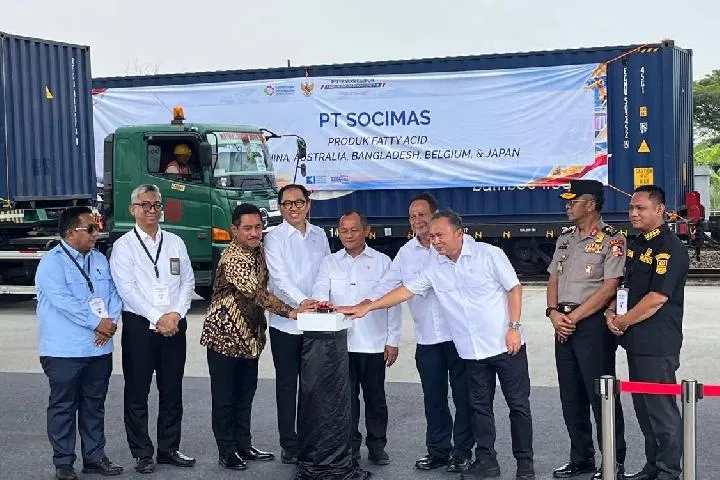
Cikarang Dry Port in Bekasi Regency, West Java, hosted the hybrid ceremony, with four other industrial sites participating simultaneously. Sarmuji identified automotive products, chemicals, pharmaceuticals and textiles (IKFT), basic metals, and food products among the prominent categories being shipped.
At Cikarang, 26 companies dispatched 29 containers. The Medan Industrial Area in North Sumatra contributed three containers from three companies, while the Java Integrated Industrial and Ports Estate in Gresik, East Java, handled 24 containers from four companies.
One company shipped six containers from the Batang Special Economic Zone in Central Java. In North Maluku, 28 companies participated from the Indonesia Weda Bay Industrial Park (IWIP).
For the Cikarang shipments' journey to Tanjung Priok Port in North Jakarta, 23 shipping firms are coordinating with the Directorate General of Customs and Excise, the Directorate General of Taxes, and the Indonesia National Single Window (LNSW).
Full-year exports forecast at $242 billion to $252 billion
At the event, Sarmuji forecast that Indonesia's manufacturing exports would total $242 billion to $252 billion in 2026. That would represent growth of 6.6 percent to 10.96 percent over 2025, according to Antara News.
His fourth-quarter estimate was $60 billion to $70 billion. From October 1 through November 15, manufacturing exports had reached $39.62 billion, a 4.05 percent increase from the same period in 2025.
The sector exported $182.3 billion in goods during January through September 2026, up 8.93 percent year over year. Manufacturing supplied 82.64 percent of Indonesia's total export value over those nine months.
Sarmuji also pointed to the sector's 2025 trade surplus of $38.91 billion, its largest in three years and nearly twice the 2024 figure. He attributed that result to exports growing 14.5 percent while imports rose 5.0 percent.
Basic metals and food lead export earnings
Basic metals generated $43.66 billion in exports from January through September 2026, followed by food products at $40.29 billion. The other three leading industry groups were chemicals and chemical goods, at $20.44 billion; computers, electronics and optical goods, at $11 billion; and leather, leather goods and footwear, at $7.12 billion.
As of September, China, the United States and India were the three main destinations for Indonesia's manufactured exports, Sarmuji said.
Manufacturing growth outpaces the broader economy
Sarmuji cited manufacturing's third-quarter performance as evidence of steady industrial progress. The sector grew 5.87 percent from a year earlier, compared with national economic growth of 5.47 percent, and accounted for 19.22 percent of gross domestic product. RRI.co.id reported that the GDP contribution was equivalent to Rp1,295.5 trillion.
Growth extended across 14 of the 15 manufacturing subsectors in the quarter. Furniture recorded the fastest expansion, at 12.68 percent. Basic metals grew 9.94 percent, leather and footwear 9.75 percent, and chemicals, pharmaceuticals and traditional medicines 8.10 percent. Food and beverages expanded 7.09 percent, while textiles and apparel rose 6.22 percent.
RRI.co.id also reported that manufacturing drew Rp246.9 trillion in investment during the third quarter, accounting for 46.7 percent of national investment. The sector employed approximately 20.04 million people as of May 2026.
Processing resources and expanding markets
Sarmuji said manufactured exports help Indonesia move beyond selling raw natural resources by processing them into higher-value products. "We must build Indonesia to stand on its own, have a strong industry, and possess an increasing bargaining position in the global economy," he said.
Tri Supondy, the Industry Ministry's director general of resilience, territorial, and international industrial access, called for stronger export commitments through government-business cooperation. He said the government hoped closer coordination with private companies would broaden overseas market access and increase manufacturing's contribution to trade and economic growth.
Sarmuji said he expected export markets to continue expanding, particularly in Europe. The Indonesia-European Union Comprehensive Economic Partnership Agreement (IEU-CEPA) has been signed and is expected to take effect in 2027, he said.