Raising incomes and widening opportunity
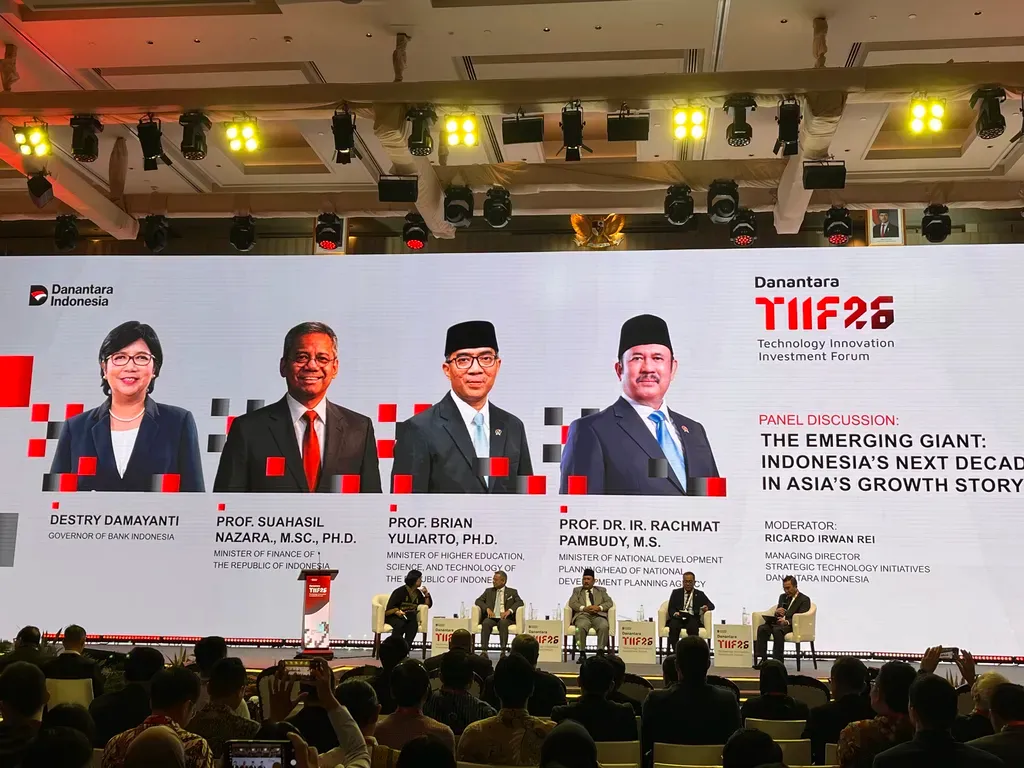
Rachmat Pambudy, minister of national development planning and head of Bappenas, told the forum that Indonesia's per capita income was still about $5,000, compared with more than $10,000 in several neighboring countries. "We've been stuck in the middle-income trap for almost 30 years," he said.
The World Bank lists Indonesia as an upper-middle-income economy. Its fiscal 2027 classification, effective July 1, 2026, places economies with gross national income per capita between $4,636 and $14,375 in that group; high-income status requires more than $14,375. According to the World Bank, Indonesia aspires to reach high-income status by 2045, while the government is targeting annual economic growth of 8 percent by 2029.
Rachmat said faster growth must give middle- and lower-income people more opportunities to raise their earnings and productivity, rather than benefit only high earners. An EBC Financial Group analysis published June 30, 2026, cited Statistics Indonesia data showing that the middle class shrank from 57.33 million people in 2019 to 47.85 million in 2024. It also reported a World Bank finding that the proportion of workers earning a middle-class-equivalent income declined from 14.5 percent in 2018 to about 7 percent in 2025.
For Rachmat, innovation should extend beyond laboratories and research institutions to public services. He pointed to Bank Indonesia's Quick Response Code Indonesian Standard (QRIS) payment system, which has reached about 70 million users, including small and medium-sized businesses. Expanding technology use across the economy, he said, could improve productivity, generate more value and reach more people.
Rebuilding industry beyond commodity processing
Bank Indonesia Governor Destry Damayanti called for a renewed industrialization effort. She said Indonesia had pursued industrial development during the 1980s and early 1990s before returning to greater reliance on natural resource commodities. More processing at home and deeper industrial supply chains were needed to move beyond exports of raw materials and minimally processed goods.
Investment in downstream processing totaled IDR 480.1 trillion during January-September 2026, according to the Ministry of Investment and the Investment Coordinating Board. That was 11.3 percent higher than a year earlier and represented 31.2 percent of total realized investment. Destry said moving into higher-value production would also require skilled workers, greater labor productivity and technology.
The EBC analysis put manufacturing at about 19 percent of Indonesia's GDP, down from a peak near 32 percent in 2002, and said the sector employed roughly 14 percent of workers. EBC described the trend as premature deindustrialization, a characterization rejected by Indonesia's Ministry of Industry. It also cited a United Nations Industrial Development Organization estimate that manufacturing needs to account for about 25 percent of GDP to sustain 8 percent growth.
The analysis also highlighted the capital intensity of nickel processing. Citing Energy and Mineral Resources Minister Bahlil Lahadalia, it reported that Indonesia's nickel downstreaming program had attracted $47.36 billion and created 180,600 jobs. EBC put the investment per job at roughly $262,000, far above that of labor-intensive manufacturing.
Rachmat urged Indonesia to develop a domestic semiconductor ecosystem with industrial capabilities and technological expertise, rather than remain only an assembly location. He advocated cooperation with Asian partners, including India and Singapore, to expand opportunities for shared growth instead of focusing solely on competition.
A budget that supports the wider economy
Finance Minister Suahasil Nazara said the state budget could not carry the growth effort alone. Planned expenditure for 2026 is IDR 3,842.7 trillion, compared with GDP of approximately IDR 25,000 trillion. Public spending therefore represents about 15 percent of GDP, with household consumption, business investment and export and import activity supporting most of the rest of the economy.
Suahasil called for coordination among economic actors so public spending, private investment and community activity support one another. He said spending should prioritize sectors offering the strongest economic and welfare benefits, while revenue collection must meet targets so the budget can support growth and stability without sacrificing fiscal credibility.
For 2027, the government projects revenue of IDR 3,435.1 trillion and plans expenditure of IDR 4,106.3 trillion. Suahasil said the budget also has a role in cushioning the public and economic activity from global uncertainty and rising oil prices. The government is working to maintain domestic prices for several subsidized goods while keeping the deficit controlled and below 3 percent of GDP.
Destry said Indonesia needed integrated medium- and long-term plans to make effective use of its natural resources and human capital. She also stressed that the central bank could not deliver growth and jobs on its own. Alongside its responsibilities for rupiah, payment-system and financial-system stability, government, businesses and other stakeholders must help strengthen the real economy.
Danantara's investment and restructuring plans
Destry said she hoped the Investment Management Agency Daya Anagata Nusantara, known as Danantara, would open up potential projects and bring in private investors. She viewed that role as important for building investor confidence and encouraging joint investment.
President Prabowo Subianto officially launched the sovereign wealth fund in February 2025 with $20 billion in initial capital. In January 2026, Chief Investment Officer Pandu Patria Sjahrir said Danantara was targeting up to $14 billion in investment for the year, compared with about $8 billion allocated in 2025.
Speaking at the October 26 forum, Chief Operating Officer Dony Oskaria said Danantara was consolidating 1,074 state-owned enterprises and subsidiaries into about 200 companies. By October, it had streamlined 364 companies and planned to close around 700 more before the end of 2026.
Connecting research with production
Minister of Higher Education, Science, and Technology Brian Yuliarto called for faster industrial development to reverse deindustrialization. He cited South Korea, China and India as examples of industry's contribution to growth and innovation. "With the industry in place, innovation will surely flourish," he said.
Brian urged businesses to take a larger role in funding and conducting research with universities. Such partnerships, he said, should produce results that businesses can use while building Indonesia's capacity to innovate.
He cited Turkey, where he said industry provides up to 70 percent of research funding, and called for more active business support in Indonesia so research can be applied to production and technology development.