Indonesia's rice supply strained as drought and price surge expose structural weaknesses
Indonesia faces mounting pressure on its rice supply as prices continue climbing for seven consecutive months, even as government reserves hit historic highs. The challenge has intensified with an El Niño-induced dry season bringing severe drought conditions that threaten to disrupt harvests and push prices higher.
As of mid-July 2026, approximately 72.8 percent of Indonesia's territory — covering 509 seasonal zones — was experiencing dry season conditions. Central Java recorded the longest dry spell, enduring 80 consecutive days without rainfall. Indonesia's Meteorology, Climatology and Geophysics Agency (BMKG) estimated a 50-80 percent probability of El Niño developing in the second half of 2026, with up to a 75 percent chance of it reaching an extremely strong category from August to October.
Drought deepens across the archipelago
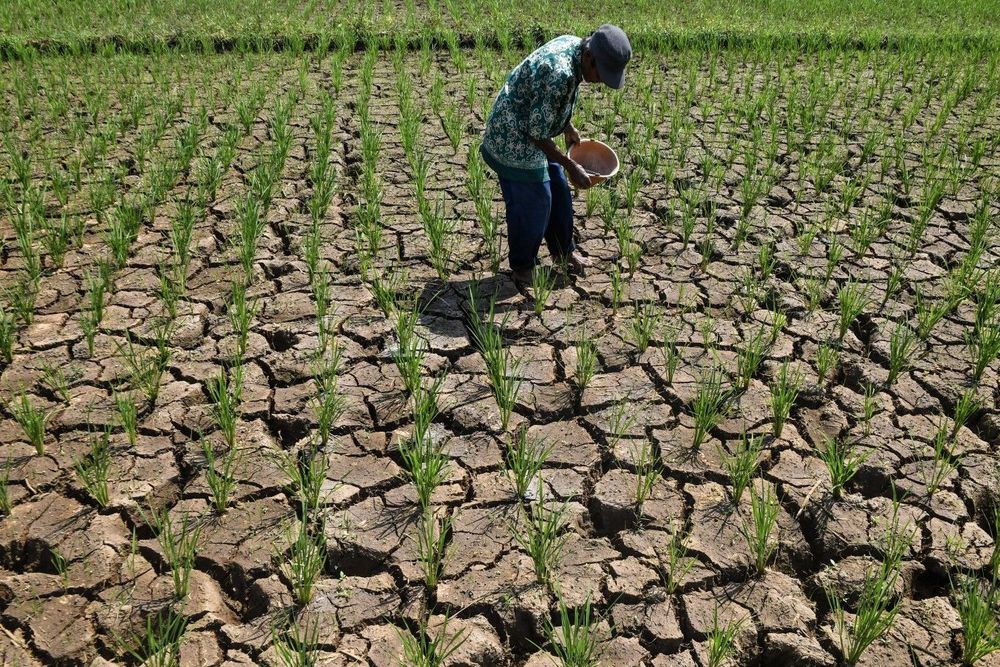
The prolonged dry conditions have triggered widespread impacts. By late July, drought had affected 214,381 people in West Java, disrupting access to clean water. More than 7,100 households struggled with water access in early July across drought-stricken areas including Cilacap, Klaten and Jepara in Central Java; Bantul in Yogyakarta; and Karawang, Tasikmalaya and Sukabumi in West Java.
Indonesia's Ministry of Public Works was addressing drought conditions in 492 locations across the nation as of August 2026. The government responded with weather modification operations, generating an estimated 40.52 million cubic meters of rainfall across Aceh and Palembang through late July.
Fire risk has escalated alongside water shortages. West Kalimantan recorded 28,680 hectares of burned land and approximately 200 hotspots across 12 regencies by late July. Nationwide, forest fire hotspots surged to 1,612 in August, up sharply from 758 in July — already the highest August figure in three years. Outbreaks typically peak in September.
Climate compound effect threatens crops
A positive Indian Ocean Dipole (IOD) phenomenon occurring simultaneously with El Niño can strengthen the impact on reduced rainfall, as both phenomena suppress precipitation in Indonesia. This compound climate threat mechanism intensifies drought severity beyond what either phenomenon would cause alone.
Water shortages pose direct threats to agricultural output. Strong El Niño conditions could suppress food production by increasing crop failure risk, particularly in eastern Indonesia. Second-season rice output is projected to decline 2.6 percent nationwide. Reduced productivity, smaller planting areas, and higher production costs threaten key rice-producing regions across Java, Sumatra, and Kalimantan. Supply declines could drive food prices and inflation higher, weaken purchasing power among vulnerable households, and increase demand for subsidies, social assistance, or imports.
High reserves fail to stabilize prices
Indonesia's national rice reserves reached a historic high of 5.37 million tons in May 2026, forcing the government to rent external storage space for 2.3 million tons beyond Bulog's standard 3-million-ton warehouse capacity. Government rice reserves increased from 3.25 million tonnes earlier in 2026 to around 5.3 million tonnes. Yet wholesale rice prices climbed from Rp 14,218 per kilogram at the beginning of the year to Rp 14,783 in July. Rice contributed 2.88 percent to Indonesia's annual inflation that month.
The government allocated Rp 22.7 trillion (US$1.6 billion) to Bulog through the 2026 state budget, alongside Rp 5 trillion to construct 100 new warehouses. However, rice quality deterioration remains a challenge as rice typically has a storage life of only four to six months, raising questions about the effectiveness of large-scale stockpiling strategies.
Production outlook remains uncertain
Rice production for January–September 2026 is estimated to increase only marginally, by 0.01 percent year-on-year, to 28.71 million tonnes. Output during July–September could decline 0.88 percent from the previous year due to drought, pests, flooding, and shifts in harvest timing across key production centers.
The sector's weather dependence remains a structural vulnerability. Rice production fell from 31.1 million tonnes in 2023 to 30.62 million tonnes in 2024 as El Niño and drought disrupted output. Imports surged to 4.52 million tonnes that year, primarily from Thailand, Vietnam, Pakistan, and Myanmar. Production recovered 13.29 percent to 34.69 million tonnes in 2025, while imports fell sharply to approximately 450,000 tonnes. Yet future production disruptions could again increase Indonesia's import reliance as demand continues rising.
Indonesia's per capita rice consumption was approximately 81.23 kg per year in 2023, with some estimates placing it around 185 kg per person annually, making Indonesia one of the world's highest per-capita rice consumers. This high consumption rate underscores why supply disruptions and price increases carry significant implications for food security and poverty.
Conflicting production forecasts
The outlook for rice production varies significantly across institutions. The Food and Agriculture Organization (FAO) projects rice production to increase from 34 million tonnes in 2024–2025 to 38.5 million tonnes in 2025–2026 and 38.6 million tonnes in 2026–2027. The US Department of Agriculture (USDA) forecasts only 33.8 million tonnes in 2025–2026, declining to 33.4 million tonnes in 2026–2027. The Agriculture Ministry targets 34.77 million tonnes and 34.83 million tonnes in 2026 and 2027, respectively. Statistics Indonesia (BPS) estimates rice production at 21.95 million tonnes for January–July 2026, down 0.35 percent from the same period in 2025.
One factor that could narrow this gap is the government's New Rice Field Development program, which aims to add 225,000 hectares of new rice fields in both 2025 and 2026. Assuming productivity of 5.32 tonnes of unhusked rice per hectare and two planting seasons, the additional fields could generate an estimated 3.06 million tonnes of rice. Combined with 2025 production, total output through the end of 2026 or early 2027 could reach 37.75 million tonnes, bringing production closer to FAO projections.
The current situation reveals persistent vulnerabilities in Indonesia's rice supply chain despite government efforts to achieve self-sufficiency. Weather-dependent production, infrastructure constraints, and quality deterioration challenges continue to test the sustainability of rice security policies amid intensifying climate pressures.