From donations to finished goods
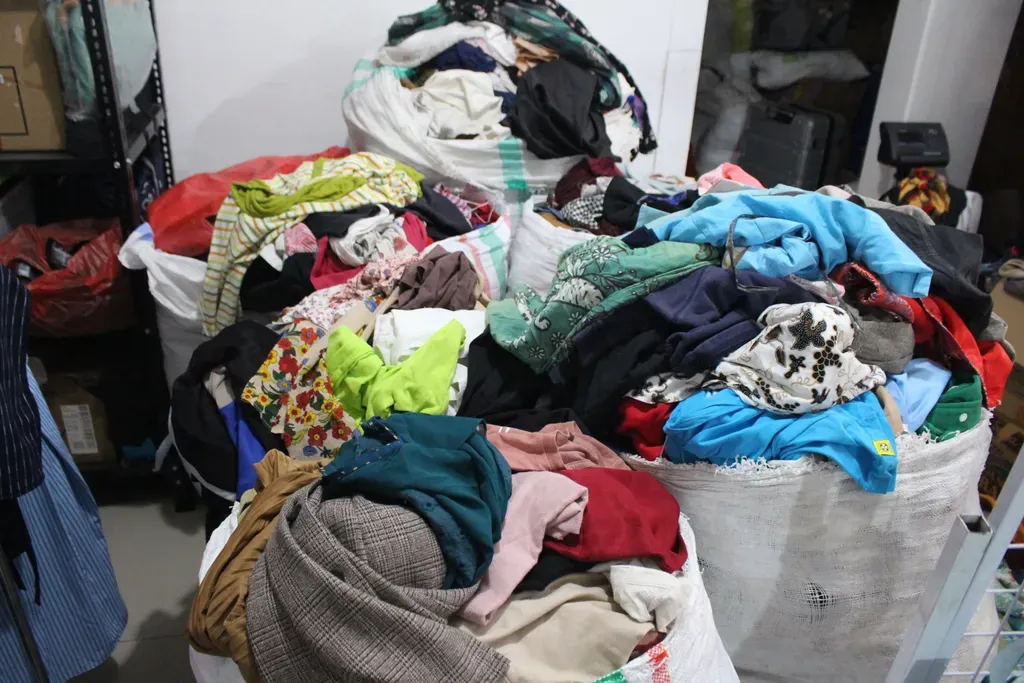
Bersibersi Lemari receives one to two tons of donated clothing each month, with shipments coming from across Indonesia, including Aceh, Riau and Bali. The community accepts donations daily; its earliest contributions came from relatives and neighbors.
At its production house in Pulogadung on Tuesday, October 27, 2026, Dermawan worked at one of three sewing machines arranged along a table while Adinda cut patterned fabric. Both are 21. The premises also serve as the office of the Teman Hebat Berkarya Foundation, which guides the upcycling work.
"They are individuals with disabilities whom we support. Here, they sew donated clothing into new creations for resale," said Engkris, a member of the Bersibersi Lemari management team.
The team sorts incoming garments according to how they can be used. Clothes suitable for immediate wear are packed for distribution to areas needing social assistance. Other good-quality pieces become products such as tote bags, coasters and accessories. Items that qualify for neither distribution nor recycling are resold, with all proceeds supporting operations and educational expenses for children with disabilities in the community's care.
Responsibility beyond the purchase
Founder Aisyah Winna Putri established the community out of a belief that people's responsibility for clothing continues after they stop wearing it, rather than ending at the checkout.
"People often forget that unused clothes are also waste that pollutes the earth. We shouldn't be so busy buying new ones that we forget to think about where the clothes will go when we no longer want to wear them," Engkris said.
A 2025 circular-textile policy report from the Indonesia Circular Business Platform, or C4RB, puts the country's annual textile waste at more than 2.3 million metric tons. Most is burned or sent to landfills. The report cites a projection by the Ministry of National Development Planning, known as Bappenas, that the total could reach 3.5 million metric tons by 2030 without intervention.
National targets and import restrictions
Textiles and apparel are among five priority sectors in Indonesia's National Circular Economy Roadmap and Action Plan for 2025–2045, launched in 2024. According to C4RB, the roadmap sets targets for 2050 of reducing material use by 28% and greenhouse gas emissions by 39%.
Indonesia also prohibits used-clothing imports under Trade Minister Regulation No. 47 of 2025 on prohibited import goods. The restriction applies to used clothing classified under HS code 6309.00.00.
Trade Minister Budi Santoso said on February 4, 2026, that the ban addresses public-health concerns, protects domestic micro, small and medium enterprises, and seeks to prevent Indonesia from becoming a major destination for textile waste, ANTARA News reported.
Finding another wearer
For Cynthia Lestari, 31, founder of Lyfe with Less, unwanted clothing does not necessarily need to become a craft project or a donation. Her community's Bersaling-Silang program offers another route: exchanging gently used garments.
The program has held more than 100 events in major cities across Indonesia, attracting hundreds and sometimes thousands of participants. Some bring purchases that never fit; others have changed body shape or no longer like a garment's style.
"Clothes that are no longer worn don't always have to be thrown away or donated. There are many more thoughtful distribution channels, and swapping clothes is one way to take responsibility for what we've purchased," Cynthia said.
Passing on, altering and repairing
Siti, 47, a resident of Kebayoran Baru in South Jakarta, passes unused clothes or items that have become too small to close family members and relatives. She sees no need to go through an organization for every donation. Her child also cuts and re-sews old garments into different styles that can be worn again.
"Clothes are still in good condition, so it's a shame to throw them away. They should still be useful to others," Siti said.
Before clothing needs to be donated, exchanged or recycled, repairing damage is another simple way to keep it in use.