Public confidence and growth ambitions
An early October 2026 survey by Saiful Mujani Research and Consulting (SMRC) put Prabowo's approval below 50 percent for the first time since his October 2024 inauguration. The latest reading followed 81.2 percent in November 2025, 66.4 percent in March 2026 and 51.1 percent in July.
SMRC linked the decline to increasingly unfavorable views of the economy, politics and law enforcement. Roughly one-third of respondents pointed to rising prices for necessities, against a backdrop of expensive welfare initiatives including the Free Nutritious Meals program and the Red and White Cooperatives.
Prabowo campaigned on better jobs, affordable housing and adequate food for children, alongside national self-sufficiency in food and energy. His economic pledge was growth of 8 percent. Fitch Ratings' latest forecasts remain well below that goal: in an Oct. 21 statement, it projected growth near 4.9 percent for both 2027 and 2028, or about two-thirds of the target.
Fitch raised its 2026 forecast from 4.7 percent to 5.2 percent but said reaching Prabowo's goal while preserving macroeconomic and financial stability would be difficult without substantial reforms and high-quality job creation. The Jakarta Post's analysis raises a related question about spending: whether fulfilling campaign commitments is taking precedence over evidence of effectiveness and more urgent needs.
Free meals: spending, safety and budget cuts
The Free Nutritious Meals program had reached about 57 million recipients by September 2026, with cumulative spending of Rp 204.7 trillion since its 2025 launch. Figures presented in Parliament, however, recorded 50,059 cases of food poisoning after recipients ate the meals through September.
The government had already scaled back the program's annual allocation. Reuters reported that the original 2026 budget of Rp 335 trillion fell to Rp 268 trillion in May and then to a provisional Rp 229 trillion, about US$12.8 billion, as of July 21. Officials left open the possibility of further reductions.
The National Nutrition Agency said fewer people would receive meals and that Prabowo was no longer pursuing a fixed recipient target. It described quality, with the aim of stopping food poisoning, as the priority.
Questions about the evidence and oversight behind the program predate those cuts. In February 2025, the Center for Indonesia's Strategic Development Initiatives (CISDI) said the impact assessments and cost-benefit studies from trials conducted in 2024 were not publicly available. Separately, Indonesia Corruption Watch found political affiliations at 28 of the 102 partner foundations it reviewed, prompting concerns about possible conflicts of interest. As The Jakarta Post's analysis notes, enrollment figures alone do not demonstrate that meals are safe or that nutrition has improved.
Cooperative openings follow delays
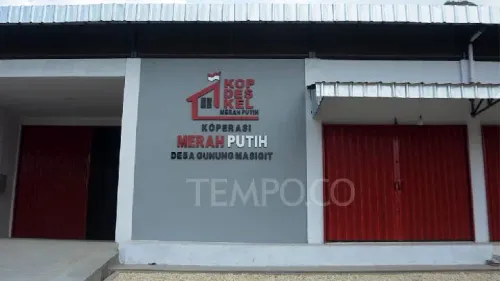
The financing of the Red and White Cooperatives differs from direct government spending on meals. Agrinas estimated that bank borrowing used to construct and equip village cooperatives had reached Rp 106 trillion.
A September 2026 report by the Institute for Economic and Community Research at the University of Indonesia's Faculty of Economics and Business (LPEM FEB UI) described loans of Rp 3 billion from a state-owned bank for each cooperative built, with a 6 percent interest subsidy. Repayments were to come from village funds allocated through the state budget.
About 83,000 cooperatives had acquired legal status following Presidential Instruction No. 9 of 2025, the report said. Operational deadlines had slipped repeatedly, including the original goal of full operation by March 2026. By late September, the government was still addressing management appointments and arranging supplies for completed outlets.
Kompas.id reported that 10,070 Red and White Village/Urban Cooperatives began operating simultaneously across Indonesia as of Oct. 15, out of approximately 28,000 with completed physical outlets. Coordinating Minister for Food Zulkifli Hasan said construction was expected to reach 35,000 units by the end of 2026 and 80,000 by 2029.
Zulkifli also said the cooperatives would distribute 1 million tons of rice assistance to 33.2 million people for October through December 2026. Beyond construction, The Jakarta Post's analysis identifies demand, dependable distribution and capable management as requirements for viable businesses. It warns that expansion without those foundations could leave taxpayers bearing the costs of failures and remedial work.
What competing services could cost
To illustrate the competing demands on public funds, The Jakarta Post used government cost benchmarks to estimate what roughly Rp 20 trillion could provide: rehabilitation of 10,000 schools, upgrades of 20 regional hospitals to Class C standards and four-year scholarships for 50,000 undergraduates.
The scholarship calculation allowed Rp 8 million in tuition per semester and Rp 1 million a month for living expenses. The hospital estimates did not include additional land, staffing or operating costs.
Adding another Rp 20 trillion, equivalent to the additional support approved for BPJS Kesehatan, would still put the combined estimate at around one-fifth of cumulative spending on free meals. The comparison illustrates the scale of alternative needs rather than a fully costed replacement plan. The analysis argues that an electoral mandate does not remove the need to justify further program expansion.
Preparedness cuts and unfinished recovery
Disaster preparedness provides another measure of those budget choices. In February 2025, the National Disaster Mitigation Agency (BNPB) warned that cuts would shrink its planned purchases of response equipment and vehicles to 235 units from 1,850. Its budget for 2026 was subsequently set at Rp 491 billion, compared with Rp 2.01 trillion a year earlier, far below the budgets assigned to the flagship programs.
Emergency funds are available separately, but the analysis distinguishes financing a response from having equipment ready before a disaster. Recovery also remained incomplete: as of Oct. 5, construction had finished on 2,085 of the 57,027 permanent homes planned across Aceh, North Sumatra and West Sumatra. An eruption of Anak Krakatau in September brought further disruption.
Forest and peatland fires in Sumatra and Kalimantan continued into October after exposing communities to hazardous smoke for months. Hundreds of thousands of people experienced respiratory problems. Discussions about foreign assistance were still underway in mid-October, weeks after Malaysia offered firefighting aircraft and personnel.