
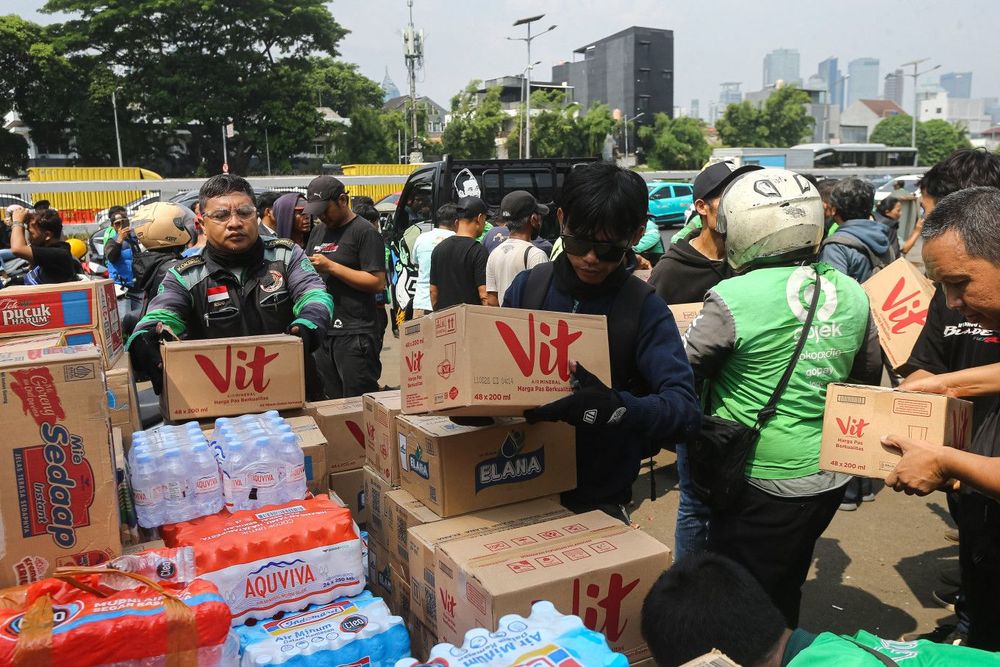
Thousands converge on Jakarta demanding asset forfeiture law and tougher corruption penalties
Thousands of demonstrators descended on the Senayan Legislative Complex in Central Jakarta on Thursday morning, demanding swift passage of an asset forfeiture bill and stronger measures against corruption, including the death penalty for corrupt officials and lower prices for essential goods.
The protests drew participants from across the country, with a significant contingent from Pati regency in Central Java—a district of approximately 1.3 million people located some 400 kilometers east of Jakarta. Members of the United Pati People's Alliance (AMPB) organized the mobilization, coordinating buses for the eight-to-ten-hour journey to the capital.
The asset forfeiture bill, which has been pending in Indonesia's 580-member House of Representatives for several years, would allow the state to seize assets acquired through criminal activities, including corruption, without requiring a criminal conviction. The legislation represents a key demand of anti-corruption advocates seeking to strengthen enforcement mechanisms.
Obstacles and public support
Authorities attempted to impede the protests through various measures. Police stopped several buses carrying demonstrators en route to Jakarta, while Bank Mandiri—Indonesia's largest state-owned bank with assets exceeding 1,900 trillion rupiah ($119 billion)—temporarily blocked an account belonging to AMPB coordinator Supriyono. The account freeze sparked widespread public anger and calls to boycott the state-owned lender.
Despite these obstacles, the movement persisted.
Five additional buses were expected to arrive in Jakarta on Wednesday night thanks to donations from the public,
Public contributions enabled the group to continue mobilizing supporters after the initial disruptions.
Security response and traffic disruptions
Beginning early Thursday, authorities implemented extensive traffic diversions around anticipated protest zones. Police blocked both lanes of Jalan Gatot Subroto—one of Jakarta's main arterial roads connecting the central business district and major government areas—from Senayan Park to the legislative complex entrance. The closure affected tens of thousands of daily commuters who rely on this critical thoroughfare.
Dozens of security personnel were deployed throughout the area. Jakarta Police spokesperson Sr. Comr. Budi Hermanto said previously that at least 500 people were expected to participate, though the number could increase as groups from beyond Pati joined the demonstrations.
Context of corruption concerns
The protests occur against a backdrop of persistent corruption challenges in Indonesia, which ranks 115th out of 180 countries in Transparency International's 2025 Corruption Perceptions Index with a score of 34 out of 100. The demonstrations also come as President Prabowo Subianto, who took office in October 2024, faces pressure to deliver on campaign promises to combat corruption and improve government accountability.
The Indonesian Corruption Eradication Commission (KPK) has investigated and prosecuted over 1,200 corruption cases since its establishment in 2003, achieving a conviction rate exceeding 80 percent. However, the anti-corruption body has faced increasing limitations to its authority following legislative changes in 2019, fueling concerns about the weakening of institutional safeguards.
Mass mobilization around governance issues carries particular resonance in Indonesia, where the 1998 reformasi movement—driven by widespread protests—led to the resignation of President Suharto after 32 years in power, establishing a lasting precedent for citizen action on anti-corruption and accountability matters.