A concert built around exchange
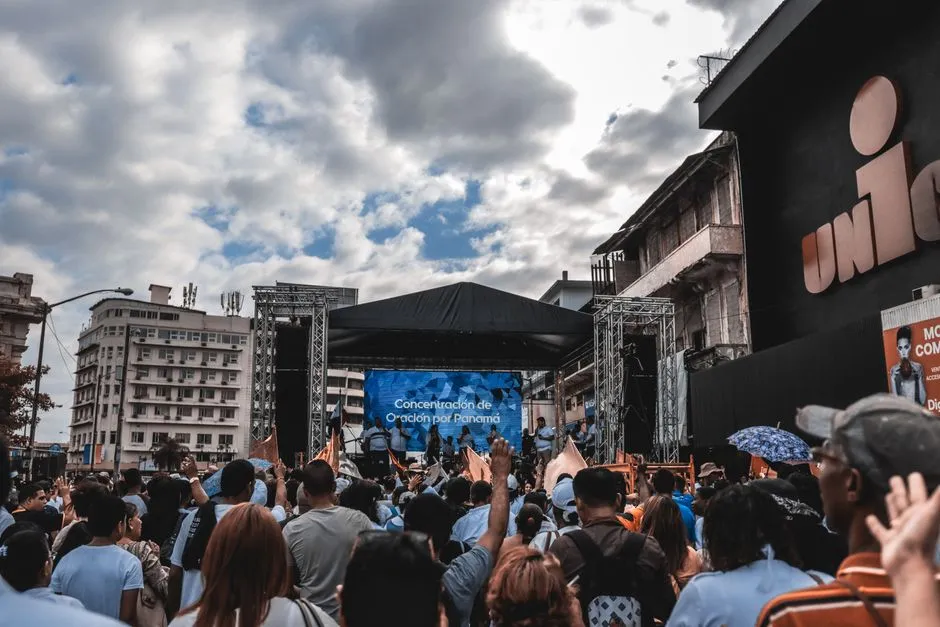
The show at Plaza Kalibaru in Cilincing was Dongker's third in a series of public-space gigs. Thousands stayed when a generator caught fire during the set, lighting the musicians with their phone flashlights as the band switched to an acoustic performance.
The event collected 4,000 books for distribution to the local community. The rice went to communities with a waste bank, where it would be exchanged for plastic waste.
Jim Alberka of the Dago Elos Resistance Forum helped develop the format. He said Dongker wanted to avoid the "Santa Claus trap": treating those who give as morally superior to those who receive.
The band's performances have long carried anti-institutional messages. Vocalist and guitarist Delpi Suhariyanto told The Jakarta Post that he often uses forceful language onstage to urge audiences not to pay taxes to a government he considers corrupt.
From Bandung's art school to eviction sites
Students at the Bandung Institute of Technology's School of Art and Design (FSRD ITB) formed Dongker. Its name combines "Bodong Kekar," conveying musicians who are new to the scene but determined to be resilient, according to a press release from Universitas Padjadjaran's Communication Science Study Programme.
The release traces the band's identity in part to Bandung's Tamansari conflict, a 2017-2019 dispute over a low-cost apartment project. Residents of RW 11 in Tamansari Urban Village, Bandung Wetan District, opposed the city government in that conflict. Dongker played "Tuhan di Reruntuh Kota" at the eviction site and later performed "Bertaruh pada Api" on the online platform Roblox.
Unconventional venues also accompanied the band's second album, "Melankolia Radikal." According to JUICE, Dongker previewed the record with "Melankolia di Kolong," a showcase at Taman Skateboard under Bandung's Pasupati Flyover, and later played to 4,000 people beneath a bridge in Yogyakarta.
Released Aug. 28, 2026, the 11-track album explores what the band calls "deep-rooted sadness."
Politics without a formal organization
Such activity sits alongside the street demonstrations through which many young Indonesians press their demands on the government. Decentralized movements and cultural outlets can help young people articulate political positions and understand politics, although experts say further work is needed to achieve systemic change.
The label "rhizomatic movement," or "gerakan rimpang" in Indonesian, draws on a concept coined by French philosophers Gilles Deleuze and Félix Guattari. As The Straits Times reported, University of Amsterdam scholar Dr. Yatun Sastramidjaja applied it to Indonesian youth activism in a 2025 Journal of Youth Studies article.
Her account described young people choosing small, informal collectives rather than established youth and student organizations, reflecting resistance to formal structures, hierarchy and membership that excludes others.
Pressure on protest and cultural expression
These forms of political expression operate amid narrowing civic space. The CIVICUS Monitor has classified Indonesia's civic space as "obstructed" since 2018. In July 2025, it placed the country on its Watchlist for rapidly deteriorating conditions, citing attacks on media freedom, protest crackdowns and the targeting of human rights defenders under President Prabowo Subianto.
In December 2025, Amnesty International Indonesia reported that at least 5,538 people exercising their right to peaceful assembly that year had faced arbitrary arrest, violence or exposure to tear gas.
Music has also faced pressure. According to the CIVICUS Monitor, Indonesian punk band Sukatani publicly apologized in January 2025 and removed "Bayar Bayar Bayar" ("Pay, Pay, Pay") from online platforms. The song criticized police corruption; many observers believed police pressure was behind the apology and withdrawal.