
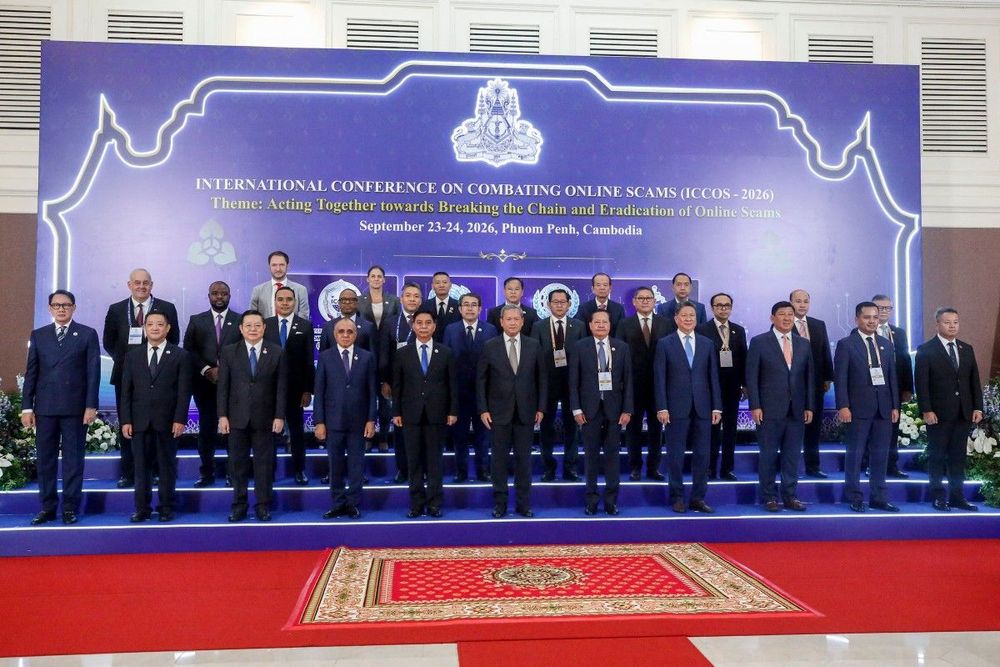
Indonesia calls for faster international response to combat transnational scam networks
Indonesia has urged nations to strengthen cross-border coordination in combating the illegal online scam industry, declaring its readiness to collaborate with organizations including the International Criminal Police Organization (Interpol) to address networks that now operate across multiple countries.
The call came during the International Conference on Combating Online Scams held in Phnom Penh from September 23 to 24, where representatives from 28 countries, including ASEAN member states, convened to discuss strategies for disrupting transnational scam operations.
Deputy Foreign Minister Arif Havas Oegroseno emphasized the urgency of matching the speed at which criminal networks operate.
We're not fighting individuals. We're fighting a network, and a network can only be beaten by a faster network,
Cambodia emerges as regional scam hub
The conference took place in Cambodia, which has emerged as a significant hub for cyber-scam operations in Southeast Asia. According to UN reports from 2023, at least 120,000 people may be trafficked into scam compounds across Myanmar, Cambodia, and Laos. Cambodia responded to international pressure by enacting the Law on Combating Cyber-Enabled Human Trafficking in August 2024, establishing penalties of up to 20 years imprisonment for operating such compounds.
Proposed solutions and mechanisms
Indonesia proposed establishing a specialized mechanism to facilitate better information exchange between countries, pursue asset recovery, and protect victims. The delegation noted that scam operations have evolved into complex forms of organized crime, involving recruiters, operators, technology providers, money mules, and launderers spanning multiple jurisdictions.
Growing scale and sophistication
The scale of the problem has grown dramatically. Global financial losses from online scams reached an estimated $1 trillion annually as of 2023, according to the Global Anti-Scam Alliance. Indonesia itself reported over 1.1 million cybercrime cases, including online scams, in 2023, marking a 40 percent increase from the previous year, according to the Ministry of Communication and Informatics.
The sophistication of these operations continues to advance. The UN Office on Drugs and Crime reported in September 2024 that scam networks now employ artificial intelligence for voice cloning and deepfake technologies, making schemes increasingly difficult to detect and prosecute.
International cooperation efforts
Indonesia called for enhanced coordination between national authorities, ASEAN, the United Nations Office for Drugs and Crimes, Interpol, and the broader international community. The country pointed to existing cooperation models, such as Interpol's Operation Storm Makers launched in 2023, which coordinated actions across 27 countries and resulted in nearly 3,500 arrests related to cyber-enabled fraud and human trafficking for online scam operations.
The transnational nature of the threat affects citizens across the region. The Philippine National Police reported in July 2024 that they rescued over 2,700 foreign nationals, including Indonesians, Malaysians, and Vietnamese, from illegal online gaming and scam operations in the first half of 2024 alone.
While ASEAN established a Ministerial Declaration on Preventing and Countering Trafficking in Persons in 2015, enforcement mechanisms remain weak across member states, highlighting the need for new approaches to regional cooperation.
At a separate conference session focused on treating the online scam industry as a global emergency, Havas stressed the need for mechanisms enabling timely responses.
Criminals move in a matter of minutes,
must be able to match their speed.