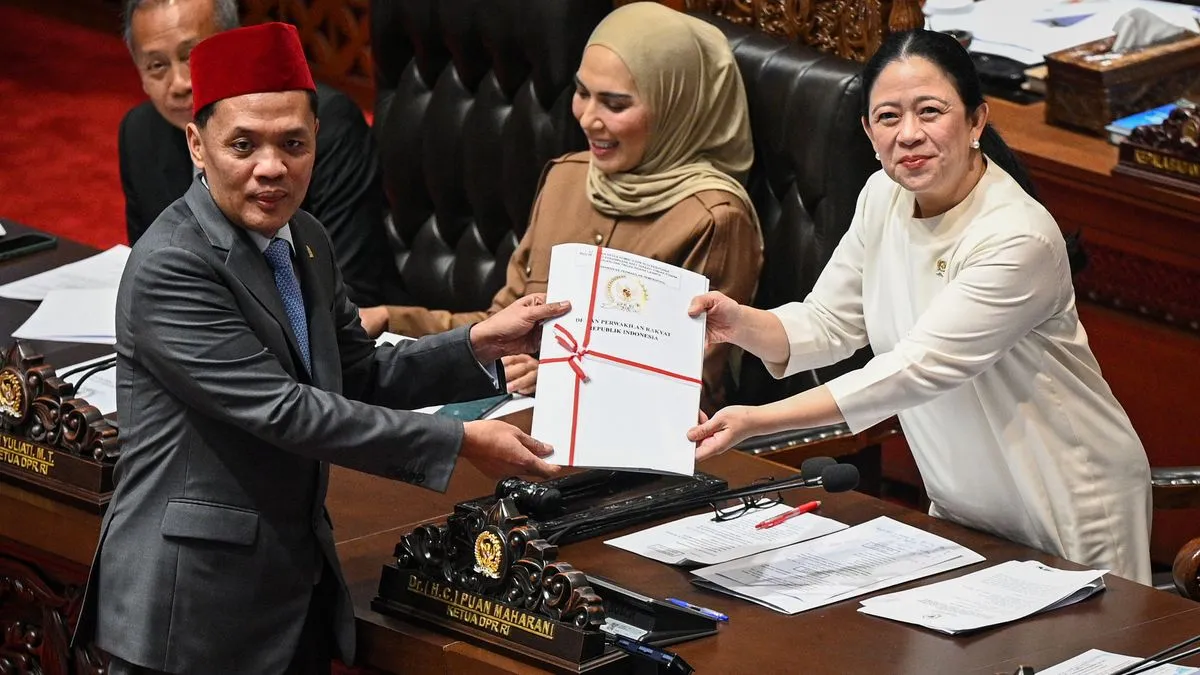
A new route to recover criminal assets
The law expands the focus of criminal enforcement beyond punishing offenders to recovering wealth linked to their crimes. The government, the Corruption Eradication Commission (KPK) and the Financial Transaction Reports and Analysis Center (PPATK) support it as a way to tackle economic crimes that have proved difficult to pursue when suspects flee or hide their assets.
Its non-conviction-based forfeiture mechanism allows the state to bring in rem proceedings directed at property, rather than wait for a criminal conviction against its owner. Under that framework, preliminary evidence of unexplained wealth can support freezing and seizure, while owners face a limited requirement to demonstrate that their assets came from lawful sources.
The mechanism applies only to assets valued at 1 billion rupiah or more, roughly US$55,000, under Articles 6 and 7, according to state news agency Antara.
The law will take effect 12 months after promulgation. Implementation also depends on the creation of an asset management agency and an independent supervisory body. Article 72 limits forfeiture and asset management under the law to offenses committed after it takes effect, excluding assets from older corruption cases from the new mechanism.
The Business Times reported that the final bill text was not yet publicly available when lawmakers passed it on November 19. Such texts are typically published during the following week.
Offenses covered and potential compensation
According to The Business Times and Media Selangor (Bernama), the law reaches beyond corruption to cover narcotics trafficking, terrorism financing, human trafficking, arms smuggling and large-scale fraud involving information technology. Its scope includes fraudulent investment schemes, illegal share trading, online gambling and cryptocurrency schemes, as well as Hajj and Umrah travel scams.
For victims of fraudulent investments and illegal share trading, the framework could provide a direct route to compensation from the sale of perpetrators' confiscated assets. The Business Times reported that those proceeds could go to victims rather than being transferred to the state without necessarily reaching the people who suffered losses.
Civil society challenges the law's protections
The Indonesian Legal Aid Foundation (YLBHI) warned that authorities would receive extensive powers to locate assets, seize property, require documents and manage confiscated holdings without comparable protections against misuse.
Indonesia Corruption Watch (ICW) raised three objections to the legislation: it omits illicit enrichment provisions sought by the KPK; it cannot be used to recover state losses from corruption offenses committed before the law takes effect; and it leaves institutional arrangements for managing confiscated assets to presidential regulations under direct presidential control.
ICW's Ibrahim described the result as "a false asset confiscation law," arguing that its substance differs substantially from the original 2023 draft.
Limits of existing oversight
A Kompas.com analysis identifies a broader concern behind those objections: extensive state powers can expose citizens to procedural abuses when safeguards are weak. Constitutional law specialists and court-monitoring groups have repeatedly pointed to the restricted authority of the National Police Commission (Kompolnas), the Prosecutorial Commission and the KPK Supervisory Board.
Those bodies generally monitor conduct and issue ethics recommendations. They do not have direct power to overturn improper asset freezes or seizures during investigations.
The analysis also points to past controversies involving officials' misuse of legal tools, including illegal wiretapping that reached senior officials and even the president. It argues that failures of internal and judicial oversight can turn enforcement powers into instruments of pressure, and that unresolved accountability gaps in wiretapping underscore the need for multiple layers of control over asset freezes.
Other countries facing integrity problems in law enforcement offer examples of procedural restrictions and checks between institutions intended to reduce arbitrary forfeiture. Under the Philippines' Anti-Money Laundering Act, police and investigators cannot freeze accounts on their own. Only the Court of Appeals can issue a freeze order, which initially lasts 20 days before formal review.