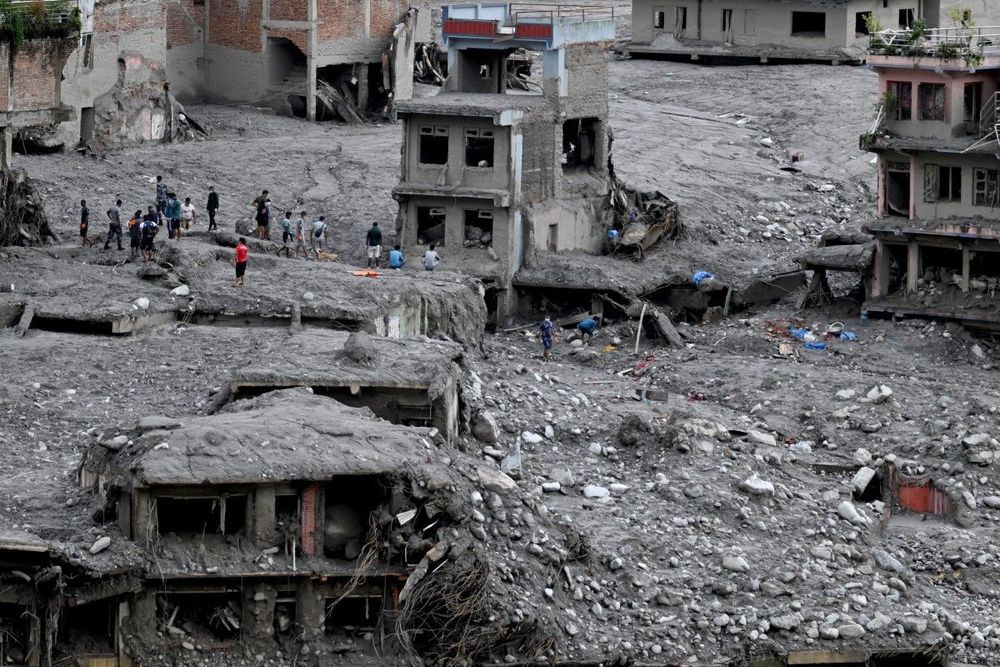
Nepal disaster toll climbs past 900 as rescuers battle through debris for sixth day
Rescue operations entered their sixth day on Monday as teams battled through mud and debris following the catastrophic glacial floods that have claimed at least 939 lives across Nepal and Tibet, with the number of missing people soaring to nearly 4,500.
The disaster, which Prime Minister Balendra Shah described as "unimaginable and heartbreaking," began Wednesday when a glacial collapse on the China-Nepal border unleashed a tsunami-like wave of freezing water, rocks and debris that smashed through villages and towns. At least 17 bodies have also been recovered from rivers downstream in India.
Unidentified bodies are being buried in mass graves after DNA sampling, as mortuaries overflow with victims. In Chitwan district, army personnel carried blue body bags from rubber dinghies up river banks, placing them in rows along dirt roads.
Race to save trapped workers
Rescue teams face a desperate race against time to reach approximately 100 hydropower workers believed trapped in multiple tunnels. The disaster has damaged or destroyed 27 hydropower plants, with about 12 facilities completely destroyed. Projects with a combined capacity of 901.1 megawatts—including 431.1 MW of operational capacity and 470 MW under construction—sustained severe damage.
The Upper Trishuli-1 hydropower project, a $647 million Korean-led venture that was 84 percent complete, suffered over 90 percent destruction of its upper dam and base camp. The 216-megawatt facility was designed to supply more than 10 percent of Nepal's electricity.
So far, three bodies have been pulled from two tunnels, with routes blocked by sludge. "We are still hopeful there are survivors inside," said an Indian army officer deployed as part of a specialized tunnel rescue team.
Shibu Giri, a 44-year-old hydropower worker in Rasuwa, counts himself fortunate after a helicopter crew attempted three rescues before finally pulling him free. "My body was stuck in the mud, up to my waist," he told AFP. "I asked them to throw water and food" before his eventual extraction and hospitalization.
Glimmers of hope amid tragedy
Nepal's Home Affairs Ministry reports that 20,600 personnel have been mobilized, with more than 3,100 people rescued from the disaster zone. Army personnel have been unloading bodies from helicopters in Nuwakot and Rasuwa districts.
Amid the devastation, rescuers Friday pulled a six-year-old girl from the mud and reunited her with her parents after police found her crying for her mother. "Her body was trapped in mud, but her head was outside," said Nepali Armed Police spokesman Netra Bahadur Karki. "She is out of danger and recovering at a hospital."
Climate change driving glacial threats
The disaster was triggered by a glacial collapse, according to the US Geological Survey. Scientists say Himalayan glaciers are melting at more than 10 times the rate of previous centuries, with ice loss equivalent to more than a vertical foot and a half annually since 2000—double the melting rate from 1975 to 2000.
"The people of Nepal are one of the major victims of the changing climate and its impact," Foreign Minister Shisir Khanal said.
Since the 1970s, Nepal has experienced 26 glacial lake outburst flood events, with projections indicating rising frequency and intensity under future climate scenarios. The region hosts 47 glacial lakes classified as potentially dangerous, with 21 located in Nepal, according to a study by the International Centre for Integrated Mountain Development and the United Nations Development Programme.
Just over a year ago, in July 2025, a similar glacial lake outburst in the Lhende river near the Nepal-China border caused the Bhotekoshi river to surge, destroying the border crossing bridge and damaging hydropower infrastructure. The Langtang valley region, near the site of the current disaster, previously experienced a major glacier collapse triggered by the 2015 Nepal earthquakes that killed over 350 people.
In 2023, neighboring Sikkim, India, suffered a glacial lake outburst flood when thawing permafrost led to a rock collapse that sent more than 13 billion gallons of water downstream, damaging several dams, more than 25,000 buildings and more than 30 bridges.
Massive aid needs and infrastructure losses
The scale of destruction is enormous, with entire communities swept away. "This is an unfolding disaster," said UN children's fund official Abiodun Banire, noting vast needs for tens of thousands impacted.
Roads have been eliminated, power plants destroyed and dozens of bridges smashed. "There are too many challenges," said police officer E. Hawadi in badly affected Nuwakot district.
Kathmandu has appealed for international support, requesting "more than a thousand" freezer units to store bodies. Nepal has begun burying some of the hundreds recovered after DNA sampling, allowing families to later retrieve remains.
Distraught families watch images of bodies on screens at community centers, attempting to identify loved ones. In Bharatpur, Shobha Adhikary told a coordinator she believed one image showed her childhood best friend. "It looks like him, for sure," she said, displaying a photograph of a smiling, middle-aged man.
Among Nepal's missing are 592 foreigners, including mountain trekkers and Hindu pilgrims who had traveled to Tibet's sacred Mount Kailash.
Questions over China's reporting
In Tibet, largely inaccessible to foreign journalists, Chinese authorities remain the sole information source. More than 2,000 personnel are part of rescue operations there, slowly advancing toward the disaster's epicenter.
China has reported 16 deaths in Tibet with 546 missing. Tibetan advocacy groups in exile have questioned China's account. Tencho Gyatso, president of the International Campaign for Tibet, called for Beijing to disclose "complete and verifiable information about the damage and casualties."
Beijing's foreign ministry said Monday that information release has been "open, transparent and timely," rejecting international reports of underreported deaths.
In riverside villages like Devighat, survivors struggle to salvage belongings from devastated homes as the recovery effort continues.