Smoke remains at fire sites
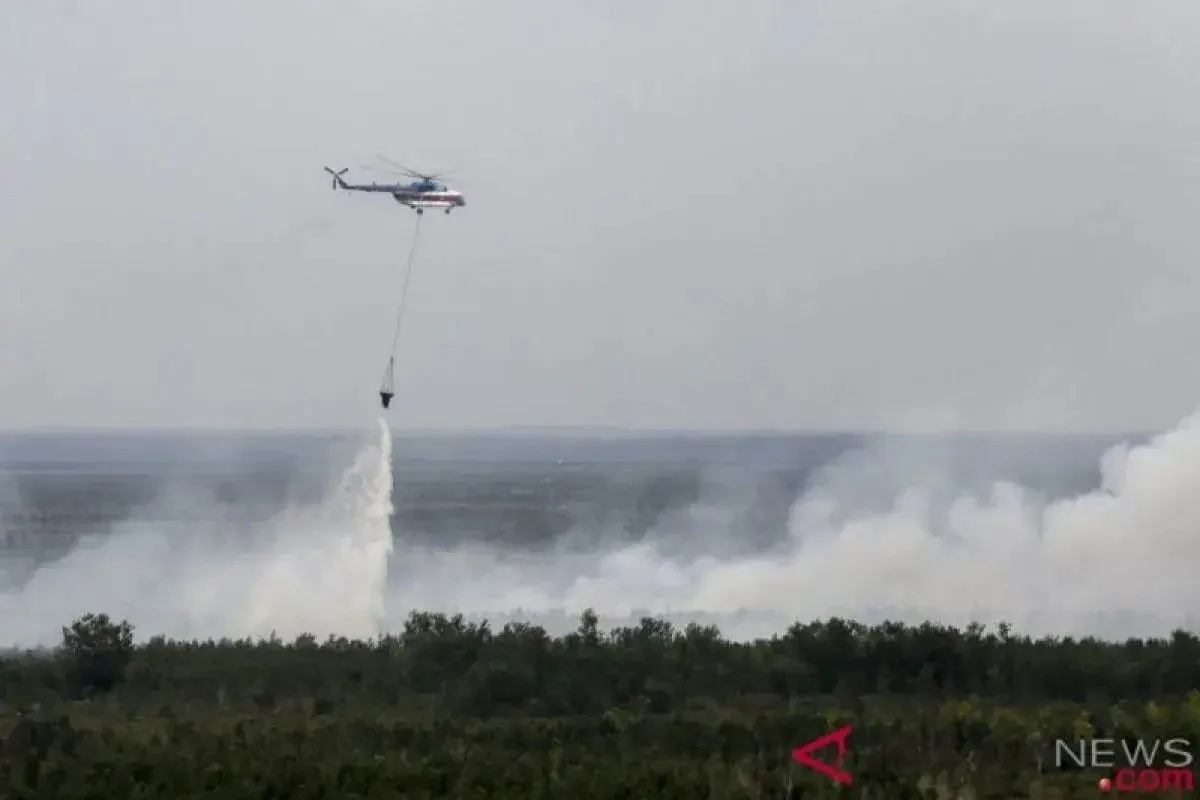
Firefighting records show that the helicopters dropped water 18 times over Cengal, 15 times over Pedamaran and eight times over Sungai Menang. Sudirman, head of emergency response at South Sumatra's Regional Disaster Management Agency (BPBD), described the results on Oct. 30.
"Although dozens of water drops have been carried out, the fires in these three areas have not been fully extinguished. Smoke was still rising from several sites when operations ended," he said.
Crews had brought four hectares under control in Cengal, where the estimated burned area was 10 hectares. In Sungai Menang, three of about eight affected hectares were under control. In Pedamaran, fires had been extinguished across two of the three affected hectares.
Rain had been light and uneven, hampering efforts to put the fires out completely. BPBD said it would keep monitoring and fighting hotspots that were still producing smoke to prevent the fires from growing or spreading.
Rain and falling hotspot counts do not confirm control
The Forestry Ministry has warned that peatland embers can survive and spread underground even after rain. It cited Talang Rimba village in Ogan Komering Ilir as a place where rainfall had not fully extinguished fires.
The ministry said crews must continue patrols, apply water, search for residual embers, and carry out mop-up and cooling work until they can confirm conditions are safe. Rainfall alone does not establish that a fire is under control.
The same caution applies to hotspot data. On Oct. 26, 2026, the ministry recorded 93 high-confidence forest and land fire hotspots nationwide, down from 147 the previous day. Across six priority provinces, the count fell from 26 to 10 as of 9 p.m. local time, including two in South Sumatra. The ministry noted that one fire can produce several hotspot detections and that embers may remain on the ground after the count declines.
Ground crews account for more extinguished area
Earlier figures from Indonesia's National Disaster Management Agency (BNPB) showed the limits of aerial firefighting in South Sumatra. On Sept. 14, 2026, with 404.22 hectares affected, ground teams extinguished fires across about 289.97 hectares, compared with about 30 hectares handled by helicopter water-bombing.
BNPB assessed aerial water-bombing as roughly 10 percent as effective as ground firefighting. Agency head Suharyanto said helicopters had been used optimally and repeatedly, but their very limited firefighting capability meant the results remained suboptimal.
Drought and the wider provincial response
South Sumatra's Meteorology, Climatology and Geophysics Agency (BMKG) attributed the prolonged drought to a strong to very strong El Niño. Most areas had gone nearly 60 consecutive days without rain, while Ogan Ilir had exceeded 81 days. BMKG had forecast natural rainfall only toward the end of October or in early November 2026 and said ground and aerial firefighting needed to continue until the rainy season was established evenly across the province.
The provincial disaster agency's figures for Aug. 23 showed 12,956 hotspots across South Sumatra. Ogan Komering Ilir had the highest count, at 2,435, followed by Musi Banyuasin with 2,139 and Muara Enim with 1,909.
By that date, the province had deployed 11,567 personnel for fire management and conducted four weather-modification sessions. BNPB was providing aerial support with two patrol helicopters and five water-bombing helicopters.
By mid-September, 12 of South Sumatra's 17 regions had been designated priority areas for forest and land fire response. Fires had also spread beyond peatland outskirts into urban areas, including several locations on mineral land in Palembang.
Rp200 billion in presidential assistance
Forestry Minister Raja Juli Antoni said on Oct. 26 that President Prabowo Subianto had disbursed Rp200 billion, about US$11 million, to support South Sumatra's forest and land fire response.
The assistance was distributed in two phases. The provincial government and four districts—Ogan Komering Ilir, Musi Banyuasin, Banyuasin and Ogan Ilir—received the first Rp100 billion, about US$5.5 million. Another Rp100 billion went to 10 additional districts and cities.
The presidential assistance supplements BNPB funding, regional budgets, and the Forestry Ministry's budgets for weather modification and water-bombing.