
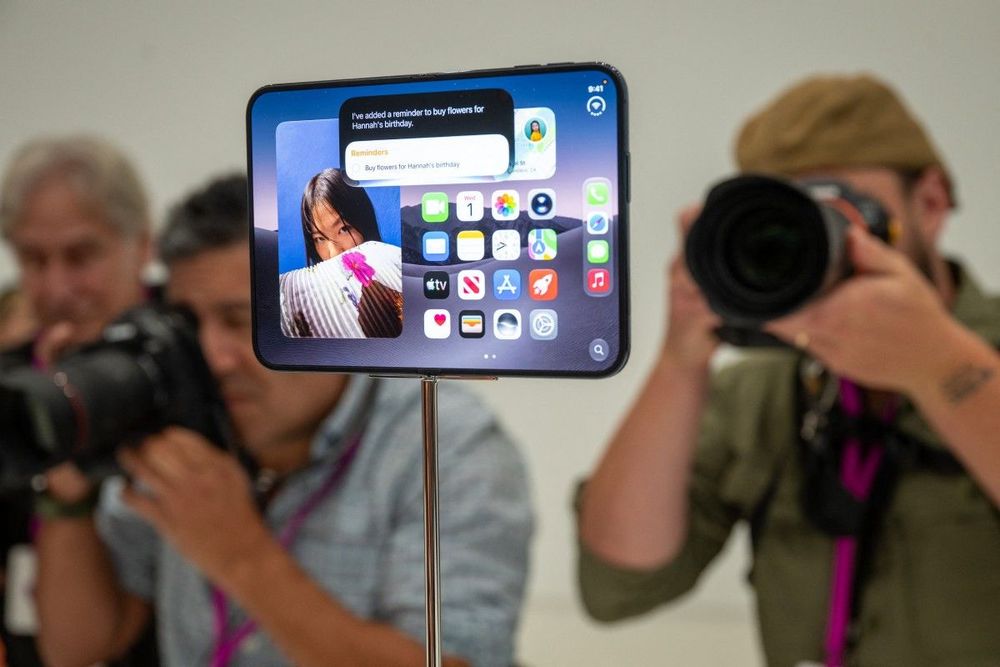
Apple enters foldable phone market with $1,999 iPhone Duo amid questions about target audience
Apple introduced its first foldable smartphone on Wednesday at its Cupertino headquarters, launching the iPhone Duo with a starting price of $1,999 in the United States. Despite showcasing advanced features and artificial intelligence capabilities, industry observers questioned whether the premium device would appeal beyond affluent technology enthusiasts.
The launch event, held at the Steve Jobs Theater in Apple Park, drew a packed audience as executives demonstrated the iPhone Duo running applications including Zoom, Slack and Netflix on an expanded display. The device was positioned as suitable for work, content creation and entertainment purposes.
John Ternus, who became Apple's CEO on September 1 after Tim Cook's 15-year tenure, emphasized the device's expanded display during the presentation. Ternus highlighted how the larger screen, which he described as feeling "as natural and intuitive as iPad," would enable the iPhone Duo to function as a personal AI hub for users. Cook, who led Apple to a $4 trillion market valuation in October 2025, now serves as executive chairman with a focus on engaging with policymakers globally.
"Apple doesn't usually define who the buyer is, but in this case specifically, they really shied away from it," said Carolina Milanesi, an analyst at Creative Strategies.
Industry analysts suggest Apple's brand strength will generate robust initial sales. However, they warn that once the initial enthusiasm subsides, the device's steep price and Apple's ambiguous targeting strategy could limit it to a narrow segment of early adopters—a challenge that has plagued the foldable category since its inception.
Market dynamics and competition
Foldable smartphones represented only 1.6 percent of the overall smartphone market in 2025. Research firm IDC projects foldables will account for less than 3 percent of global smartphone sales in 2026, with modest growth expected in 2027 despite Apple's market entry. However, industry projections indicate global foldable smartphone shipments will grow 20-21 percent year-over-year in 2026, with Apple expected to capture approximately 25-28 percent market share in its first year.
"Definitely there was a little bit of a lapse in positioning," said Neil Shah, vice president of Counterpoint Research. "From our end, it was not clear whether it's for work or play, but I think what iPhone has always stood for is being a versatile device."
Apple's broad marketing approach failed to articulate which customers would pay for a phone retailing at $3,199 for the highest storage configuration. This strategy contrasts with previous Apple product launches that clearly defined their target markets and use cases.
Samsung currently dominates the foldable phone market with 40 percent share, having sold devices since 2019 despite early setbacks. When Samsung launched its first Galaxy Fold in 2019, review units experienced screen failures and breaking displays after just days of use, forcing the company to delay its April 26 launch. The device eventually reached stores in September 2019. Samsung now holds 64 percent of the global foldable market as of the third quarter of 2025, though its share is projected to decline to 32 percent in 2026 as Apple enters the market.
In July, Samsung unveiled a redesigned passport-style foldable phone that has outperformed its predecessors. The company launched a public campaign mocking Apple for "reheating our leftovers" in response to the iPhone Duo announcement. Other manufacturers offering foldable options include Alphabet's Google and China's Huawei.
Challenges of market positioning
When Apple co-founder Steve Jobs introduced the iPad in 2010, he positioned the tablet as a new category for enhanced media and entertainment consumption. By 2015, Apple had repositioned the iPad Pro line as a tool for creative professionals, demonstrating the company's ability to evolve product positioning over time. The Apple Watch similarly evolved from a fashion item to an essential health and fitness companion.
Apple faced positioning challenges in 2023 with its Vision Pro augmented reality headset, priced at $3,500. The device sold approximately 370,000-500,000 units in its first year through 2024, falling short of some expectations. IDC reported the Vision Pro failed to sell 100,000 units in any single quarter since its February 2024 launch. Analysts praised the technology but expressed doubts about its high price and limited use cases beyond entertainment—concerns now echoed with the iPhone Duo.
Technology research firm Omdia forecasts the foldable market will reach 22.3 million units in 2026, marking the largest year-over-year increase in shipments since 2021. This growth surge is primarily attributed to Apple's entry into the category.
Bob O'Donnell, chief analyst at TECHnalysis Research, noted the iPhone Duo's premium pricing narrows its potential audience, particularly among younger consumers. However, he expects devoted Apple customers to drive early sales momentum.
"It'll be something that'll be lusted after," O'Donnell said. "It'll be a status symbol, for a while, because I think it's going to be hard to get."
Counterpoint's Shah estimated Apple would sell approximately 6 million iPhone Duo units by year's end, driven by pent-up demand from existing iPhone users. Those sales alone would give Apple roughly a quarter of the global foldable market, despite questions about long-term adoption beyond the company's loyal customer base.