Review sought before activity begins
Hidayat's request calls for a review of ESDM Ministerial Decree No. 65.K/MB.01/MEM.B/2026. In his November 19 statement, he argued that natural resource use must not come at the expense of ecosystems or species that form part of Indonesia's biological wealth and world heritage.
The Environment Ministry said no mining is taking place in the designated Mining Business Area, known as WUP, and no direct effects on Javan rhinos have been recorded. Hidayat nevertheless wants the surrounding waters excluded to prevent activities, including surveys, that could disturb the animals.
His letter asks the energy minister to revoke the designation if scientific assessments establish that it breaches environmental protection rules or presents unacceptable risks to the conservation area's ecological functions.
Hidayat also said his ministry would exercise its authority over environmental approvals if a mining permit were issued. Referring to Ujung Kulon National Park by its Indonesian abbreviation, TNUK, he said: "Including if PT ANTAM obtains a mining permit in the waters of the TNUK. As Minister of Environment, I will not grant its environmental approval."
Designation does not authorize mining
The Energy and Mineral Resources Ministry, or ESDM, said on November 17 that the national park itself is not designated as a mining area. Only part of the surrounding sea waters is included in the WUP. Ministry spokesperson Dwi Anggia said no mining permit of any kind had been issued for either the park or its surrounding waters.
ESDM described the WUP as a mineral-resource planning designation, not permission to mine. It said the designation neither alters the area's conservation status nor diminishes the park's protective function.
Any mining permit would still have to meet Law No. 4 of 2009 on Mineral and Coal Mining, most recently amended by Law No. 2 of 2025. ESDM said the requirements include conformity with spatial plans, approval of conformity of marine space utilization activities, known as PKKPRL, and environmental approval.
The decree now under review concerns the establishment of mining areas in Banten Province. Energy and Mineral Resources Minister Bahlil Lahadalia signed it, and it took effect on February 12, 2026.
A boundary review and a designation dating to 2017
The Environment Ministry is pursuing a joint spatial and ecological check with other ministries and agencies. The work would compare WUP coordinates against the national park's boundaries, marine conservation areas, Environmental Protection and Management Plan guidelines, known as RPPLH, and land and sea spatial plans. Hidayat offered data, studies and technical advice to support resource-use policies consistent with environmental safeguards.
The park includes substantial marine territory. Its authority's 2025 work-area map records a total area of 105,694.46 hectares, comprising about 61,357 hectares of land and 44,337 hectares of waters. The park authority operates under the Forestry Ministry's Directorate General of Natural Resources and Ecosystem Conservation.
According to ESDM, the designation process began with a 2013 proposal from Banten's provincial government that included a WUP in the province's sea waters. Those waters were left out of Decree No. 1204 of 2014. Banten submitted the area again in a letter dated November 16, 2015.
Part of the waters surrounding Ujung Kulon subsequently became part of the WUP through Decree No. 3672 of 2017 on Mining Areas of Java and Bali. Decree No. 84.K/MB.01/MEM.B/2022 retained the designation. At Banten's request, the 2026 decree repeated it with partial corrections.
Risks to the rhinos' remaining habitat
The Environment Ministry's concern extends beyond the boundaries of individual mining sites. Citing studies of Javan rhinos' specific behavioral and habitat needs, it said protection requires both intact habitat and connections among neighboring terrestrial, coastal and aquatic ecosystems.
Mining could affect those systems through noise and vibration, sediment buildup, pollution, poorer water quality and greater human activity, the ministry said. It cited the area's conservation value and the rhinos' small population as reasons to address those possibilities during planning rather than wait for activity to start.
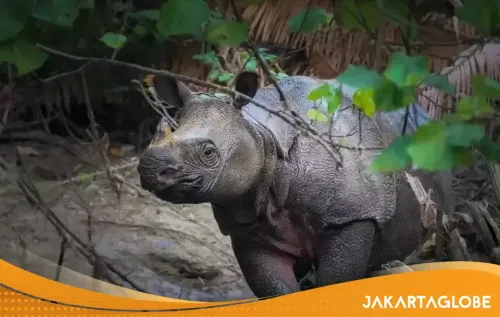
Ujung Kulon is the last natural home of the critically endangered Javan rhinoceros, Rhinoceros sondaicus. A February 2026 assessment by the IUCN SSC Asian Rhino Specialist Group put the surviving population below 50, compared with a previous high of about 76. The group attributed the decline to poaching: 26 animals, roughly one-third of the population, were killed between 2019 and 2023. There is no second wild population or managed breeding population to serve as a fallback.
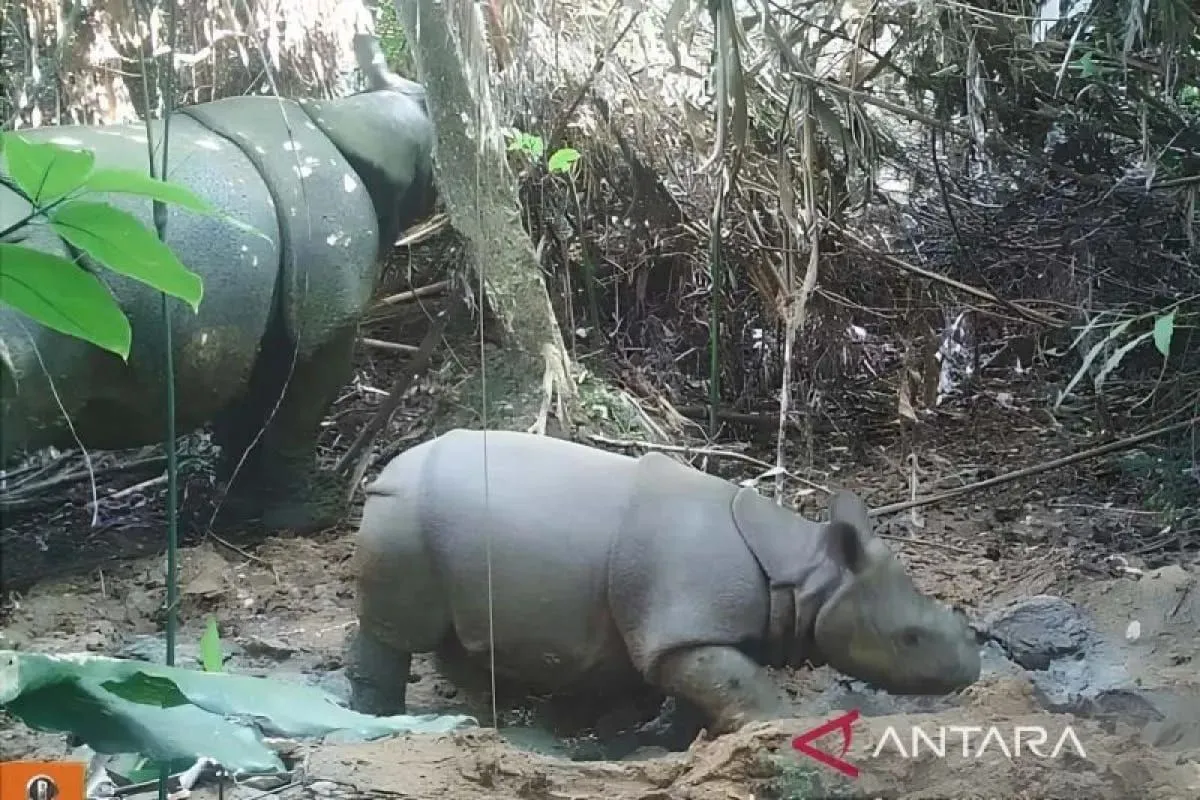
The Forestry Ministry has also reported a healthy calf born in the park on October 10, 2026. Observers saw it wallowing and following its mother, Desy. Monitoring analysis identified the calf as her fifth offspring since 2013, following Arjuna in 2013, Arum in 2015, Hawa in 2018 and Syauki in 2024.
A second habitat remains under study
In a separate conservation effort, the government is considering a second habitat for Javan rhinos and is studying Alas Purwo National Park in East Java. Forestry Minister Raja Juli Antoni said on November 19 that the search reflects threats from volcanic activity, tsunamis, disease outbreaks and inbreeding associated with confinement to a single habitat.
Antoni said Ujung Kulon would remain the species' primary home and that there is no plan to relocate all the rhinos.
The second-habitat proposal has been discussed since the 1980s. Hashim Djojohadikusumo, the president's special envoy for climate and energy, raised it at COP31 in Antalya on November 12, 2026, citing Mount Anak Krakatau.