Challenge centers on local control
The court registered the petition as Case Number 399/PUU-XXV/2026. The petitioners are Sabiq Muhammad, who heads Prawatan Village in Klaten, Central Java; Muhammad Tauhid Aminullah, chair of the Lestari State Edukarya Cooperative; and the Sajogyo Institute.
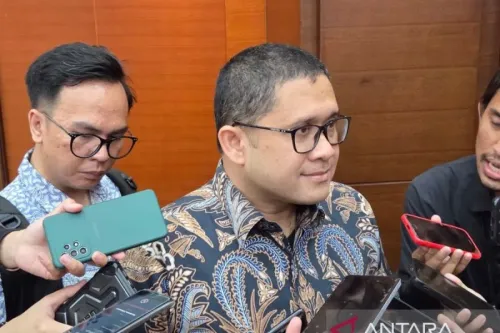
Their legal representative, Muhammad Saleh, said government directives had imposed cooperatives on villages, redirected local funds toward a central government initiative and exposed rural communities to financial risks. He argued that the approach weakened the petitioners' ability to choose local development priorities and infringed on cooperative members' constitutional right to manage their organizations.
"Essentially, we are asking the Constitutional Court to immediately stop the command-style management model for cooperatives currently practiced by the Prabowo-Gibran administration, which violates constitutional mandates and statutory rules," Saleh told reporters at the court in Jakarta.
The challenge covers provisions in three laws: the Village Law, the Cooperative Law and the Law on Financial Relations between the Central Government and Regional Governments (HKPD). It addresses government tasks assigned to villages, priorities for village fund spending, village decision-making assemblies, and the principles and oversight governing cooperatives.
Backing the petitioners is the Coalition to Sue Red and White Village Cooperatives. Its members are the Center of Economic and Law Studies (CELIOS), Themis Indonesia, Indonesia Corruption Watch (ICW), Transparency International Indonesia, Trend Asia and Solidarity of Women New Cooperative Indonesia.
Who should pay for central government assignments?
At the heart of the funding challenge is Article 22, paragraph (2), of the Village Law. Saleh said it requires dedicated funding to accompany government assignments to villages, whereas the cooperative program draws on money villages already use for basic administration.
The petitioners want the court to find the provision conditionally unconstitutional unless it is read to require adequate, dedicated funding from the budget of the authority assigning the task. Under their proposed interpretation, that money must be separate from the core revenues villages use to carry out their autonomous responsibilities.
The financial rules extend beyond the disputed statutory provision. BBC News Indonesia reported that Finance Ministerial Regulation No. 7 of 2026, enacted on February 12, requires 58.03 percent of the Village Fund to go to the Red and White Village Cooperative program. The allocation removed about Rp34.57 trillion from the fund's 2026 ceiling of Rp60.57 trillion, leaving roughly Rp25 trillion for other village needs.
Cooperatives also borrow up to Rp3 billion each from state-owned banks, with a 6 percent interest rate and a six-year term. New Mandala reported that village administrations repay those loans through deductions from intergovernmental transfers: the General Allocation Fund (DAU), Revenue-Sharing Fund (DBH) and Village Fund.
Saleh said the diversion of village money was disrupting public services and infrastructure work. Many village administrations could no longer pay early childhood education (PAUD) teachers, he said, while numerous village-owned enterprises (BUMDes) and local road repair projects had stalled.
Village heads have also protested the funding cuts. Mastur, head of Senggigi Village and chair of Apdesi West Nusa Tenggara, told BBC News Indonesia that reductions across West Lombok Regency averaged 70 to 80 percent. Senggigi's annual allocation, he said, dropped from Rp1.3 billion to Rp365 million in 2026.
A nationwide rollout
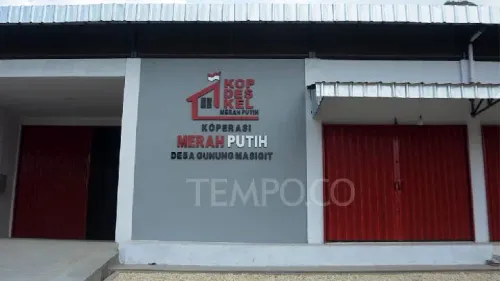
President Prabowo Subianto announced the Red and White Village Cooperative (KDMP) program during a limited cabinet meeting on March 3, 2025. Its legal framework followed through a Ministry of Cooperatives circular dated March 18 and Presidential Instruction No. 9/2025, issued March 27. The program launched on July 21, 2025, according to New Mandala.
The goal is roughly 80,000 cooperatives, covering every village and urban ward in Indonesia. Ministry of Cooperatives figures for July 2026 put completed cooperatives at 15,845, with another 19,539 under construction.
In an October 15 update reported by Kompas.id, Coordinating Minister for Food Zulkifli Hasan said 10,070 Red and White Village/Urban Cooperatives had started operating simultaneously. About 28,000 physical outlets had been built, he said, with construction expected to reach 35,000 units by the end of 2026 and 80,000 by 2029.
Management and procurement concerns
PT Agrinas Pangan Nusantara, a state-owned food company established in 2025, is expected to run the cooperatives for their first two years, according to New Mandala. The company received the nationwide construction contract through a presidential assignment, not a competitive tender. It also has a commitment to import about 105,000 vehicles from India, with a budget of roughly US$1.5 billion.
A July 2026 review by Indonesia Corruption Watch and Project Multatuli examined pickup trucks purchased for the cooperatives through an intermediary trading company. It found that the price paid exceeded fair import value by Rp60 million to Rp69 million per vehicle and projected potential rent-seeking of several trillion rupiah across the order.
New Mandala also reported analysts' comparisons with the Suharto-era KUD (Koperasi Unit Desa) network, an earlier effort to establish rural cooperatives on a mass scale that largely withered after state attention shifted elsewhere. Critics say the new program proceeded without a published feasibility study or pilot.
The petitioners are seeking an order suspending the cooperatives' current operating model until the government establishes a replacement framework that fully complies with the Cooperative Law.