Destry points to fundamentals and market conditions
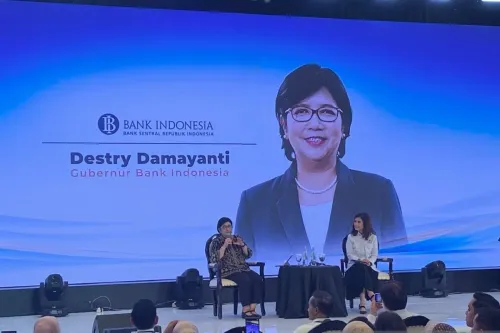
Speaking to reporters on October 29, 2026, Destry said Bank Indonesia's central responsibility is to keep the rupiah stable. She described Indonesia's economic fundamentals as relatively strong compared with its peers, while noting that exchange rates also respond to supply, demand and investor sentiment.
Destry characterized the rupiah's recent movements as financial-market fluctuations. She pointed to US monetary policy as an influence beyond Indonesia's control, saying the Federal Reserve's decision not to raise interest rates had brought an immediate improvement in sentiment and currency appreciation globally, including for the rupiah.
She said maintaining stability helps provide the conditions for the real economy to expand and create jobs. But she did not commit to a benchmark rate increase, either to ease pressure on the currency or to attract foreign capital. Those decisions, she said, would depend on incoming economic data and market conditions.
"We will see how developments unfold, because we have many policy instruments, not just interest rates," Destry said. She identified lower hedging costs, macroprudential measures and Bank Indonesia Rupiah Securities (SRBI) among the central bank's options.
Recent rates, hedging incentives and capital flows
Bank Indonesia's latest policy meeting, held October 20–21, left the BI-Rate at 5.75% and the Lending Facility rate at 6.50%. The central bank raised the Deposit Facility rate to 5.00%, according to its news release.
The October policy package also expanded incentives for Domestic Non-Deliverable Forward (DNDF) hedging with Bank Indonesia for underlying foreign funding transactions. For six-month tenors, the premium reduction increased from 25% to 40%; for 12-month tenors, it rose from 30% to 45%.
The central bank reported an exchange rate of Rp17,985 per US dollar on October 20. That represented a 0.61% point-to-point decline from the end of September, following appreciation through mid-September.
Bank Indonesia said its incentive policies had attracted $9.9 billion in foreign capital inflows between their implementation in June 2026 and October 20. It also reported international reserves of $146.3 billion at the end of September.
MSCI evaluation underlies Hashim's warning
Hashim, chairman of the Advisory Council of the Indonesian Chamber of Commerce and Industry (Kadin), delivered his warning at Kadin's national leadership meeting, or Rapimnas, in Jakarta on October 29. He urged business leaders to preserve foreign investor confidence amid scrutiny of stock trading practices.
According to ANTARA News, Hashim linked the risk to MSCI's evaluation of Indonesia's capital market. He warned that an unresolved MSCI-related problem could lead to a downgrade to "standalone market" status. In his assessment, foreign investors could then withdraw, reducing funding for the domestic capital market and putting pressure on the rupiah.
"I have calculated it could reach IDR 20,000–IDR 21,000. Some say IDR 22,000. If that happens, the rupiah could hit IDR 21,000–IDR 22,000 per US dollar. We would have to pay more for our foreign loans," Hashim said. He warned that such depreciation would make Indonesia's foreign debt more expensive to service and could harm the broader economy.
Hashim said the President had assigned him to help the government mitigate risks from the MSCI evaluation and keep capital-market conditions under control. He called for firm government action against stock trading that violates the rules.
Citing data he said he had received from Indonesia's Financial Services Authority (OJK), Hashim said about 32.7 million Indonesian citizens have stock-investment accounts. He warned that those investors would suffer if unhealthy trading practices and a possible MSCI downgrade prompted foreign capital to leave.
He also cited a recent case involving Turkey's stock market as a cautionary comparison, arguing that stronger supervision and compliance with capital-market rules were needed to prevent a similar problem in Indonesia.