Agreements await detailed studies
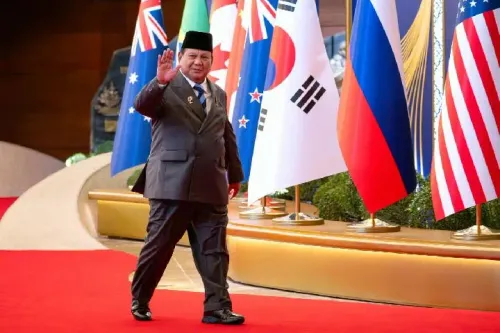
President Prabowo Subianto witnessed the signing while in Shenzhen, China, for the Asia-Pacific Economic Cooperation (APEC) Summit, Reuters reported.
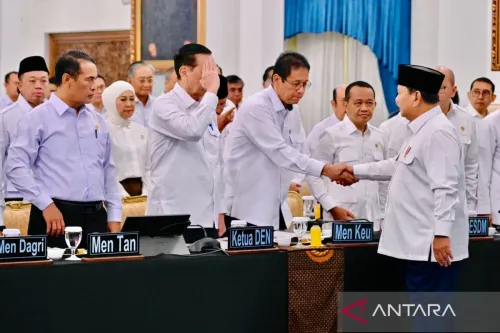
Archynewsy reported that the four agreements signed on November 18, 2026, are non-binding memoranda of understanding or frameworks to strengthen commitments. Detailed feasibility studies and definitive agreements are still required.
Danantara Indonesia, the sovereign wealth fund involved in the package, was launched by Prabowo in February 2025, according to a November 18 release from Media OutReach Newswire.
Ten smart cities planned under $50 billion program
The largest component is an estimated US$50 billion program to build 10 smart cities. The Presidential Secretariat identified the partners as Danantara and a consortium headed by Shaanxi Construction Engineering Group Corporation Limited.
The project entity is PT Kota Masa Depan Indonesia (KMDI), in which PT Danantara Asset Management holds a 99% stake. According to Media OutReach, KMDI signed the non-binding memorandum with the Shaanxi-led consortium.
The release puts the indicative investment at US$5 billion per city. Across the program, plans envisage approximately 1.5 million homes, along with infrastructure to support about 3 million residents. Subject to the required procurement process, the consortium expects to provide public amenities, municipal works, utilities and digital infrastructure over the next three to five years.
Danantara CEO Rosan Roeslani identified the project as one of the development initiatives scheduled to start in early 2027. "This will be one of the most historic projects, with development set to begin early next year," he said.
Danantara had already outlined plans for more than a dozen smart cities in different parts of Indonesia. Those developments are intended to combine housing with universities, hospitals, shopping centers and urban infrastructure.
Renminbi financing could also fund the cities
A separate US$10 billion infrastructure-financing agreement pairs Danantara with a consortium led by State Development and Investment Corporation (SDIC), a Chinese state-owned investment company.
Media OutReach names three Chinese financial institutions involved in the framework: Changjiang Securities International, Shanghai Pudong Development Bank Hong Kong Branch and SDIC Securities (Hong Kong). The proposed financing would be raised in renminbi, split between panda bonds worth the equivalent of US$5 billion in mainland China's interbank market and dim sum bonds worth the equivalent of US$5 billion in Hong Kong.
The same release says proceeds could also finance the smart-city program. That means as much as US$10 billion may be counted in both components of the stated US$71.8 billion package.
Manufacturing, research and coal-to-ethanol technology
Together, the three agreements outside the smart-city program carry a stated value of US$21.8 billion. Alongside infrastructure financing, they include a US$10 billion agreement among Chinese electronics company Hisense, Danantara and Indonesia's Ministry of Higher Education, Science and Technology for laboratories and home-appliance manufacturing facilities.
Hisense intends to build its largest home-appliance factory outside China in Indonesia, supplying both Indonesian buyers and export markets, according to Media OutReach. The facility's scale, location and schedule have yet to be defined.
Hisense is also funding a laboratory it is establishing with Institut Teknologi Bandung (ITB). The collaboration will develop energy-efficient appliances and provide joint professional training to support Indonesian households' transition from gas to electricity.
The remaining US$1.8 billion agreement concerns coal-to-ethanol processing technology. Its participants are the Ministry of Higher Education, Science and Technology, state-owned energy company PT Pertamina (Persero) and Beijing Petrochemical Engineering Co., Ltd.
According to Media OutReach, Beijing Petrochemical Engineering developed the process package jointly with the Chinese Academy of Sciences' Dalian Institute of Chemical Physics. The cooperation aims to turn Indonesia's low-grade coal into ethanol for transportation fuel, with both production and refining located in Indonesia.