UN warns Israeli displacement of West Bank refugees may constitute crime against humanity
The United Nations human rights office has issued a stark warning that Israel's systematic emptying of three Palestinian refugee camps in the occupied West Bank during a major military operation last year may constitute crimes against humanity.
In a report released Friday, the UN Office of the High Commissioner for Human Rights detailed how Operation Iron Wall, launched on January 21, 2025—just 48 hours after a ceasefire took effect in Gaza—resulted in the forced displacement of more than 33,000 Palestinian refugees from the Jenin, Tulkarm, and Nur Shams camps in the northern West Bank. Multiple UN agencies have reported displacement figures ranging between 33,000 and 40,000 people, representing what UNRWA described as the largest displacement of Palestinians in the West Bank since the 1967 war.
The affected refugee camps
The three camps, established in the early 1950s to shelter refugees from the 1948 Arab-Israeli war, had combined populations of approximately 58,000 registered Palestinian refugees before the operation began. Jenin Camp hosted 24,239 registered refugees, Tulkarm Camp 27,631, and Nur Shams between 6,400 and 12,000 residents, according to UNRWA data.
Details of the military operation
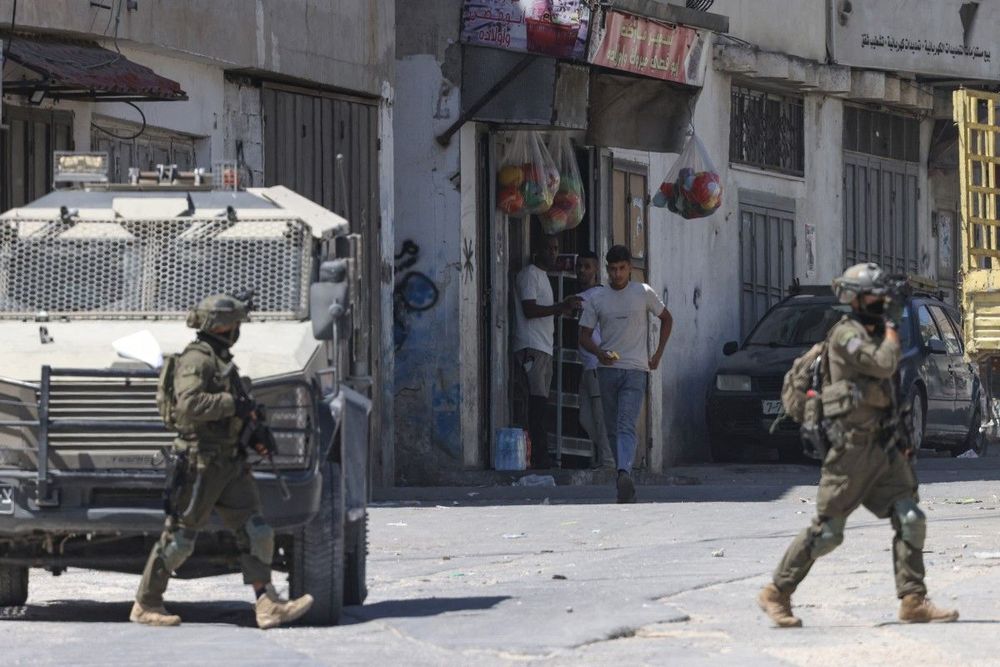
The report describes how Israeli military, police and security forces entered the camps at the operation's outset and killed civilians, destroyed hundreds of homes and damaged critical infrastructure. Authorities cut off water and electricity supplies and blocked humanitarian access before conducting door-to-door operations forcing residents to leave. Within days, Israeli forces had consolidated control over the camps and forcibly displaced their entire populations.
The large-scale, long-term and systematic displacement of over 33,000 Palestinian refugees from refugee camps such as Jenin, Nur Shams and Tulkarm during Israel's Operation Iron Wall raises serious concerns of the crime against humanity of forcible transfer.
Legal implications
Under the Rome Statute of the International Criminal Court, forcible transfer constitutes a crime against humanity when committed as part of a widespread or systematic attack directed against any civilian population. The legal definition does not require physical force but may include threat of force or coercion.
The UN rights office emphasized that the use of airstrikes, armoured bulldozers and controlled detonations, to render entire camps uninhabitable, to force the displacement of their residents and to prevent their return are not permissible under international law. Since the operation began, Israeli security forces have issued demolition orders for approximately 1,400 homes.
Israel's actions appear to amount to collective punishment and raise concerns of ethnic cleansing, the report warned. As of July this year, 33,362 Palestinian refugees displaced from the three camps had not been permitted to return.
The findings align with a separate determination by Human Rights Watch, which found that Israeli forces committed forcible displacement in violation of the law of occupation under international humanitarian law that amounts to war crimes during Operation Iron Wall from January through July 2025.
Scale and scope of Operation Iron Wall
Operation Iron Wall marked the largest Israeli military operation in the West Bank in decades and the longest operation since the second intifada. On February 23, 2025, Defense Minister Israel Katz announced that the Israeli army had emptied the three refugee camps and instructed troops to prepare for a prolonged presence for the coming year and to prevent the return of residents.
UN High Commissioner for Human Rights Volker Turk said the manner in which the operation was conducted suggests its aim was to expel as many Palestinians as possible and to make way for more illegal Israeli settlements, in further violation of international law. Settlement expansion in the West Bank reached record levels in 2025, with approximately 47,390 housing units advanced, approved, or tendered compared to 26,170 in 2024, according to a UN Secretary-General report—the highest rate since the UN began systematically tracking this data in 2017.
Broader context of violence
The operation unfolded against a backdrop of escalating violence across the West Bank. UN humanitarian coordinators documented 1,680 attacks by Israeli settlers across more than 270 communities in 2025—an average of five incidents per day—with over 1,000 Palestinians injured in settler attacks, more than double the number injured in 2024.
Israeli response
Israel's mission in Geneva rejected the report, accusing the UN rights office of setting aside impartiality, independence and neutrality, to serve as the epicentre of vile activism. The mission claimed the report was spreading misinformation and neglecting to mention the threat of terrorist attacks.
The West Bank, occupied by Israel since 1967, has experienced a surge in violence since the outbreak of war in Gaza following Hamas's attack on Israel on October 7, 2023. Violence escalated dramatically with the launch of Operation Iron Wall in January 2025. Jenin camp, which was established in 1953, had previously been severely damaged during the second intifada in 2002 when over 400 houses were destroyed.