
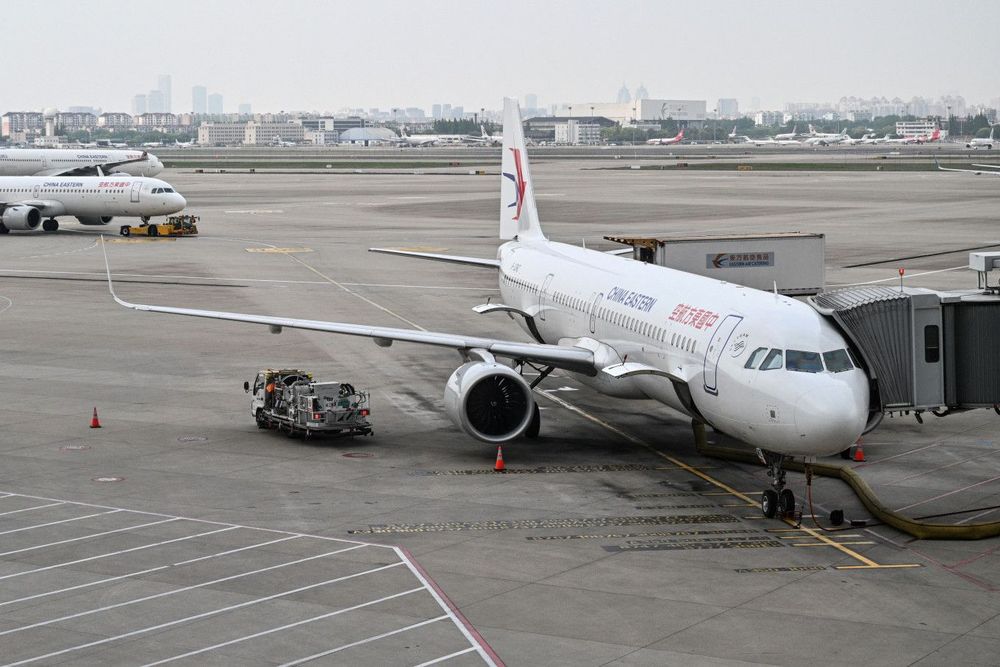
US carriers resist Chinese proposal to expand trans-Pacific flight capacity
The head of Airlines for America has declared opposition to expanding direct flights between China and the United States, despite Chinese President Xi Jinping raising the possibility during his Washington visit on Thursday. The industry group represents major US carriers including American Airlines, United Airlines and Delta Air Lines.
Chris Sununu, who leads the organization, stated that American carriers face significant competitive disadvantages because Chinese airlines operate eight flights that overfly Russia, while US carriers remain barred from that airspace. Aviation experts estimate this routing restriction adds two to three hours to flight times on key US-China routes and increases fuel costs by 20 to 40 percent.
"It's not just a minor thing. It's a huge cost to the airlines to have to go around Russia," Sununu said in an interview, adding that he has been urging Trump administration officials not to accommodate Chinese requests for additional flights.
Historical context and current restrictions
The competitive imbalance stems from restrictions imposed in March 2022, when the US Department of Transportation banned Russian aircraft from American airspace following Russia's invasion of Ukraine. Moscow retaliated by closing Russian airspace to US carriers and most European airlines, forcing them to take significantly longer routes.
Before the COVID-19 pandemic, US and Chinese carriers combined to operate over 150 weekly nonstop passenger flights between the two countries. At that time, approximately three million Chinese travelers visited the United States annually, contributing more than 30 billion dollars to the American economy.
Currently, the United States and China each can operate around 50 round-trip flights per week. This gradual expansion from just 12 weekly round-trips per side in May 2023 still represents less than one-third of pre-pandemic capacity levels.
Presidential remarks and industry response
At a Washington event on Thursday, Xi suggested increasing bilateral flight capacity.
"Our two sides may also increase direct flights to facilitate two-way travel and trade," the Chinese president said.The White House did not immediately comment on the proposal.
Airlines for America last week formally opposed a request from Air China to operate additional scheduled flights. The group argued that US airlines are effectively banned from flying from the US East Coast to China because they cannot access Russian airspace, while Chinese carriers continue to use those routes for eight US-bound flights.
"It's imbalanced. It's unfair," Sununu stated. "They already have an advantage with the eight flights. To give them even more of an advantage would be huge. Don't make it worse for us."
Previous regulatory attempts
In October 2025, the US Transportation Department proposed banning Chinese airlines from flying over Russia on routes to and from the United States, arguing that the reduced flight time this practice enables puts American carriers at a competitive disadvantage. However, the proposal encountered opposition from other US agencies and was shelved ahead of trade negotiations with China.
According to filings submitted to the US Department of Transportation, Air China estimated that at least 4,400 passengers would be affected if such a Russian airspace ban took effect during the Thanksgiving and Christmas travel season.
The broader competitive impact extends beyond trans-Pacific routes. Chinese airlines are expected to add nearly 2,900 more China-Europe flights to their summer 2026 schedules compared with 2025, capitalizing on their continued access to Russian airspace while Western carriers cannot use those routes.
Longstanding aviation partnership
The current dispute marks a significant departure from decades of expanding cooperation between the two countries. The US-China bilateral aviation agreement was first established in 1980 following the normalization of diplomatic relations in 1979, and has been amended multiple times with major liberalization protocols signed in 2004 and 2007.
The United States struck a deal with China in 2023 stipulating that additional approved flights would not overfly Russia, but Chinese carriers have continued to use Russian airspace for eight existing routes. This arrangement has remained a central point of contention as both countries consider further expansion of trans-Pacific aviation links.