SpaceX Launch Lights up US East Coast with 'Space Jellyfish'
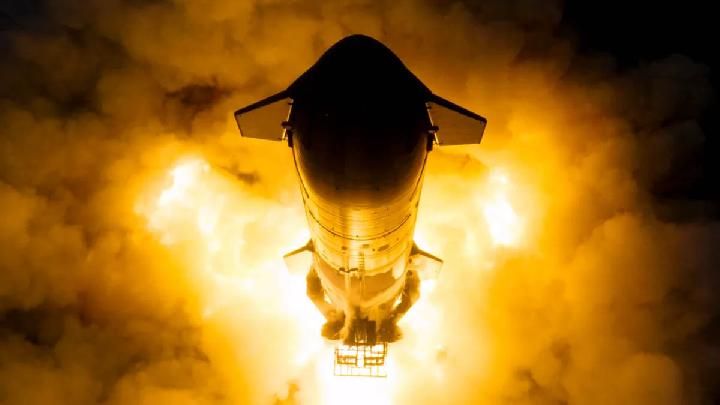
A SpaceX Falcon 9 rocket launched from Cape Canaveral Space Force Station early Tuesday morning, creating a striking luminous display that stretched across the U.S. East Coast sky. The 6:33 a.m. EDT liftoff carried an uncrewed Dragon cargo spacecraft on the company's 35th commercial resupply mission to the International Space Station.
The rocket's exhaust plume formed what observers widely described as a "space jellyfish" — a phenomenon that occurs when launches take place during twilight, typically 30 to 60 minutes before sunrise or after sunset. During this window, observers on the ground remain in darkness while exhaust gases at high altitudes catch sunlight above the horizon, creating an illuminated spectacle.
As the Falcon 9 ascended into progressively thinner atmosphere, gases from its engines expanded outward into a cloud far broader than the rocket itself. The morning's first light set the plume aglow, with water vapor and carbon dioxide from the engines freezing into ice crystals that formed the distinctive jellyfish shape.
"You can imagine my surprise when I opened my back door" to let her dogs out that morning, Ellen Alence told Space.com after photographing the launch from her farm in Colbert, Georgia.
The northbound trajectory required to reach the space station's orbital path put the glowing trail in view of millions along the eastern seaboard.
Completing a Decade-Long Power Upgrade
The Dragon spacecraft carries more than 6,300 pounds of supplies and hardware to the orbiting laboratory. Among the most significant cargo are the final two roll-out solar arrays that will complete a power upgrade campaign that began with a prototype test in 2017. Six arrays have already been installed on the station since operational deployments started in 2021.
The International Space Station's original solar arrays, completed in March 2009, originally generated 240 kilowatts of electricity. However, years of radiation exposure in orbit have degraded their output to approximately 160 kilowatts. Each new iROSA (ISS Roll-Out Solar Array) produces more than 20 kilowatts and enables a 30 percent increase in power production, with the complete set designed to restore the station to approximately its original generating capacity.
These advanced arrays use an innovative deployment mechanism featuring carbon-fiber composite booms coiled under spring tension. When released, they unroll autonomously without requiring motors, pyrotechnics, or drive mechanisms — a simpler and more reliable design than traditional solar panel systems.
Medical Research in Microgravity
The cargo manifest also includes new experiments, notably hardware for manufacturing artificial retinas in the microgravity environment. LambdaVision has conducted nine investigations on the ISS over the past decade, with retinas produced in space demonstrating improved uniformity, optical performance, and reproducibility compared to those manufactured on Earth.
The artificial retina technology targets retinitis pigmentosa, a rare genetic disorder affecting approximately 1.5 million people worldwide for which no cure currently exists. The treatment uses bacteriorhodopsin, a protein derived from an ancient microorganism, to restore light sensitivity to damaged retinal cells.
Mission Timeline and Return Capability
Dragon is scheduled to dock autonomously with the station's Harmony module at 11 a.m. EDT on Thursday, October 15. Unlike earlier Dragon 1 capsules that required capture by the station's robotic arm and manual berthing, current Dragon cargo spacecraft dock without astronaut intervention using onboard thrusters.
The spacecraft will remain attached to the ISS until mid-November before departing for Earth. Unlike other cargo vehicles such as Northrop Grumman's Cygnus or Russia's Progress spacecraft, which burn up on reentry, SpaceX's Cargo Dragon is designed for atmospheric reentry and ocean recovery. This capability allows NASA to return experiments, equipment, and other materials from the station to Earth for analysis.
CRS-35 marks the second Dragon mission to the ISS in less than two weeks, demonstrating SpaceX's operational tempo in supporting the orbiting laboratory. The mission represents another milestone in the company's ongoing partnership with NASA for space station logistics and research support.