Religious values and education plans
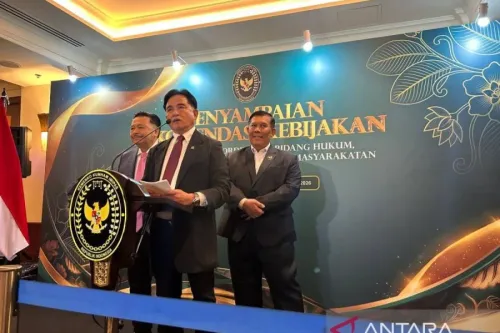
Speaking in Jakarta, Syafi'i called the public act "immoral" and said it conflicted with Indonesia's religious values, social norms and national principles. He invoked the first principle of Pancasila, the belief in one God.
"Indonesia is a religious nation. We have Pancasila, with belief in the One and Only God as its first principle. Therefore, public spaces must not become places for normalizing behavior that contradicts the religious values and social norms upheld by Indonesian society," he said.
Syafi'i urged stronger moral and religious education for young people, saying the incident underscored an urgent need for that work. He also said people exercising freedom of expression must observe applicable laws, ethics and norms.
The curriculum materials being finalized would cover every educational institution overseen by the ministry, including those providing Islamic, Christian, Catholic, Hindu, Buddhist and Confucian education. He said the ministry would also expand the role of religious instructors, interfaith leaders, schools and families in educating and guiding the public.
Defense policy cited
Syafi'i linked the ministry's response to policy direction from President Prabowo Subianto under Presidential Regulation No. 111 of 2025, which sets out the general national defense policy for 2025-2029. He said the policy addresses the spread of LGBT behavior among non-military threats to national defense.
According to Tempo English, Prabowo signed the regulation on October 24, 2025. It classifies the spread of LGBTQ culture as a non-military threat to the state, alongside terrorism, separatism and radicalism.
"The Ministry of Religious Affairs is obliged to take concrete steps through education, religious guidance, and strengthening family resilience," Syafi'i said.
He said the government's concern was the spread of behavior it considers inconsistent with religious values and Pancasila. That position, he stressed, must not be taken as permission to commit violence against or persecute individuals.
Religious council criticism and a lawmaker's response
The Indonesian Ulema Council (MUI) also criticized a display at the march. In remarks on November 9, Deputy Chair KH M. Cholil Nafis said placing an LGBT flag alongside the Palestinian flag had damaged the purity of the Palestinian independence struggle. He argued that support for Palestine should not serve to legitimize or tolerate LGBT people in Indonesia.
A Jakarta lawmaker, meanwhile, urged authorities to distinguish expressions of LGBTQ+ aspirations from violations of law. Kevin Wu, a PSI party member serving on Commission A of the Jakarta Regional Legislative Council (DPRD DKI), said on November 9 that Article 28E(3) of the 1945 Constitution protects demonstrations as a constitutional right.
Wu said expressing those aspirations should not automatically be treated as unlawful. He called on police and the Jakarta provincial government to base their actions on rules and evidence, rather than pressure from public opinion.