US and Australia announce $580 million Pacific Islands funding amid regional competition
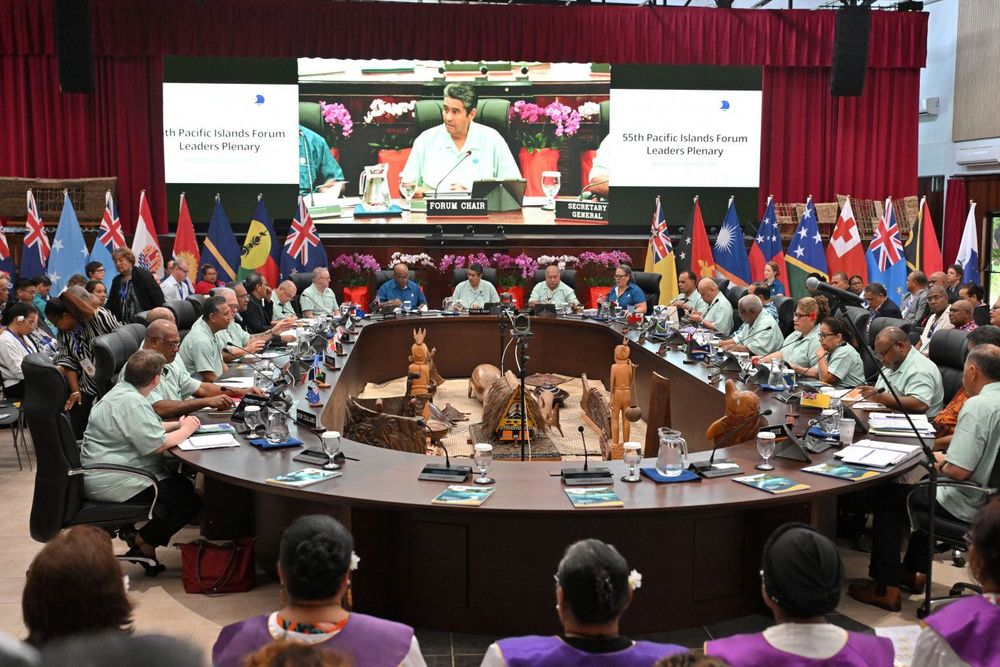
The United States and Australia have pledged a combined $580 million in funding for Pacific Island nations during the 55th Pacific Islands Forum in Palau, marking a significant escalation in Western engagement across a region where Chinese influence has grown substantially over the past decade.
Australian Prime Minister Anthony Albanese announced a A$600 million ($430 million) package on Wednesday focused on combating organized crime and drug smuggling, which has escalated sharply in recent years as traffickers increasingly use Pacific Island nations as transit points for methamphetamine destined for Australian and New Zealand markets.
The Australian funding will enhance aerial surveillance capabilities and provide expanded training for police and border officials across the region.
"The Pacific is our home and our family. That's why it's in Australia's interests to work with our Pacific partners to combat organized crime. For the good of every country in the region, including our own – we need to work together to stamp out the illicit drug trade."
Separately, US Deputy Secretary of State Christopher Landau announced $150 million in American funding at the forum, which represents the 18-member bloc's combined population of approximately 50 million people across Melanesia, Micronesia, and Polynesia. The US package includes $60 million specifically allocated to address energy security challenges by expanding fuel storage capacity and supporting electrical grid stability across the islands.
The energy infrastructure component addresses a critical regional priority, as Pacific Island nations face severe climate change impacts, including rising sea levels that threaten the existence of low-lying atoll nations. Energy security has become increasingly urgent as these countries seek to transition to more sustainable and resilient power systems.
Strategic competition intensifies
The announcements come as Western powers respond to China's expanding footprint in the Pacific, where Beijing has committed billions in loans and grants over the past decade for infrastructure projects, scholarships, and military cooperation agreements. The 2022 security agreement between China and Solomon Islands particularly alarmed Washington and Canberra, raising concerns about potential Chinese military installations in the region and marking a significant shift in Pacific security dynamics.
That agreement prompted renewed Western engagement exemplified by the AUKUS security partnership between Australia, the United Kingdom, and the United States, announced in 2021, which includes enhanced cooperation provisions for the Indo-Pacific region encompassing the Pacific Islands.
The diplomatic landscape has shifted notably in recent years, with Kiribati and Solomon Islands switching recognition from Taiwan to China in 2019, reducing Taiwan's diplomatic allies in the region. Currently, only Palau, Nauru, and the Marshall Islands among Pacific Island Forum members maintain diplomatic relations with Taiwan rather than China, making them strategically significant in cross-strait tensions.
Taiwan participation dispute
The forum meeting, which began on August 30 and continues through September 4, has been dominated by tensions over Taiwan's participation. China, which views Taiwan as its own territory, has objected to the democratically governed island's presence at the annual gathering.
Australia and New Zealand stated on Tuesday that the forum membership would determine the guest list. Palau's role as host nation has placed particular focus on the issue, given its status as one of Taiwan's three remaining Pacific diplomatic allies.
The coordinated US-Australian funding announcements underscore the strategic importance both nations place on the Pacific region, where competition for influence has intensified amid broader geopolitical tensions between Western powers and China across the Indo-Pacific theater.