Limited access to Washington
Bayuni's column questions whether Prabowo is upholding bebas aktif, Indonesia's longstanding "free and active" foreign policy, or accommodating Washington at the expense of its independence. The doctrine presents Indonesia as a middle power that charts its own course rather than siding with competing major powers.
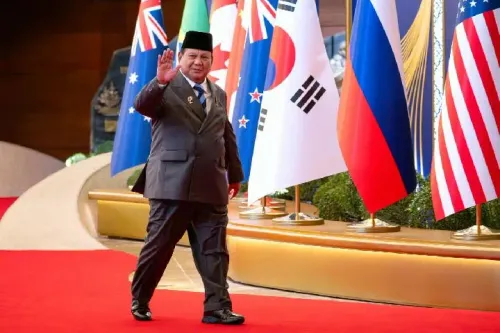
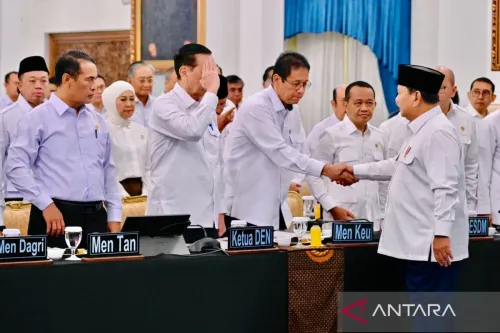
Despite months of overtures, Prabowo has yet to obtain a full bilateral state visit to the White House. His encounters with President Donald Trump have instead been brief meetings around summits, United Nations gatherings and ceremonies, including the launch of the US-led Board of Peace.
Bayuni also points to the optics of those encounters. A hot mic reportedly captured Prabowo asking about meeting one of Trump's sons, while photographs from the board's launch showed him carrying folders for Trump. In the columnist's assessment, these scenes and Indonesia's substantive concessions have not been accompanied by a clear return from Washington.
Trade concessions followed by new pressure
The trade agreement signed in Washington on Feb. 19, 2026, reduced US tariffs on most Indonesian goods to 19%, down from 32%. In exchange, Jakarta accepted obligations extending beyond tariff rates: it agreed to follow US export controls for sensitive technologies and forgo trade agreements with other countries that could compromise "essential U.S. interests," according to Foreign Policy.
The timing quickly became contentious. On Feb. 20, one day after the signing, the US Supreme Court ruled Trump's tariffs illegal. Critics in Indonesia argued that Jakarta should have delayed its agreement.
Further US trade action followed. About three weeks after the deal, the Trump administration launched a Section 301 inquiry into alleged manufacturing overcapacity in Indonesia. An investigation into Indonesian imports allegedly produced with forced labor began the following day. Washington subsequently imposed a 10% tariff on Indonesian goods in July 2026, Foreign Policy reported.
A Gaza commitment put on hold
Indonesia was quick to join the Board of Peace and accepted the deputy commander role in the International Stabilization Force, according to Kompas. Its commitment of 8,000 personnel was the largest national contribution, representing about 40% of the force's planned strength of 20,000.
The mission's authority comes from UN Security Council Resolution 2803, adopted Nov. 17, 2025, rather than a dedicated UN peacekeeping mandate. That distinction accompanies a commitment that also faced domestic opposition: a March 2026 survey found 50.9% of respondents opposed board membership. On sending Indonesian troops to Gaza, 44.9% were opposed and 33.8% were supportive, Foreign Policy reported.
Prabowo later froze Indonesia's participation in the board and suspended the planned deployment after the US-Israel war with Iran escalated. Any renewed troop commitment would come with conditions: Indonesian forces would not disarm Hamas, and deployment would require explicit approval from Palestinian leaders and key Muslim-majority countries, including Egypt, Pakistan, Saudi Arabia and Turkey.
Disputed military airspace access
A separate question about Indonesia's security relationship with Washington emerged in April 2026. Foreign Policy reported that Prabowo had approved an agreement allowing the US military precleared access to Indonesian sovereign airspace for crisis responses and other contingencies.
The Defense Ministry subsequently denied that Indonesia had made a binding commitment. The Foreign Ministry, meanwhile, warned that blanket access for US forces could draw Indonesia into a South China Sea conflict.
Expanding ties with China and Russia
Bayuni contrasts Washington's limited reception with Prabowo's engagements in Beijing and Moscow. Visits to China have produced agreements covering trade, infrastructure and maritime matters, reinforcing what the columnist describes as Beijing's position as Indonesia's most consequential economic partner. He sees Washington as the weak point in an otherwise diversified foreign policy.
Prabowo's contacts with Russia have been frequent. On Sept. 3, 2026, he met President Vladimir Putin in Vladivostok during the 11th Eastern Economic Forum. According to The Diplomat, this was his fifth meeting with Putin since becoming president in late 2024 and his second visit to Russia in 2026. Trade between the countries totaled $4.8 billion in 2025, an increase of 21.7% from the previous year.
Since Prabowo took office, Indonesia has also entered BRICS and signed a free trade agreement with the Russia-dominated Eurasian Economic Union. Indonesia and Russia elevated their bilateral relationship to a strategic partnership in December 2025.