A majority awaiting the transfer of power
The Student List won 53 percent of the vote in the October 25 parliamentary election, against 39 percent for Vucic's Serbian Progressive Party, or SNS. The movement grew out of student-led protests and includes professors, activists and artists.
An October 30 briefing from the UK House of Commons Library reported that the Student List won 141 seats in the 250-member National Assembly, while the SNS-led United Serbia list secured 103. The briefing and Al Jazeera reported seats for minority parties as well: three for the Alliance of Vojvodina Hungarians, two for the Albanian bloc and one each for two Sandzak lists. Vucic ran as the SNS-led list's candidate for prime minister.
Participation reached 68.78 percent, the highest turnout in more than 30 years, according to Republic Election Commission data reported by Al Jazeera.
The result has not yet completed the electoral process. Irregularities in the initial vote prompted repeat voting at about 50 polling stations on Sunday, November 1. Parliament can convene after those ballots have been counted.
Under the procedure described by Al Jazeera, the National Assembly must be constituted within 30 days after the Republic Election Commission publishes final results. A government must then be formed within 90 days. The Student List does not need coalition negotiations because it has an outright majority, and government formation is expected to move quickly.
No prospective cabinet members have been announced. Al Jazeera identifies the movement's lead candidate, Ilija Srdanović, as the likely choice for prime minister, though the Student List has not formally nominated anyone. He is a cardiologist and professor at the University of Novi Sad's Faculty of Medicine. Former central bank governor Dejan Šoškić is another prominent figure on the list.
Investigations and pressure for accountability
The transition has not begun, but challenges to Vucic's authority are already visible. DW reported that residents in several cities peacefully took down his portraits from municipal buildings. The organized crime prosecutor's office has opened investigations, including into suspected election fraud.
A special commission is also reviewing the Higher Public Prosecutor's Office in Belgrade. Critics have accused that office of following Vucic's instructions and targeting his opponents.
The demand for accountability grew from the November 2024 collapse of a concrete canopy at Novi Sad railway station, which killed 16 people. According to the House of Commons Library, a renovation led by a Chinese consortium had recently been completed. Poor workmanship and corruption in the award and execution of the renovation contract are believed to have caused the collapse.
Fighting corruption and organized crime were central commitments in the Student List's September 2026 election program, Al Jazeera reported. The movement also promised higher living standards, more employment, better education, media freedom and stronger institutional independence.
Dejan Bursac of Belgrade University's Institute for Philosophy and Social Theory told DW that the delay in transferring power was testing supporters' patience. "A society that was oppressed for so long by a party that acted like a feudal lord now, understandably, expects justice," he said.
Vucic and other senior officials have pledged to form a strong opposition. Many of their critics, meanwhile, want Vucic investigated and criminally charged.
Media upheaval and Vucic's response
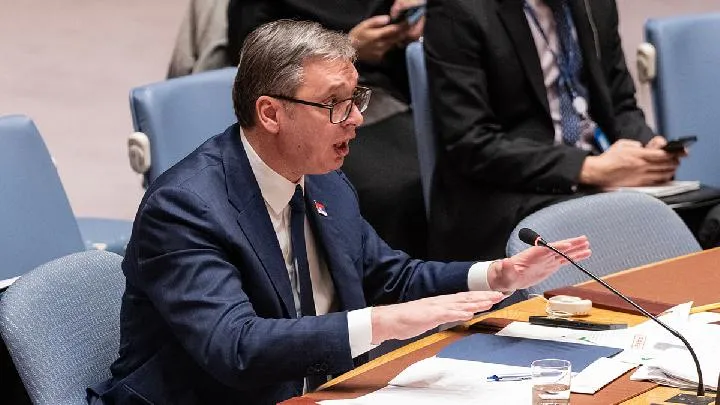
At a press conference with fewer microphones than he usually attracts, Vucic accused the election winners of practicing "revolutionary terror." He pointed to the immediate resignation of the general director of state broadcaster RTS; several senior editors there have also been dismissed.
"If they continue to terrorize those who think differently – beatings, destruction and all the rest – and the state authorities do nothing, we will be forced to organize ourselves," he warned.
On Monday, a small group of protesters entered Informer TV. The station has accumulated thousands of complaints about its reporting and its demonization of Vucic's critics. Journalists' associations are now seeking the withdrawal of its broadcasting license.
Other tabloids aligned with Vucic have softened their coverage. Unlike Informer, they no longer label the Student List's members "terrorists" or "mercenaries."
Officials still able to shape the transition
Vucic has acknowledged that former allies are abandoning him. Switching political allegiance, often toward those gaining power, is common in Serbia. Transparency Serbia's Zlatko Minic told DW that some officials would resign or retreat from public view, "even putting themselves forward as informants for the next government."
Minic warned that officials who remain in office could still leave their successors with substantial commitments. "There's still time for many officials to award contracts and create financial obligations for the agencies they run without necessarily committing a criminal offense," he said.
People familiar with the situation told DW that the Student List had made contact with police and administrative officials who opposed Vucic's governing style. Those relationships could help it block some actions by the outgoing administration.
On Wednesday, the movement renewed its demands for senior police and judicial officials to resign. It also appealed to whistleblowers to report any attempt by the outgoing government to "destroy documents."
The Student List chose Pioneers Park, opposite parliament, for its first press conference. Vucic supporters had fenced it off in 2025 to establish a pro-government camp. Investigative journalists said it also served as a base for thugs and criminals who attacked anti-government protesters. The morning after the election victory, Student List supporters brought garbage bags to clean up the site.
EU ambitions without a sharp foreign-policy turn
The Student List spans the left and right, including both pro-European and pro-Russian politicians. Domestic reform is its priority, but it also wants substantive changes to move Serbia's European Union accession negotiations forward.
The movement nevertheless rejects sanctions on Russia and recognition of Kosovo. DW reported that those positions are shared by almost the entire Serbian population.
"Our plan is to stabilize and develop the country, not to destabilize it with some abrupt change of course on foreign policy," Oliver Toskovic, a psychology professor and incoming lawmaker, told DW.
Toskovic said the EU would no longer serve as a "cover," as he said it had under Vucic. He blamed the previous government for Serbia's heavy reliance on Russian energy, while arguing that imposing sanctions now would destabilize the country. The incoming government's energy policy remains unclear.
The accession process has already encountered resistance. In July 2026, eight EU member states blocked the European Commission's attempt to open a new negotiating cluster, citing Serbia's rule-of-law record and its failure to align with sanctions against Russia, according to Euronews. Vucic has accused "the West" of encouraging a "color revolution."
EU leaders welcomed the Student List's victory. Euronews reported that European Council President António Costa and European Commission President Ursula von der Leyen jointly offered support for reforms covering the rule of law, media freedom, anti-corruption and democratic institutions, alongside work to advance Serbia's EU future. Enlargement Commissioner Marta Kos said "the door to the EU is open."
Student List leaders have also promised better relations with neighboring countries and less regional tension. Srdanović has expressed willingness to hold talks with the government in Pristina and has spoken by telephone with Croatia's prime minister.