Deputy Minister Highlights Importance of MBG Menu Tailored to Special Needs Children
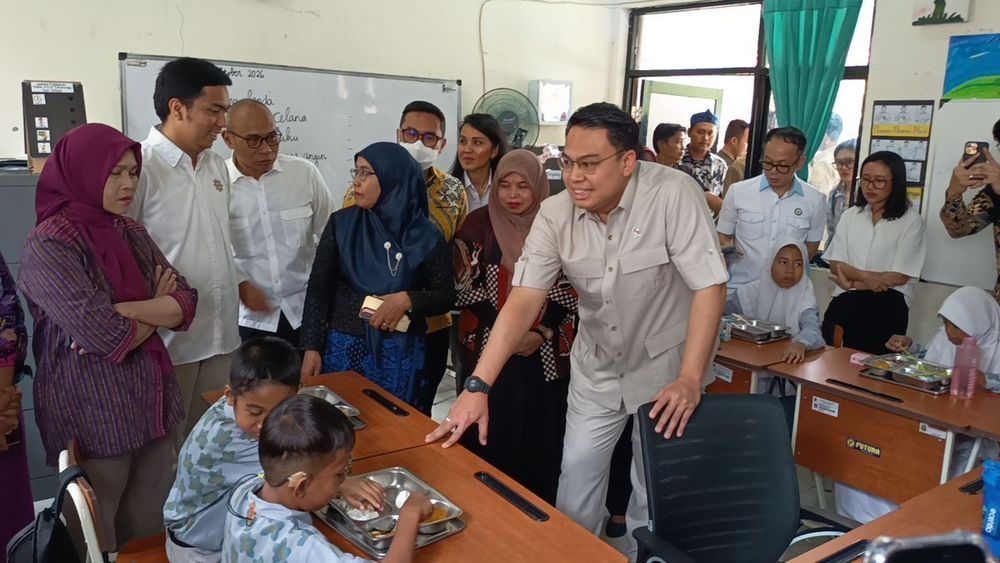
Indonesia's Deputy Minister of Communication and Digital Angga Raka Prabowo underscored the critical need to customize nutritious meal menus for children with special needs, ensuring the food provided accurately addresses their unique nutritional requirements during a Thursday visit to State Special School 01 in South Tangerang.
The visit focused on reviewing implementation of the Free Nutritious Meals (MBG) program, a collaborative initiative involving technology companies Grab and OVO alongside the Inclusion Foundation for the Nation. The program represents part of a broader national effort launched on January 6, 2025, as a cornerstone of President Prabowo Subianto's campaign promises and the Golden Indonesia 2045 vision to develop a healthier, stronger, and more capable Indonesian population.
"I witnessed firsthand the children's happiness, and the presentation of the meals was excellent. From a nutritional perspective, the menu offered is outstanding and fulfills the need for protein and carbohydrates. Because this is a special school for children with various special needs, the menu is also customized. This highlights the importance of understanding our children's requirements."
The adaptation of meal programs for students with disabilities takes on added significance given that nearly three in ten children with disabilities in Indonesia have never attended school, with approximately 140,000 children aged 7-18 with disabilities currently out of the education system.
Public-Private Partnership Model
The Deputy Minister praised the collaborative approach to implementing the MBG program at the school, characterizing it as evidence of effective government-private sector cooperation. The initiative launched its trial phase on April 14, 2025, at special schools in Tangerang City, initially targeting 1,500 beneficiaries across 11 schools in the Tangerang region.
"Visiting this government program for free nutritious meals, which also collaborates with Grab and OVO, demonstrates synergy showing that government priority programs are not conducted solely by the government, but by partners working throughout Indonesia."
The program forms part of a much larger national initiative that had reached more than 41.2 million people by early November 2025, achieving approximately 50 percent of its five-year goal to serve 82.9 million beneficiaries. The National Nutrition Agency (BGN), established through Presidential Regulation No. 83 of 2024, coordinates and manages the nationwide MBG program as the lead institution for nutritional fulfillment across Indonesia.
Corporate Social Responsibility Funding
Grab Indonesia CEO Neneng Goenadi explained that the company's involvement in the MBG program stems from corporate social responsibility funding channeled through partnership with the Inclusion Foundation for the Nation to provide nutritious meals to children with special needs.
"We are utilizing our CSR funds to provide MBG to children with special needs. We have been implementing this since April 2025 and will continue consistently moving forward."
The companies reported assisting approximately 5,000 students through the program, working with around 40 local merchants across 12 districts. The program has expanded significantly since beginning operations in September 2024, with the number of participating schools growing steadily.
Digital Technology Integration
The implementation utilizes an end-to-end digital system that enables schools to order meals for the upcoming week through a mobile application. The technology platform incorporates real-time monitoring, AI-based command centers, and has reportedly achieved 99.99 percent food safety rates and 100 percent compliance among participating micro, small, and medium enterprises.
Meal deliveries involve Grab driver partners, with the digital system including reporting mechanisms for any shortcomings identified in provided menus. Deputy Minister Angga Raka noted that the technology employed by Grab and OVO holds potential for consideration by the National Nutrition Agency, particularly to support monitoring and food supply coordination in the broader MBG program.
According to BGN specifications, the MBG program is designed to cover approximately one-third of recipients' daily nutritional needs, with menus tailored to the energy, protein, carbohydrate, and micronutrient requirements of different recipient groups.
"We empower local merchants around the schools, and currently have about 40 merchants operating in 12 districts, serving around 5,000 students. This has been in place since September 2024, and the number of schools has continued to grow since then."
The program's focus on special needs education addresses a significant gap, as Indonesia has 2,270 special schools at various education levels—593 government-owned and 1,677 privately operated—serving only a fraction of an estimated 10 million children with special needs nationwide.