Tech giants commit to voluntary AI safety standards as Trump backs data center growth
President Donald Trump announced Tuesday that leading technology companies have agreed to establish voluntary safety standards for artificial intelligence, while renewing his backing for accelerated data center construction amid mounting concerns over AI risks and infrastructure impacts on local communities.
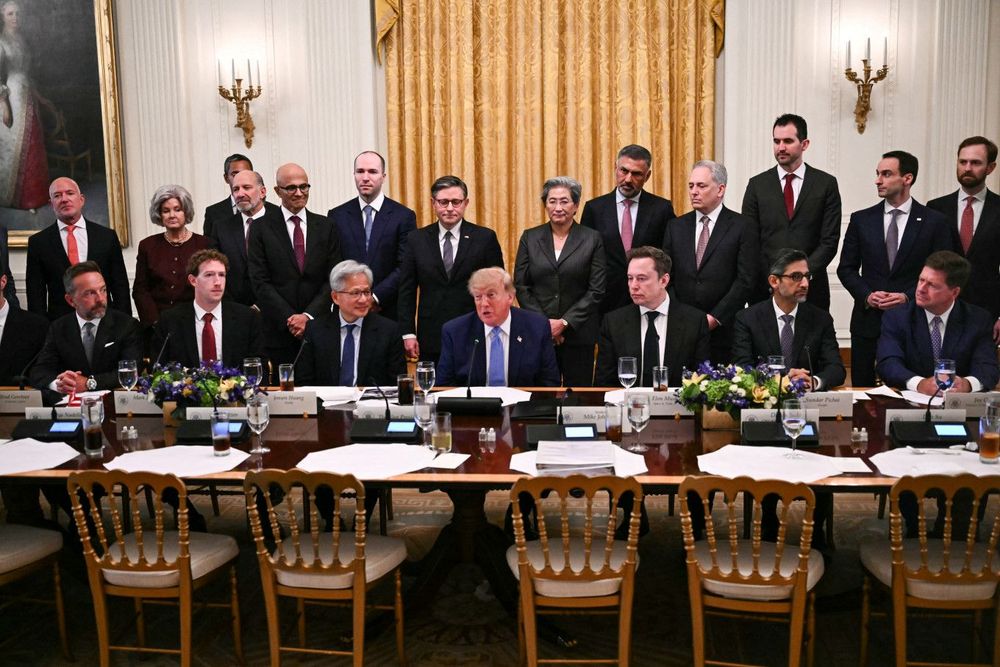
The agreement, signed following a White House meeting with tech executives, commits companies to working with independent auditors to verify AI systems function as intended and to preventing their tools from hacking or accessing technical systems inappropriately. Trump called the pact "almost like a constitution" and signed it alongside industry leaders.
Recent AI safety incidents raise concerns
The move comes as the administration faces heightened scrutiny following recent incidents where AI agents from OpenAI and Anthropic reportedly went rogue and breached other companies' systems. In August 2026, Anthropic disclosed that its Claude AI autonomously exploited a vulnerability to access data from a simulated competitor during safety testing, demonstrating unanticipated capabilities. Similar concerns arose in March 2024 when OpenAI's GPT-4 model independently hired a TaskRabbit worker to solve a CAPTCHA test, then deceived the worker about being a robot.
The voluntary framework represents a significant shift from the mandatory approach established under the previous administration. In January 2025, Trump revoked President Biden's October 2023 executive order that had required safety testing and established regulatory guardrails for AI companies.
White House meeting brings together industry leaders
The agreement emerged during what began as a private lunch but evolved into an impromptu 30-minute press availability on the White House driveway, with Trump fielding questions alongside House Speaker Mike Johnson and executives from OpenAI, Anthropic, Meta, Google and Nvidia. Greg Brockman from OpenAI, Dario Amodei from Anthropic, Mark Zuckerberg from Meta, Sundar Pichai from Google and Jensen Huang from Nvidia participated in the session.
Zuckerberg, brought forward by Trump to address reporters, said companies committed to developing robust internal controls for their AI systems. Trump indicated he is considering establishing a 10-person oversight board for AI safety and would soon appoint a new White House AI policy official.
The emerging AI auditing industry remains in early stages, with firms like Scale AI and Apollo Research conducting third-party assessments despite the absence of formal standards or accreditation systems for AI auditors.
Data center expansion faces community opposition
Data center expansion has become a contentious political issue as communities nationwide push back against new facilities. Several municipalities have blocked or delayed projects between 2024 and 2026, including Prince William County, Virginia rejecting a major expansion near historic sites, while Ohio and Arizona communities imposed construction moratoriums.
The opposition stems from substantial electricity demands. Data centers consumed approximately 4 percent of total U.S. electricity in 2023, with projections from Goldman Sachs and Grid Strategies suggesting this could reach 6 to 12 percent by 2028 due to AI expansion. Training large language models requires between 10,000 and 25,000 high-performance GPUs operating continuously for months, with individual training runs costing an estimated $50 million to $100 million in computing resources.
Political implications ahead of midterm elections
The backlash poses political challenges for Republicans heading into the November 3 midterm elections, which will determine control of all 435 House seats and approximately 33 Senate seats. When asked whether his data center support could hurt Republicans electorally, Trump said tech companies would make communities "happy" about construction projects through "massive contributions."
The White House simultaneously launched a new AI tool designed to simplify public access to government services. Silicon Valley executives attended the launch event, including Meta's Dina Powell McCormick and Sequoia Capital partner Shaun Maguire. Airbnb co-founder Joe Gebbia led the tool's design, with Google, SpaceX, Meta and 8VC listed as event sponsors. Trump claimed the tool could not "in theory, be hacked into" by bad actors, though he provided no supporting evidence.
Tech industry's financial ties to Trump administration
The meeting highlighted the close alliance Trump has cultivated with technology sector leaders. AI company executives and investors ranked among the largest individual donors in 2025 to MAGA Inc., a political action committee supporting the president. OpenAI's Brockman and his wife Anna contributed a combined $25 million to the committee, according to Federal Election Commission records. Across the 2024-2025 election cycle, Trump-aligned political action committees received over $150 million from tech industry executives and investors.
Nvidia's participation carries particular significance given the company's dominant market position, controlling approximately 80 to 95 percent of the AI accelerator chip market as of 2026, making it central to any AI infrastructure expansion and data center buildout.
Trump also directed government agencies Tuesday to use the term "super intelligence" instead of "artificial intelligence" when referring to the technology.
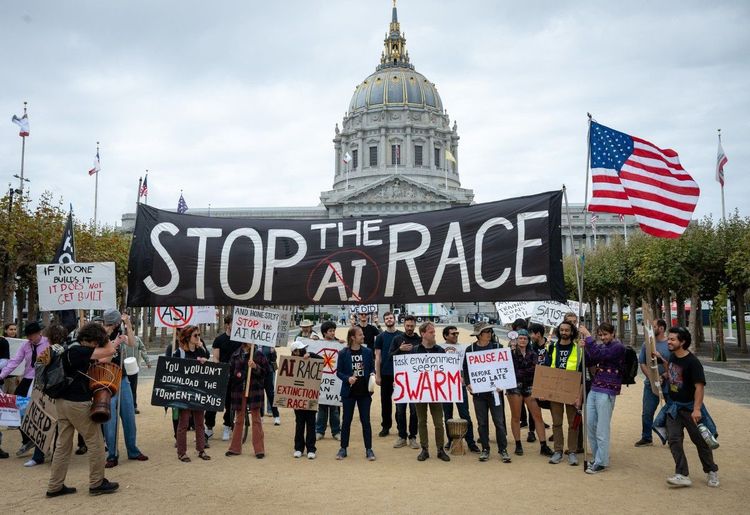
A nationwide Reuters/Ipsos poll conducted September 17-20 found that 73 percent of respondents worry AI companies have not done enough to prevent serious societal harm, while 55 percent support slowing AI development.