Turning school records into useful information
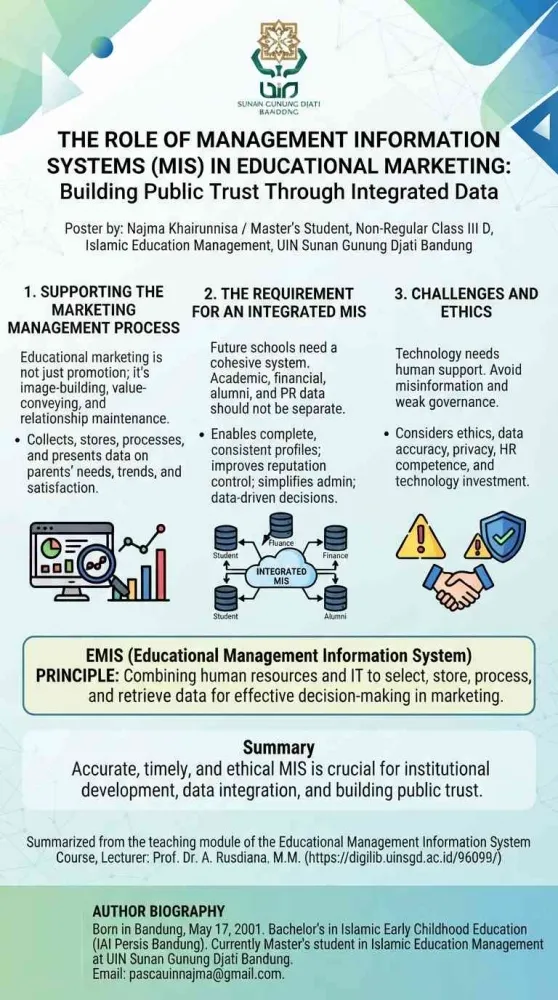
Khairunnisa, a master's student in Islamic Education Management at UIN Sunan Gunung Djati Bandung, describes educational marketing as an ongoing effort to explain a school's value and maintain public relationships. Information technology has changed that work, she writes, but collecting more data does not by itself make a school more trustworthy.
Her proposed management information system, or MIS, would bring together information about prospective students, parents and alumni with records of school achievements, flagship programs, satisfaction and public feedback. Processing those records into accurate, relevant information when it is needed is central to her argument.
Schools could use the system to understand parents' needs and public interest alongside their own capacity and service quality. Those findings would inform which audiences to reach, what goals and messages to set, which communication channels to use and how to assess the results.
The essay draws on a teaching module for the Educational Management Information System course taught by Prof. Dr. A. Rusdiana, M.M. It is a user contribution to Kompasiana, which states that such content does not represent the editorial views of Kompas.
Connecting departments and decisions
Khairunnisa calls for schools to connect records across academics, student affairs, finance, facilities and infrastructure, alumni relations and public relations. Rather than leaving those departments with separate information, an integrated system would give leaders and stakeholders a consistent, accessible picture of the institution.
She illustrates the approach with a possible marketing dashboard: applicant totals and their previous schools could appear alongside program preferences, the most effective information channels, enrollment conversion rates and parent satisfaction. These are proposed uses, not results from a reported school deployment.
In her account, a well-organized system can reduce administrative work, move information more quickly and help schools manage their reputation and make decisions. Its uses extend to admissions planning, promotional policy, communication budgets and service-quality reviews, as well as planning, carrying out and supervising marketing activities.
EMIS offers a national reference point
The essay uses the Education Management Information System, or EMIS, to illustrate how people and technology can work together to select, store, process and retrieve education data for decisions. Khairunnisa argues that schools can apply that principle to information about their programs, achievements, services and communities' needs.
Indonesia's Ministry of Religious Affairs, known as Kemenag, has operated EMIS since 1998. A March 21, 2024, article from UIN Syarif Hidayatullah Jakarta reported that EMIS 4.0 held records for 86,343 education units, 10,464,648 students, 878,484 teachers and 55,703 education staff. It also described connections with the ministry's BOS, PIP, EDM/e-RKAM, AKMI, RDM, SIMPATIKA and SIAGA systems, and EMIS's inclusion in the PUSAKA one-data super app.
The ministry launched EMIS 4.0 in mid-2021. According to Kemenag's Directorate General of Islamic Education, an Audit of the Accuracy of Islamic Education Data conducted from September 8 through December 31, 2021, covered a sample of 689 madrasahs in 40 districts and cities across 27 provinces. It found an overall data accuracy index of 65%, up 11 points from the 2020 survey's 54%.
Integration and upkeep are also regulatory requirements. Keputusan Menteri Agama (KMA) No. 83 of 2022, dated January 26, 2022, required the ministry's education data-management systems other than EMIS to be integrated into EMIS by December 31, 2023. Each education unit must also enter, complete and update its EMIS data at least once per semester.
Accuracy, public trust and children's privacy
Khairunnisa cautions that software alone cannot support responsible school marketing. Schools also need capable staff, suitable equipment, technology investment, clear procedures, ongoing information maintenance and effective management. Accuracy, privacy and marketing ethics must remain part of that work.
She warns against misleading information, inflated claims and poorly governed data. In her view, public trust rests instead on demonstrated quality, transparency, consistent service and what students and parents actually experience. The ability to respond to change therefore depends on people and governance as well as timely, integrated information.
Indonesia's Personal Data Protection Law, UU No. 27 of 2022, enacted October 17, 2022, classifies children's data as specific personal data. Article 25 requires special handling when processing it, with consent from the child's parent or guardian.
The law provides for up to five years in prison and/or a fine of up to Rp5 billion for unlawful collection or use of another person's personal data. Falsifying personal data carries penalties of up to six years in prison and/or a fine of up to Rp6 billion.