Two Years of Prabowo: Political Consolidation "Faster" than Technocratic
As President Prabowo Subianto and Vice President Gibran Rakabuming Raka mark two years since their inauguration on October 20, 2024, their administration faces growing scrutiny over a fundamental contradiction: a cabinet that continues to expand even as the government demands budget cuts across ministries and agencies.
The Indonesian proverb 'more rafters than posts' captures a central tension in the current governance approach. While the administration calls for fiscal discipline, the executive power structure has grown substantially through continuous additions and restructuring of positions, raising questions about whether political energy is being expended more on expanding power structures than on strengthening bureaucratic capacity.
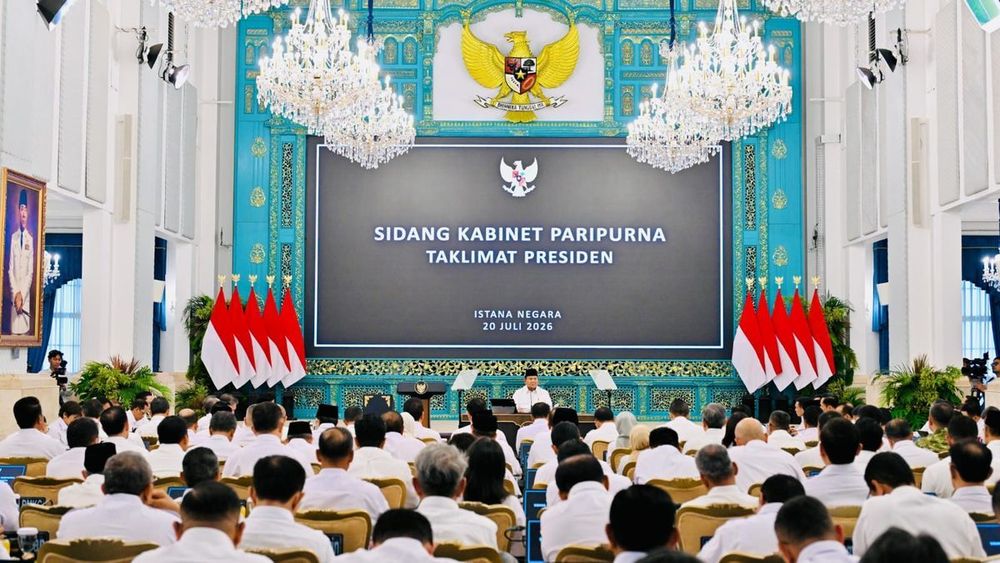
Following the seventh cabinet reshuffle on October 1, 2026, the government structure now comprises 131 positions: 8 Coordinating Ministers, 4 Deputy Coordinating Ministers, 42 ministers, 51 Deputy Ministers, and 26 officials at the ministerial level and heads of agencies. This figure excludes the 26 members of the Presidential Advisory Council appointed the next day, as well as various presidential special staff and advisors.
This represents the largest cabinet Indonesia has formed since 1966, when President Sukarno appointed the Dwikora II cabinet with 132 members—a government that lasted only one month. The expansion became legally possible after parliament amended a 2008 law in September 2024, removing the previous ceiling of 34 ministers and allowing presidents to appoint unlimited numbers of ministers.
Stark Contrast with Predecessor
The scale of expansion becomes clear when compared to the previous administration. President Joko Widodo's Working Cabinet (2014-2019) consisted of 34 ministers and 3 deputy ministers, while his Onward Indonesia Cabinet (2019-2024) had 34 ministers and 19 deputy ministers. After a decade of Widodo's leadership, Prabowo's government represents a dramatic departure in organizational scale.
The initial Red and White Cabinet announced at the start of Prabowo's term included 7 Coordinating Ministers, 41 ministers, 55 deputy ministers, and five officials at ministerial level. The structure has since evolved through repeated reshuffles, with each adjustment reflecting ongoing political consolidation.
The Efficiency Paradox
The cabinet expansion stands in sharp tension with the administration's efficiency agenda. On January 22, 2025, President Prabowo signed Presidential Instruction No. 1 of 2025, ordering budget cuts totaling Rp 306.69 trillion (approximately $18.8 billion)—equivalent to 8.47% of the total 2025 state budget of Rp 3,621.3 trillion. The instruction restricts ceremonial spending, travel expenses, studies, comparative studies, printing, publications, and seminars across government agencies.
Yet even as ministries face these constraints, the 2026 state budget approved by parliament targets total spending of Rp 3,842.7 trillion ($231.5 billion), representing a 9% increase from 2025 estimated spending. Finance Minister Sri Mulyani Indrawati clarified that the efficiency measures represent budget reallocation rather than spending cuts, and her ministry proposed an expanded budget of Rp 52.02 trillion for 2026—an increase of Rp 4.88 trillion from the initial ceiling.
This contradiction raises fundamental questions about the design of cabinet institutions. A large structure does not automatically indicate strong state capacity. Instead, it may increase coordination layers, prolong decision-making chains, and heighten operational spending needs if authority division, functions, and performance indicators are not designed proportionally.
Broader Bureaucratic Growth Pattern
The cabinet expansion fits within a longer pattern of bureaucratic growth in Indonesia. According to a World Bank report, the civil service expanded by 25% from 3.6 million in 2006 to more than 4.5 million in 2018, demonstrating a sustained trend toward larger government structures.
While international comparisons show that large democracies can have substantial cabinets—India's Modi government operates with 71 ministers comprising 30 cabinet ministers, 5 state ministers with independent charge, and 36 deputy ministers—Indonesia's current structure significantly exceeds this scale when accounting for all deputy ministers and ministerial-level officials.
Political Consolidation or Functional Necessity
In Indonesian politics, the distribution of positions often serves as part of coalition maintenance. However, as political consolidation becomes more dominant, the boundary between organizational needs and political accommodation becomes increasingly important to examine.
Every public position should arise from functional requirements rather than compromise necessities. The state requires officials capable of making technocratic decisions, solving problems, and being accountable for performance—not simply more seats to fill.
The burden of a large cabinet structure includes not only salaries and allowances for officials but also Ministerial Operational Funds, official facilities, and various supporting needs. Each position added should be justified by organizational need analysis, fiscal consequence evaluations, and measurable performance targets.
As Indonesia's political dynamics continue to evolve, with political issues becoming increasingly accessible to the public through social media, the question of government effectiveness becomes more pressing. The challenge facing the Prabowo administration is whether its expanded structure will translate into enhanced state capacity and improved public services, or whether it represents a prioritization of political accommodation over administrative efficiency.
Efficient budgeting cannot solely target expenditures while simultaneously expanding the bureaucratic structure that generates those expenditures. Without addressing the rationality of the organizational structure itself, efficiency policies risk losing their substance—cutting spending on one side while creating new obligations on the other.