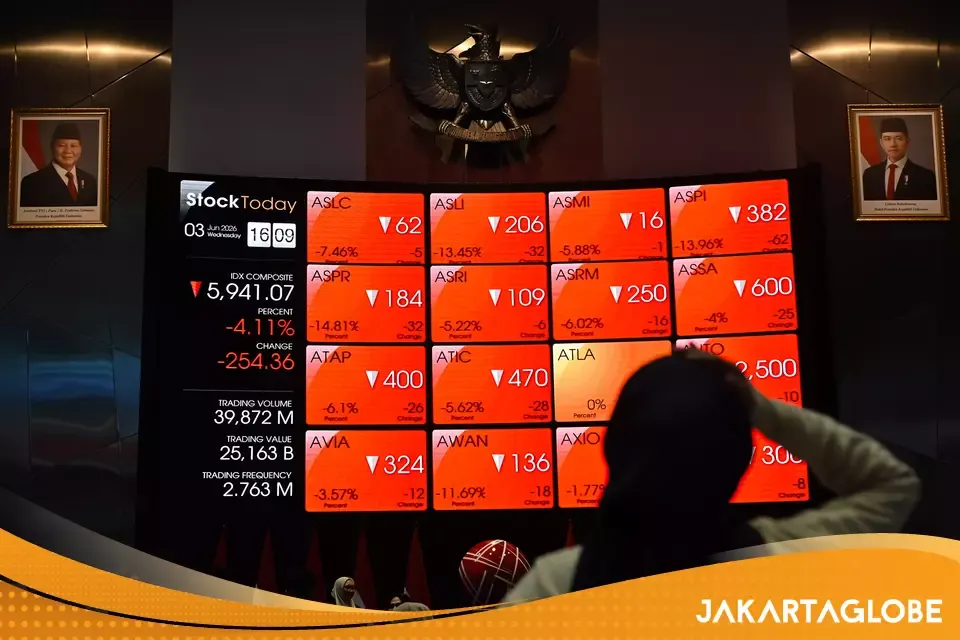
Decliners outnumber gainers
The JCI traded as low as 5,152 and as high as 5,276. More than 1.29 million transactions involved 31.27 billion shares, generating turnover of Rp 16.53 trillion ($905.18 million). Declines affected 261 stocks, compared with 99 gainers and 98 that finished unchanged.
Elsewhere in Asia, Hong Kong's Hang Seng lost 1.9% and the Shanghai Composite slipped 0.3%. Japan's Nikkei and South Korea's Kospi moved higher, gaining 0.7% and 1%, respectively.
Indonesia's equity market had already suffered substantial losses earlier in the year. As of Nov. 2, cumulative foreign net outflows totaled Rp 98.03 trillion (about $5.40 billion), while the JCI's year-to-date decline stood at 41.06%, according to Indonesia Stock Exchange data reported by Investortrust.id.
BI raises rates to support the rupiah
Pilarmas identified Bank Indonesia's November rate increase as another drag on sentiment. At its Nov. 17-18, 2026 meeting, the central bank's Board of Governors raised the BI-Rate to 6.00%, the Deposit Facility rate to 5.25% and the Lending Facility rate to 6.75%. Each increase was 25 basis points.
Bank Indonesia said the moves sought to stabilize the rupiah amid heightened global uncertainty and preemptively keep inflation within its 2.5±1% target corridor for 2026 and 2027. The decision also came amid uncertainty about the policy direction of central banks in the US, Europe and Japan.
The rupiah was at Rp 18,245 per US dollar on Nov. 17, according to Bank Indonesia. That represented a 0.66% point-to-point depreciation from the end of October, which the bank attributed to persistent global uncertainty and foreign investor sentiment toward equities.
Pilarmas warned that higher rates did not ensure lasting appreciation of the currency. "Global uncertainties and expectations of higher interest rates for longer could continue to weigh on domestic financial markets," the brokerage said.
The domestic economic figures showed third-quarter growth of 5.47% from a year earlier, up from 5.29% in the preceding quarter, Bank Indonesia reported. October consumer price inflation was 3.23% year over year, within the bank's target corridor. Its full-year 2026 growth projection was 4.9-5.7%.
Fed minutes reinforce expectations of tight policy
The minutes of the Federal Open Market Committee meeting added to market pressure. Most Federal Reserve officials considered further rate increases potentially necessary to return inflation to the 2% target.
Two officials suggested that December could require an increase larger than 25 basis points if inflation failed to develop as expected. "These signals reinforced expectations that monetary policy would remain tight for longer," Pilarmas said.
APEC talks and chip restrictions draw scrutiny
Pilarmas said caution ahead of talks among US President Donald Trump, Chinese President Xi Jinping and Russian President Vladimir Putin had weighed on Asian stocks. In its Thursday research note, the brokerage said the anticipated agenda included trade, semiconductors and the wars in Ukraine and Iran.
The Business Times reported that the leaders met Nov. 19 in Shenzhen, China, alongside the APEC summit for their first three-way leaders' meeting. It was also Putin's first in-person attendance at an APEC leaders' meeting since 2017.
Investors were also watching renewed US-China friction over Washington's restrictions on chip exports intended to limit China's artificial intelligence development capabilities, Pilarmas said. Beijing warned of possible retaliation.
According to The Business Times, the measures announced Nov. 16 require export licenses for certain advanced semiconductors sent to Singapore, Malaysia, Indonesia, Thailand and Brazil. They also cover overseas data centers supplying significant computing capacity to Chinese companies.