Publication depends on audit clearance
"It should have been today. The BPK will check it first," Chief Operating Officer Dony Oskaria told reporters on Monday at the Energy and Mineral Resources Ministry in Central Jakarta.
Danantara had targeted Nov. 23 for publication. Dony said on Nov. 3 that the state-owned enterprises, or SOEs, had finished their financial statements and were waiting for the BPK. Chief Executive Officer Rosan Roeslani also said that day that he hoped the 2025 reporting process would be finished in November.
AIGOS News reported that Danantara moved the public presentation to Wednesday, Nov. 25, after the BPK formally hands over the audited report. Rosan said the fund would publish the full statements, not a condensed summary. The accounts cover March through December 2025, described as a nine-month reporting period, because Danantara was established in February 2025.
What the consolidated audit covers
The report combines the accounts of SOEs within Danantara into one set of financial statements for the first time. Preparing it involves adjusting accounting records and removing transactions within the group so they are not counted twice. Dony explained on July 31 that this work makes consolidation more time-consuming than preparing separate reports for each SOE.
The BPK started its audit on Sept. 17. Its examination extends to Danantara, subsidiaries Danantara Aset Manajemen (DAM) and Danantara Investasi Manajemen (DIM), and every SOE within the fund's structure.
Auditors will determine whether the statements fairly represent Danantara's financial position. Their work includes checking compliance with accounting rules and regulations, whether disclosures are sufficient, and how effectively internal controls operate. BPK Member VII Slamet Edy Purnomo said the audit was necessary for transparency and accountability in the fund's financial management.
DAM's own financial statements have already been audited by Ernst & Young, Dony said. That separate audit does not replace the BPK examination of the consolidated accounts, which remains underway.
Company restructuring and investment deals
Danantara holds the state's interests in 1,074 companies, including many major companies listed on the Indonesia Stock Exchange, according to Capital Times. At a full cabinet meeting on Oct. 21, Rosan said 364 companies had been closed or streamlined. The fund aimed to bring that number to 700 by the end of December 2026.
DAM also signed agreements on July 22, 2026, to buy controlling stakes in Mandiri Manajemen Investasi, BRI Manajemen Investasi, BNI Asset Management and PNM Investment Management, The Business Times reported. Together, the four state-owned investment managers oversee 170 trillion rupiah ($9.5 billion). The acquisitions are intended to create what will become Indonesia's largest asset manager.
On Nov. 23, Danantara closed a $250 million preferred equity investment in Texas oil and gas producer HighPeak Energy, Inc., according to AIGOS News. PT Danantara Investment Management executed the investment as part of a $450 million preferred equity package in HighPeak, which trades on Nasdaq under the symbol HPK.
Dony separately said on Nov. 3 that SOEs' third-quarter profit had increased 20 percent from a year earlier. The figure was unaudited; he supplied neither a rupiah amount nor a breakdown identifying the companies responsible for the gain.
DIM forecasts lower profit for 2026
The Business Times reported that DIM executives said on Nov. 24, 2026, that losses on local equity investments would leave the unit short of its annual net profit target. They estimated profit at 800 billion rupiah, about $44 million, compared with the previous target of 3.4 trillion rupiah. DIM is targeting net profit of 5 trillion to 6 trillion rupiah in 2027.
The unit expected assets under management to total 248 trillion rupiah in 2026, with more than three-quarters allocated to public investment. Its forecast for total assets in 2027 ranges from 390 trillion to 421 trillion rupiah; the upper figure would represent annual growth of 70 percent.
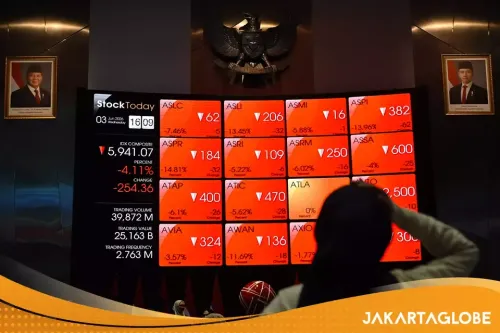
Those forecasts come amid sharp declines in Indonesian markets. According to The Business Times, Jakarta's main stock index had fallen nearly 40 percent by late November 2026, making it the world's worst-performing stock-market gauge. The rupiah had lost more than 8 percent and reached record lows amid concerns over fiscal health and central bank independence, along with MSCI warnings that the market could be downgraded to "standalone" status.