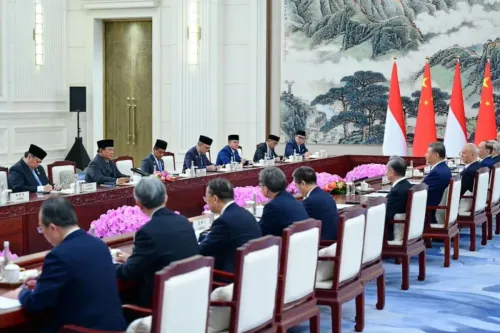

Malaysia prepares disclosure law
Johari told The Star in a written response that the scope of GPU reporting would be limited. "The disclosure requirement will only apply to GPUs that are subject to US export controls. It will not cover other GPUs," he said.
His ministry does not yet have operators' customer details for China. Johari said information gathering was continuing and that customer data would be "collected on an ongoing basis under the disclosure requirements being introduced."
On Nov. 12, Johari said Malaysia would put the disclosure obligations into law. Operators would have to report information including electricity use and the number of GPU chips they import.
The Digital Ministry is drafting the Digital Infrastructure (Data Center) Bill. It said earlier in November that it expected to introduce the legislation in Parliament in 2027, provided the government approves it.
Johari also cautioned operators that the US rule was already effective. His ministry was still seeking clarification from Washington and had not issued an official notice.
US licensing threshold and February deadline
The US interim final rule, "Addressing Remote Access to Advanced Semiconductors," took effect on Nov. 19, 2026. It imposes a licensing requirement on exports, reexports and transfers of advanced computing items when the exporter knows they are destined for a data center that provides, or will provide, more than 12 million in aggregate Total Processing Performance (TPP) to or for certain companies.
The control applies worldwide and covers companies headquartered in, or ultimately owned from, China, Macau or another Country Group D:5 destination. According to law firm Latham & Watkins, the threshold is roughly equivalent to 760 Nvidia H100 chips and can include capacity at a single facility or across "linked data centers."
Non-US data centers and computer service providers already supplying significant computing capacity to entities headquartered in those destinations before publication of the rule have 90 days from its effective date to obtain a license if they want to continue. Latham & Watkins puts that deadline at Feb. 17, 2027. The US Bureau of Industry and Security warns that providers without a license will "face future export restrictions."
A separate provision requires licenses for exports, reexports and transfers of advanced computing items to or within Malaysia, Indonesia, Singapore, Thailand and Brazil. The Bureau of Industry and Security says those countries "present a higher-than-normal risk of diversion." The commerce secretary can expand the list after consulting the secretary of state or national security advisor.
The November rule also formally rescinds the Biden-era AI Diffusion Rule, published Jan. 15, 2025. It eliminates that rule's three-tier country licensing system, the AI model-weights control designated ECCN 4E091, License Exceptions AIA and LPP, and the Data Center Validated End User authorization. License Exception ACM remains in place.
Existing controls and chip-diversion investigations
Digital Minister Gobind Singh Deo told The Star that Malaysia already regulates strategic trade through the Strategic Trade Act 2010. Additional permit requirements introduced on July 14, 2025, cover exports, transit and transshipment of high-performance US-origin AI chips to prevent potential diversion to China. Malaysiakini reported that the Investment, Trade and Industry Ministry subsequently clarified that imports were excluded, while subsequent exports and reexports were covered.
Gobind said Malaysia's credibility as an AI infrastructure investment destination depended on "a strong regulatory framework, responsible industry practices and effective enforcement." He said the government took possible circumvention of export controls seriously and that "appropriate action will be taken where violations are established."
Asked about Speedmatrix Sdn Bhd, a Malaysian subsidiary of Singapore-based Megaspeed International, Johari said relevant agencies were still conducting verification. He directed questions about the police investigation to the home minister.
Home Minister Saifuddin Nasution Ismail said on Nov. 14 that police had been investigating alleged use of Malaysia to evade US restrictions on Nvidia AI chips since April 2025, under the Strategic Trade Act 2010. According to Malaysiakini, the Investment, Trade and Industry Ministry leads the investigation, with participation from police, Bank Negara Malaysia, the Inland Revenue Board, the MCMC and the Customs Department.
Reporting cited by Malaysiakini put Megaspeed's Nvidia AI chip purchases between June 2024 and February 2026 at US$4.8 billion, or 19.5 billion ringgit. Megaspeed denies illicit chip trading and says inspections by US and Malaysian officials, as well as Nvidia, found no wrongdoing.
On Nov. 24, Malaysiakini reported that Washington had blacklisted seven companies linked to an alleged spy case over chip-smuggling concerns. Those named included Singapore-based Megaspeed International Pte Ltd and its Malaysian subsidiaries PT Megaspeed International, Speedmatrix Sdn Bhd and MSFusion Sdn Bhd.
Industry exposure and investment
MBSB Research senior analyst Royce Tan said the Investment, Trade and Industry Ministry's customer-data gap was understandable: operators had not previously been required to provide the information, and most had confidentiality agreements with clients.
"This is particularly relevant for colocation operators, which provide the physical infrastructure but may have limited visibility over the ultimate users of the computing capacity," he said.
Tan said it was difficult to quantify the exposure. He identified GPU-intensive AI facilities and colocation operations using advanced US-controlled chips, especially those serving Chinese customers, as the main areas of risk, rather than conventional cloud and enterprise data centers.
He called for a secure, confidential reporting process so authorities could identify affected facilities without revealing commercially sensitive information. Although tighter scrutiny could delay some projects, he did not expect the regulations to fundamentally change structural demand for data center capacity. "We are still positive about the longer-term prospects for data centers in Malaysia," he said.
Malaysian Investment Development Authority figures show that data centers represented 35.2% of the country's 350.4 billion ringgit in approved investments during January through September 2026. The sector's share totaled 123.5 billion ringgit, or US$30 billion.