An escape still to come
The episode's description on Kompasiana places the boats in fog under another barrage from Cao Cao's forces. While Zhuge Liang remains calm, Lu Su begins to grasp how the strategy works.
Collecting the arrows does not complete the mission. The description leaves both the fleet's safe return and Cao Cao's discovery of the ruse unresolved, directing viewers to Episode 16.
The novel's ruse and its historical model
The straw-boat story belongs to chapter 46 of the 14th-century novel Romance of the Three Kingdoms, not the official historical record. SinoChronicle and Past in Practice trace its historical model to an account involving Sun Quan rather than Zhuge Liang.
That anecdote appears in the Weilüe and was preserved in Pei Songzhi's annotations to Records of the Three Kingdoms. It takes place at Ruxu in 213 CE, five years after Red Cliffs. Sun Quan was observing Cao Cao's camp from a boat when arrows accumulated on one side, causing the vessel to list.
Sun Quan had the boat turned so that arrows would strike the opposite side as well. With its balance restored, he returned safely. The novel recast this incident as Zhuge Liang's exploit during the Red Cliffs campaign of 208 CE.
The commanders and battle behind the fiction
Zhuge Liang's historical contribution at Red Cliffs was to help secure Sun Quan's alliance, not to command the fighting, according to Past in Practice. Zhou Yu led the allied forces at the front; the novel subsequently depicted him as Zhuge Liang's jealous rival.
The battle took place in the winter of 208 CE, pitting the northern warlord Cao Cao against the combined forces of Sun Quan and Liu Bei. Cao Cao claimed in a letter to Sun Quan that he commanded 800,000 troops. That claim, recorded in the Jiangbiao Zhuan and cited in Pei Songzhi's commentary, was propaganda. Modern estimates cited by Past in Practice put his army at about 200,000 and the allies at roughly 50,000.
In the official account, Cao Cao lost the opening engagement and pulled back to the northern bank. Huang Gai then pretended to surrender, approaching Cao Cao's fleet with vessels carrying firewood and oil and setting the fleet on fire. Strong wind carried the flames into the shore camps. Cao Cao subsequently retreated north.
Why Huang Zhong's memorial appears in the post
The Kompasiana post also includes images and captions about Huang Zhong's tomb site in Huangzhong Village, in Chengdu's Yingmenkou Subdistrict, Jinniu District, Sichuan. Citing Wikipedia, the captions say a tombstone bearing his name and title was reportedly discovered in 1825. Repairs and construction of an ancestral hall followed in the 19th century, but the tomb and hall were destroyed in 1965-1966.
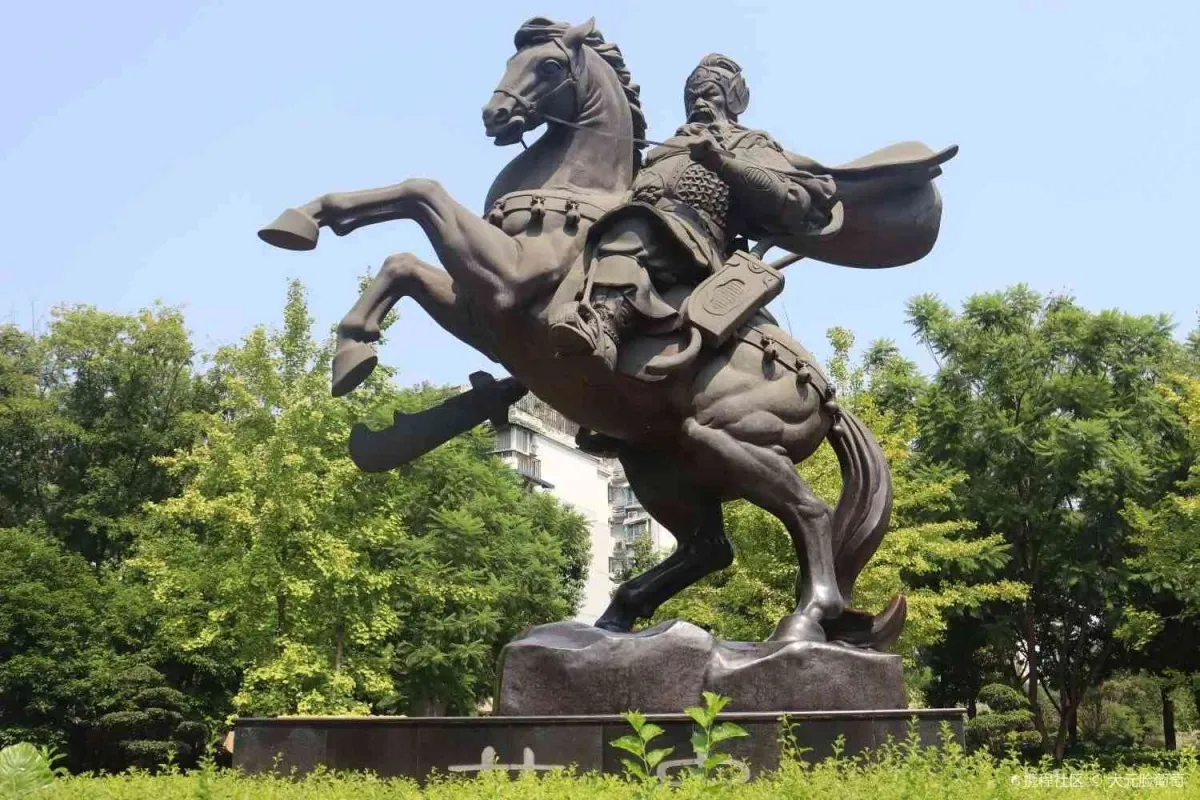
A residential community now occupies the former site. Nearby, Huangzhong Cultural Square has a statue of the general, while Huangzhong Park also commemorates him and the area's history.
Huang Zhong served Liu Bei and died in 220. Wikipedia identifies his best-known victory as the Battle of Mount Dingjun in 219: his troops routed the force of Wei general Xiahou Yuan, who died during the raid. The victory helped pave the way for Liu Bei's conquest of Hanzhong. Romance of the Three Kingdoms and popular culture depict Huang Zhong as an elderly warrior and one of Liu Bei's Five Tiger Generals.