An identity taken at the camp
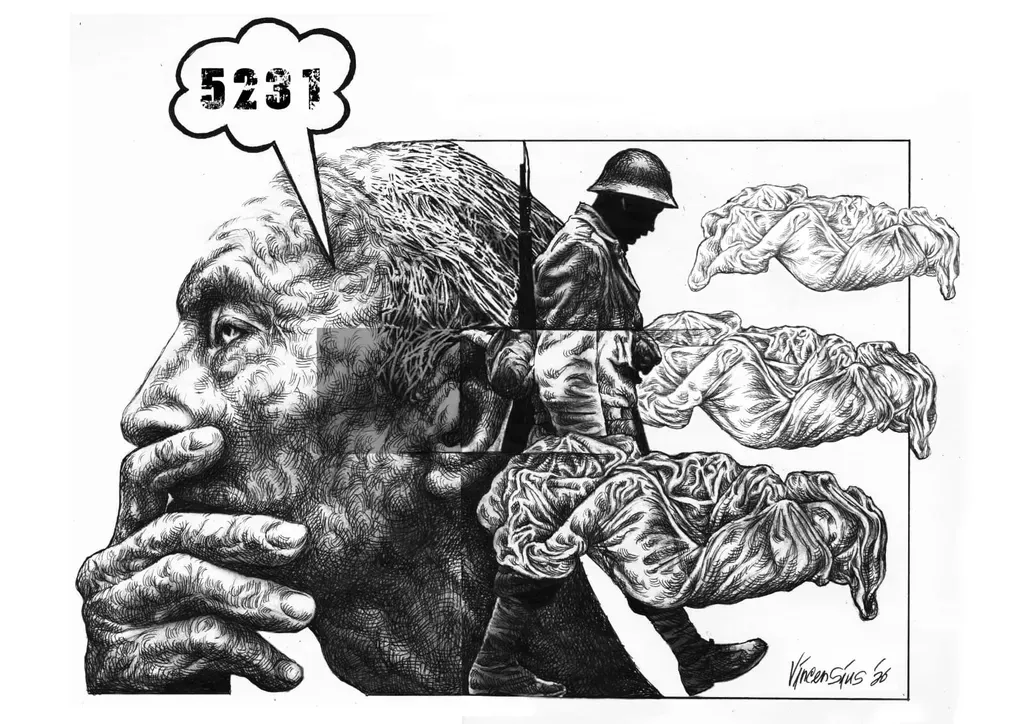
Warjo is already gravely ill when the story begins on a March night in Tanglin. Bodies wrapped in burlap have arrived by ship and been dumped in a ditch. Rather than continue caring for him, his fellow laborers carry him outside and place him beside 16 decomposing corpses. The narrative places this scene amid roughly six refugee camps in Singapore, mainly around the port, holding more than 8,500 Indonesians, most from Java.
One companion, an elderly man who formerly polished swords for the kempeitai, takes Warjo's labor badge, number 5231. The badge identifies Warjo with the shipping dock's lifeboat section. Hoping its higher rank will help him secure passage back to Priok, the man apologizes and promises to honor Warjo with a feast and prayers in Gondeng. He treats the exchange of names as temporary, even as Warjo lies unable to object.
The sword polisher also intends to kill the village head who profited from selling him into forced labor. What he does not know is that only one payment he sent home ever arrived: F.10, accompanied by a burial shroud. His family has taken this as notice of his death in Singapore, and his wife has married the same village head.
The stolen badge gives a personal form to the story's concern with recognition and erasure. Rōmusha, a Japanese term meaning "paid conscripted laborer," generally refers in English to non-Japanese people forced to work for Japan's military during World War II. BiblioAsia, published by the National Library Board Singapore, describes railway recruits receiving false promises of fair pay, food and lodging. It also reports that no official records of their names or deaths were kept, leaving these workers largely absent from accounts of the railway.
The village duties that precede Warjo's flight
Warjo's memories explain how he reached Tanglin. His father, a village head, orders him to carry out the emergency food program, kinkyû shokuryô taisaku, on village land. The assignment clashes with the family's expectation that nobles should remain above field labor. Warjo becomes an agricultural instructor, or nôgyô shidôin, charged with explaining Japanese policies and planting methods to farmers.
His authority quickly becomes a source of humiliation. During one demonstration, a Japanese supervisor pushes him toward the rice field. Warjo manages not to fall but ends up standing in the mud as villagers suppress their laughter. The incident earns him a lasting, insulting nickname.
His responsibilities expand as occupation policies tighten. Rice becomes scarce, chemical fertilizer disappears, and farmers must grow cotton and castor oil crops. Warjo serves as instructor for all three crops, earning F.15 a month while becoming a target of local resentment. The narrative marks the introduction of compulsory rice deliveries in April 1943 as a further escalation.
When Warjo asks to give up the work, his father responds fearfully. He has heard that Japanese authorities no longer consider noble birth a prerequisite for office, preferring educated, literate candidates who have passed the national examination.
Returning from his parents' house, Warjo encounters unrest outside his home. His younger brother urges him to escape and tells him that his wife and children have been killed. Warjo wants to confront the crowd, but his brother stops him. A cart takes him toward the city, where he is advised to register as a rōmusha until it is safe to return.
The wider toll of forced labor extended far beyond this fictional village. The U.S. Library of Congress estimates that 4 million to 10 million rōmusha were compelled to work in Java during the occupation. Historian M. C. Ricklefs estimates that 200,000 to 500,000 Javanese laborers were sent elsewhere, including to the outer islands, Burma and Thailand; only about 70,000 of those taken off Java survived the war. A later United Nations report put deaths resulting from the occupation in Indonesia at four million. Around 2.4 million people died from famine in Java during 1944–45.
The journey to Singapore and the railway in the background
Several weeks after his escape, Warjo travels by train to Jakarta. He works on roads at Tanjung Priok before being shipped to Teluk Betung and then Singapore. In Tanglin, he labors under a Japanese overseer and an Indian clerk. Fellow workers die from exhaustion or dysentery. After developing a high fever and suffering repeated beatings, he is deemed unfit for work and sent to a camp.
The story also refers to the Burma–Siam Railway through a conversation about bodies arriving in Singapore. Warjo recalls meeting a Railway Department worker in Priok who was being sent to Nong Pla Duk and described a line extending toward Thanbyuzayet.
The historical railway, also called the Death Railway, ran 415 kilometers between Ban Pong, Thailand, and Thanbyuzayat in Burma, now Myanmar. Built by the Japanese military in 1942–43 to supply its Burma campaign, it was finished ahead of schedule and ceremonially opened on October 25, 1943.
According to Wikipedia's account of the railway, at least 250,000 Southeast Asian civilians were forced to work on its construction. More than 90,000 died, as did around 12,000 Allied prisoners of war. After World War II, 111 Japanese military officials faced war-crimes trials over brutality during construction; 32 received death sentences.
Triono ends not with Warjo's recovery but with preparations to remove the bodies. Warjo can barely open his eyes, though he can still hear. When someone points out that a man among the corpses remains half alive, the response is to take him anyway: there is no room for someone in that condition.
About Eko Triono
Publisher Gramedia's biography says Triono was born in Cilacap in 1989 and grew up in Central Kalimantan and West Aceh. He studied at Yogyakarta State University and pursued postgraduate study at Sebelas Maret University in Surakarta. He attended the Jakarta Arts Council Novel Writing Academy in 2014 and received a scholarship for a writing residency in the Netherlands in 2018.
Kompas identifies him as a lecturer in Indonesian language and literature education at Yogyakarta State University. His short-story collections include What Religion is Suitable for Trees? (2016), You Are Reading This Writing (2018), The Funny People's Republic (2018) and How Much is a Life Today? (2022). Kompas labels the English edition of the Tanglin story as an AI translation.